
By Associated Press, McClatchy News Service and Peninsula Daily News staff
EDITOR’S NOTE — For the latest ballot count, go to http://vote.wa.gov/results/current/
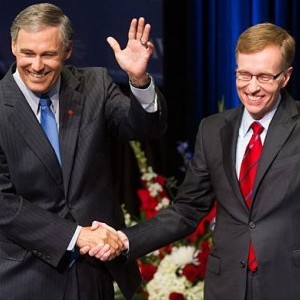
OLYMPIA — After easily advancing to the general election, the contest between Democrat Jay Inslee and Republican Rob McKenna is expected to be one of the most competitive governor’s races in the country.
Inslee, a seven-term congressman from Bainbridge Island, led the primary election count Tuesday night, with about 47 percent of the votes for Inslee to 43 percent for McKenna, the state attorney general. Both men easily outpaced seven lesser-known rivals.
McKenna is seeking to be the first Republican governor elected in Washington since 1980.
About half the votes remain to be counted in coming days as ballots in the all-mail election trickle in.
Both candidates will now get ready for the November election. The top two vote getters in the primary go to the fall ballot; the only exception are judicial races as well as the race for the state’s top education post. They are subject to special rules that allow any candidate who gets more than 50 percent of the vote to advance alone to the general election ballot.
As results came in, Inslee told supporters at his headquarters, “We’re going to win this in November.”
Taking the stage at a Bellevue gathering, McKenna compared the race to the Olympics: “The preliminaries are over, now on to the final!”
“We need a new direction,” McKenna said. “Do we keep electing the same people over and over who have been digging the budget hole deeper and deeper, or do we craft a sustainable budget?”
The primary outcome was never in doubt, as Republicans and Democrats have long looked ahead to the November matchup. With the two running neck and neck in recent polls, both campaigns spent the days leading up to the primary lowering expectations for their candidates.
While primary results do not usually predict the general-election outcome, McKenna’s tally of 35 percent in King County was far below the 51 percent he received there in the 2008 primary for attorney general.
Overall, the results mirrored the state’s so-called “Cascade Curtain,” with McKenna leading in Eastern and Central Washington and Inslee ahead in the more populous Puget Sound counties.
The race has been named the hottest in the country by some national political observers and is likely to draw tens of millions in outside spending in addition to the funds amassed by the Inslee and McKenna campaigns.
“Washington has been fundamentally a Democratic state, but I think Republicans got the best challenger they can hope for with McKenna,” said Jessica Taylor, senior analyst with the Rothenberg Political Report.
McKenna is counting on voter discontent with decades of Democratic control in Olympia.
McKenna and Inslee have each raised more than $7 million already, and their campaigns have been focused against each other for months. They are vying to replace Democratic Gov. Chris Gregoire, who is not seeking a third term.
Cantwell dominates
In her bid for re-election, U.S. Senator Maria Cantwell held a large lead over her Republican challenger, Michael Baumgartner.
State Supreme Court justices Susan Owens, a former District Court judge in Forks, and Steve Gonzalez easily retained their seats, and Seattle appeals lawyer Sheryl Gordon McCloud is leading a crowded field seeking to replace retiring Justice Tom Chambers.
McCloud is leading with nearly 32 percent of the vote.
Former Justice Richard Sanders is collecting 27.5 percent, King County Superior Court Judge Bruce Hilyer 25.6 percent, and former Pierce County Executive John Ladenburg 15 percent.
If no candidate wins 50 percent, the top two advance to the general election.
Former Seattle Mayor Greg Nickels was not able to stage a comeback in his attempt to become the next state Secretary of State. In that race, Republican Kim Wyman, the Thurston County auditor, took a commanding lead over Democrat Kathleen Drew.
In the race to replace McKenna as attorney general, Republican Reagan Dunn was trailing Democrat Bob Ferguson. Both serve on the Metropolitan King County Council.
Congressional and other races
All 10 congressional seats were on the ballot, but all eyes were on the competitive 1st District. Voters for the newly redistricted seat — which runs from northern King County to the Canadian border — had five Democrats, one Republican and one independent to choose from.
Republican John Koster advanced to the November ballot along with former Microsoft executive Suzan DelBene, a Democrat who had to fend off a slate of other Democrats.
Voters in the old 1st District — which includes Kitsap County — also voted in a special election for the final month of Inslee’s term, and Koster and DelBene advanced in that race as well.
In the race for lieutenant governor, Lt. Gov. Brad Owen advanced to November with 49 percent of the vote. Former Republican state Sen. Bill Finkbeiner had the second highest amount of votes in early returns with 25 percent.
In the race to replace retiring Auditor Brian Sonntag, Republican James Watkins advanced through the primary with more than 45 percent of the vote.
State Rep. Troy Kelley of Tacoma had more than 24 percent, and state Sen. Craig Pridemore of Vancouver had more than 20 percent as they battled for the second spot.
Randy Dorn, the current superintendent of public instruction, advanced by more than 54 percent, a large enough margin that he can advance to the general ballot unopposed.
Washington and three other states — Kansas, Michigan and Missouri — held primaries Tuesday.
All of Washington’s 3.7 million voters receive their ballots by mail, and had to have them postmarked and in the mail by Tuesday or dropped off at specialized boxes around the state by 8 p.m. Ballots were sent out last month.
All of the state’s 39 counties reported their initial returns Tuesday night, and will do updates to their counts as ballots continue to arrive in the mail in the coming days.
Reed has predicting a 46 percent turnout.
The average of the last six primaries in similar election years is 43 percent, and the highest primary turnout in recent years was 45.8 percent in 1992.
