
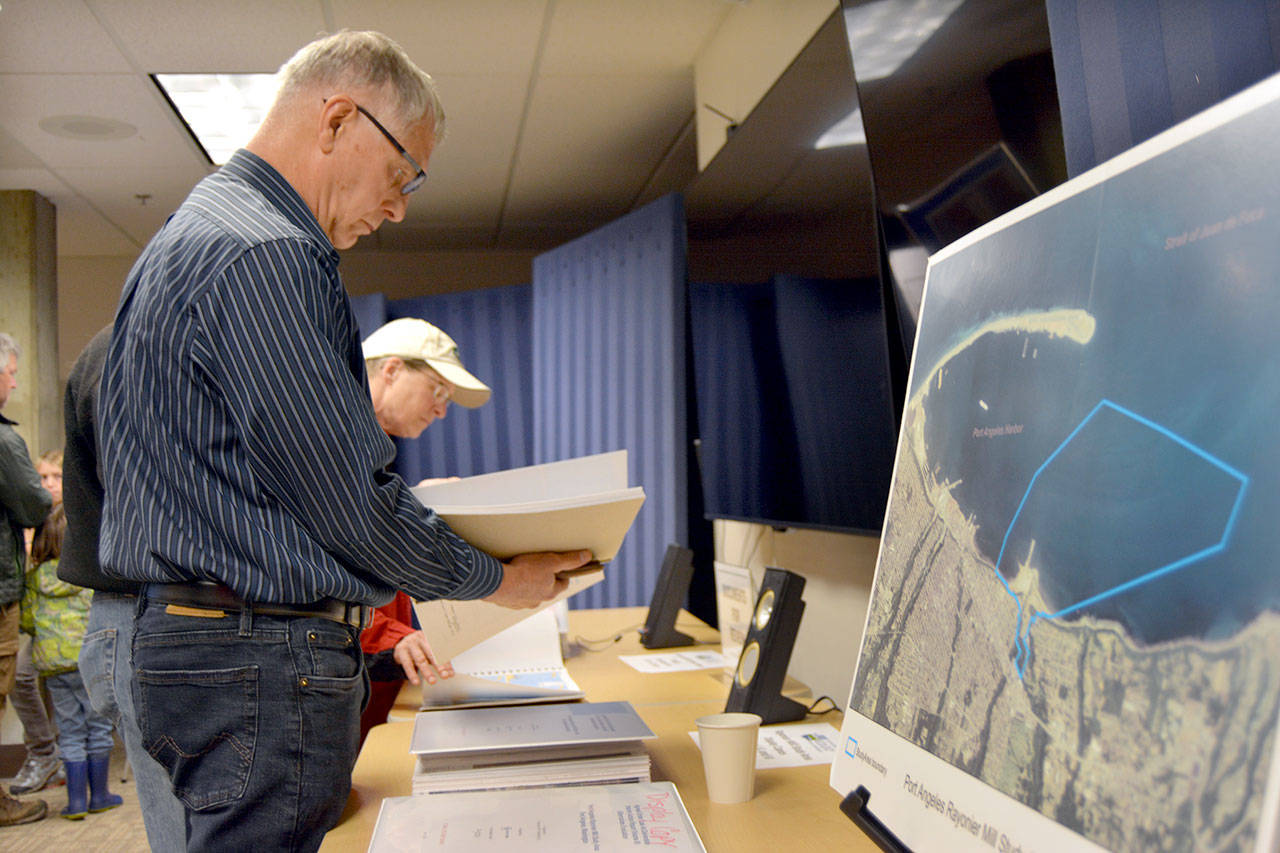
PORT ANGELES — Creation of open space for potential — though only occasional — use is included in a proposed cleanup strategy for the abandoned, still-polluted Rayonier pulp mill site and adjacent Port Angeles Harbor.
The voluminous three-part study, and options it includes for the 75-acre industrial parcel east of downtown Port Angeles, were presented Wednesday at an Olympic Medical Center meeting room where some participants wanted more than that.
Three of those who spoke during the state Department of Ecology’s 30-minute public comment period, which followed an hour-long presentation, wanted a higher level of cleanup than what was proposed.
The contamination “just can’t stay there,” said Darlene Schanfald, longtime Rayonier project coordinator for the Olympic Environmental Council Coalition.
“It’s not restoring our shoreline to what we had all hoped would happen.”
But Rebecca Lawson, Ecology’s southwest region manager, said her department needs to follow cleanup rules laid out in the state Model Toxics Control Act, under which land owner Rayonier AM of Jacksonville, Fla., is paying for cleanup.
“I need to ensure that those standards are met,” Lawson said.
“The regulation does not require what you are talking about. I don’t have the regulatory authority to require that.
“It’s not about us removing every speck of everything to get us to some pristine state,” she said. “In terms of regulations, that would not be practicable.”
From 1930 until 1972, when plant wastewater began being treated, ammonia and sulphur dioxide spewed directly into the harbor from five outfalls. In 1972, it began being treated and discharged out of a deep-water outfall.
The mill closed in March 1997. Ecology took the lead on cleanup in February 2000. Since then, state laws have expanded the extent of the cleanup area.
The soil included contaminant levels of arsenic, lead and dioxins; the groundwater, arsenic, copper and nickel; the sediment, arsenic, cadmium, copper and zinc.
The soil, groundwater and sediment were described as pathways of pollution that Ecology is addressing with the plan, available on the department’s website at tinyurl.com/PDN-RayonierCleanup.
Comments on Volumes 1, 2, and 3 can be made through the website until Oct. 28.
To address soil pollution, 10 acres would be excavated to 1 foot deep and 0.5 acres to more than 1 foot. An additional 10 acres would be capped.
To address groundwater pollution, air sparging — or the injection of air to disperse pollutants — would be employed to oxidize ammonia and metals in phases starting near the shoreline.
To address sediment pollution in Rayonier’s portion of the harbor cleanup area — several other parties including the Port of Port Angeles are cleaning the western harbor — a log pond near a soon-to-be-removed 4-acre dock would be dredged.
Sand, silt and gravel would be used as fill for dredged areas and berth and approach areas. It and the remainder of a sediment remediation area would be topped by a sand layer “to address sediment contamination and to provide suitable habitat,” according to the Volume 3 report.
Cleanup costs of $24 million under the proposed plan will be borne by the land owner, Jacksonville, Fla.-based Rayonier Advanced Materials.
The company listed the site as a $45 million liability in its annual 10K Securities and Exchange Commission report for 2018 (https://tinyurl.com/PDN-RayonierSEC).
During 2017 and 2018, the estimated liability increased by approximately $5 million due to re-evaluation and changes in the remediation cost estimates, according to the report.
The company removed 30,000 tons of of contaminated soil from the site since Ecology took on cleanup duties at the site.
“What’s left behind is the low level contamination,” Ecology Professional Engineer Marian Abbett said at Wednesday’s meeting.
“There is this proposed conceptual restoration along Ennis Creek which would lend itself to another use, something like open space, and that is what is evaluated in the Volume 3.”
Lawson said the goal is to make the site available for “occasional use” that would be at a lower standard than an industrial use, which would have to be clean enough for workers spending, for example, eight hours a day on the site.
“This open space or occasional use would be protective of people just being there two times a week with the exposure assumptions we used,” Lawson said.
“I don’t think anyone knows what the future use is going to be, and that’s not something that Ecology dictates.”
Port Angeles City Manager Nathan West, who attended the presentation, said the city will be looking further into cleanup levels offered in the plan.
“I think it’s really important to look at what levels are we talking about there,” West said.
“I think there’s a concern that if you only clean up to industrial level, that you are not gong to have an ability to do any other things with it,” he said.
“We want to ensure that there is nothing that prevents the ability of future uses potentially coming into that site, whatever they may be, and make sure that health risks are fully considered in the overall recognition of how important the site is to the community.”
Lawson estimated that dock removal and sediment mitigation work could begin as soon as 2021. It could take five to seven years more or longer to complete the cleanup, depending on such factors as design development and obtaining permits, she said.
Riger McGinnis, a retired environmental consultant who worked on Ecology projects though not on the Rayonier site, also attended the hearing.
Twenty years or longer to complete a cleanup project is “not unusual,” he said.
Carla Yetter, Rayonier AM vice president of sustainability, and Warren Snyder, company environmental engineering senior manager, also attended the meeting.
“We’ll make whatever changes we need to make and we’ll do the action plan,” Yetter said.
“Following the process, we’re always following the process,” Snyder said.
________
Senior Staff Writer Paul Gottlieb can be reached at 360-452-2345, ext. 55650, or at pgottlieb@peninsuladailynews.com.
