
By Tristan Baurick
The Associated Press
SEABECK — Josh Frederick hops out of an idling state Department of Fish and Wildlife motorboat and begins scooping beach gravel into a bag labeled with his precise location on Hood Canal. He pulls out a handful and gives it a hard look.
“Nothing,” he says.
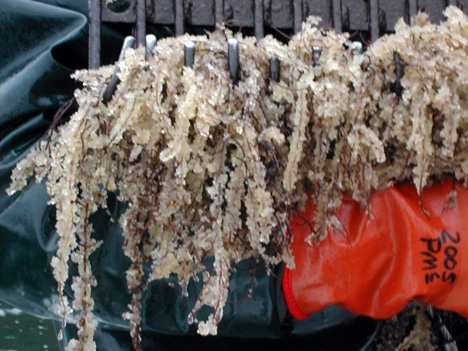
Spotting the tiny, pen point-sized eggs of Puget Sound’s smallest fish isn’t easy, but this stretch of Misery Point has just about everything that spawning herring, smelt and other forage fish could want: shade from trees, few nearby homes, no bulkheads and a beach covered in the not-too-fine, not-too-gritty sediment they favor for tucking in their unhatched young.
“Sometimes we’ll find spots where they’re easy to see because the eggs just cover the ground,” said Fish and Wildlife research scientist Phillip Dionne.
“Sometimes we won’t see anything.”
Finding few eggs in ideal spawning grounds could be part of the mounting evidence that the sound’s forage fish are in decline.
That’s bad news for salmon, seabirds and just about every marine animal bigger than the bait-sized fish.
“They play a critical role in the food web,” Dionne said. And yet, he admits, the fish are poorly understood by state fisheries managers.
Fish and Wildlife aims to change that with the first comprehensive study of the sound’s forage fish population.
Launched in November, the study will analyze thousands of beach samples and include a deep-water trawl survey to gauge the survival rate of adult forage fish.
Dionne and two members of the Washington Conservation Corps — Frederick and Brandon Osterlund, both of Lacey — conducted a survey of the east shore of Hood Canal.
The crew documented beach conditions and took five-pound sediment samples from dozens of private and public beaches.
At a lab in Olympia, each sample is sent through a centrifuge that separates the sediment from the eggs and other lighter materials.
The types and abundance of eggs are noted, and then fed into a database.
At regular intervals, the data is used to update a map showing forage fish spawning habitat around the sound.
The study is a result of legislation introduced by state Sen. Christine Rolfes, D-Bainbridge Island, last year.
Budgeted for $2 million over two years, the study has allowed four small crews to survey about 150 sites each month.
About half of the 12 WCC members involved in the study are veterans or active in a military reserve unit.
Fish and Wildlife biologist Dayv Lowry said the state has had no method for tracking forage fish populations.
“This fills some important holes in our fish management,” he said.
A few localized and limited-scope studies indicate that forage fish populations have declined precipitously in recent decades.
A few years ago, a survey near Bellingham showed herring stocks were less than 10 percent of what they were in the early 1970s.
Surveys conducted by the National Oceanic and Atmospheric Administration showed steep herring declines around the San Juan Islands and the Central Puget Sound.
State scientists said herring are also declining in average size and age.
The causes are unknown, but a broad range of factors might be to blame, including chemical contamination, parasites, disease, lack of food and increasing shoreline development.
The ripple effect is being felt in seabirds, said Trina Bayard, Audubon Washington’s bird conservation director.
“We know that birds that rely on forage fish are in decline,” she said, noting that western grebes and surf scoters are much less plentiful compared with 30 years ago.
“We lack a basic understanding of forage fish. Without it, how can we best manage and protect their populations?”
Started just two months ago, the study is already changing the way scientists think about forage fish.
The role of trees in forage fish spawning might be larger than initially thought. Sites with good beach conditions but little tree cover tend to have lower egg survival rates, Dionne said.
“People want views and trees get logged off near beaches — but that might mean there’s less protection for eggs,” he said. “With less shade, the eggs might not be staying cool enough.”
Fish and Wildlife officials were surprised to find forage fish spawning year-round in the south sound. A pilot project conducted before the main survey showed that certain fish species were laying eggs well outside the prime winter spawning months.
“We’ve seen that in other parts of the sound, but we didn’t expect to find eggs every month in the south sound,” Dionne said.
The survey’s results could spur new protections or steer shoreline development and construction rules.
“We’re certainly finding that not all beaches were created equal,” he said. “The study might help us protect habitat or [guide] activities in the water so there’s the least impact on fish.”
