THIS MONTH, SATURN drops into the sun’s afterglow.
But its disappearance from our sky may go unnoticed, given everything the morning planets are up to.
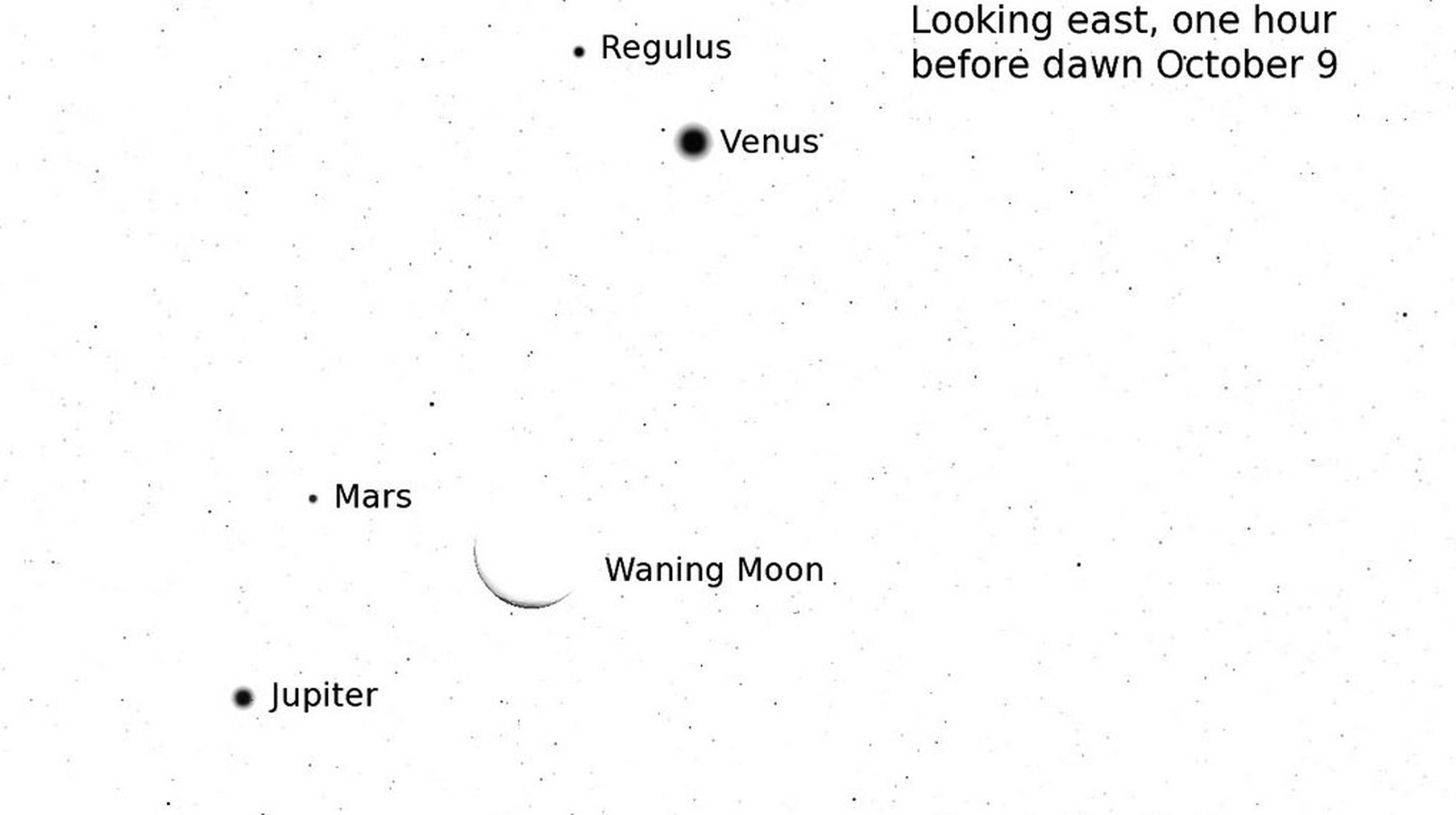
The month begins with three planets and one bright star stacked up in the eastern predawn sky.
Look an hour before sunrise to see — from top to bottom — brilliant Venus; Regulus, the heart of the constellation of Leo the Lion; dim Mars; and Jupiter, bright but no match for Venus.
By the 8th, Earth’s orbital motion will have pushed Regulus higher than Venus.
On that morning, a waning moon hangs above Venus and Regulus, poised for a three-day plunge through the lineup.
On the 9th, the moon is closest to Mars; on the 10th, it appears below Jupiter; and on the 11th, a very old sliver of moon, along with Mercury, just makes it over the eastern horizon before the sun’s rays overpower it.
Regulus climbing
Regulus keeps climbing, but Venus, Mars and Jupiter spend most of the month drawing closer together.
Jupiter climbs past Mars in mid-month, coming closest on the 17th and 18th, then proceeds to Venus, passing about two full moon widths from the queen of planets on the 25th and 26th.
Meanwhile, Venus and Mars close in on each other.
As a bonus, the familiar winter stars are up in the south an hour before sunrise, with the brightest of all — Sirius — at about the same altitude as Venus.
This makes for a great chance to compare the brightest star and planet.
Even this month’s full moon steals the limelight from the evening sky.
It rises the evening of the 26th, about 10 hours after reaching perigee, its closest approach to Earth in a given orbit.
The moment of fullness comes at 5:05 a.m. the next morning, barely 23 hours after perigee, so it will appear larger than usual.
This full moon is called the Hunter’s Moon by East Coast tribes.
With the fields empty of crops, Native Americans laying in food for the winter could use its light to hunt summer-fattened deer gleaning for grain by night.
But the evening sky does have its attractions, especially during the first two full weeks of the month, when no moon interferes.
See a galaxy
Try “star hopping” to the Andromeda Galaxy, our Milky Way’s closest large neighbor.
Starting with the Great Square of Pegasus high in the south-southeast, find the line of stars extending northeast from the Square’s upper left corner.
From the second star in the string, extend an imaginary line perpendicularly northward to a nearby but fainter star.
Extend the line the same distance again, and you should see a fuzzy oval patch; this is the Andromeda Galaxy.
Binoculars are highly recommended.
Shooting stars
The modest Orionid meteor shower takes place over several nights and will probably peak between 2 a.m. and dawn on the 21st and the 22nd, when observers under a clear, dark sky might see 10 to 20 meteors an hour.
The night before or after might feature meteors, too.
Fortunately, the waxing moon will set before the peak viewing hours.
Add a thermos of hot chocolate and some snacks, and you’ve got a party.
The Orionids appear to radiate out of the constellation Orion (the Hunter), which hangs high in the south-southeast before sunrise.
Although you may see a few more meteors if you face generally southeast, Orionid meteors may appear in any part of the sky.
Annual meteor showers occur when the Earth passes through a ring of debris that a comet has cast off as it orbits the sun.
The Orionids come from Halley’s Comet, which last appeared in 1986 and will return in 2061.
Space station
The International Space Station, the orbital research station for six astronauts and cosmonauts of different countries, makes nightly appearances in the North Olympic Peninsula sky through much of this month.
There are three-minute flyovers beginning at 7:30 p.m. Sunday and at 8:13 p.m. Monday, and a five-minute pass starting at 7:21 p.m. this coming Tuesday.
The ISS is easy to see with the naked eye — it often outshines anything else in the sky and looks like a fast-moving plane — but it’s dozens of times higher than any airplane and travels thousands of miles an hour faster.
For exact times and locations in our sky, visit the ISS section of the NASA website, http://spotthestation.nasa.gov.
You can also sign up there for email alerts on local ISS fly-bys.
Halloween spirits
October ends with Halloween, an old Celtic holiday known as Samhain (rhymes with SOW-when).
It was one of four “cross-quarter days” falling midway between an equinox and a solstice.
At sunset that night, evil spirits that had been cooped up since May Day were freed to wreak havoc on humankind.
People lit candles inside gourds to ward off the spirits and bribed them with gifts of food, two traditions that survive in the lighting of jack-o’-lanterns and the handouts to trick-or-treaters.
Spaceflight anniversary
On Oct. 15, 2003, China became the third nation to launch a human into space.
Its Shenzhou 5 spacecraft lifted off from the Jiuquan Satellite Launch Center in Inner Mongolia.
Astronaut Yang Liwei orbited Earth 14 times during his 21-hour flight.
China has since made several other manned flights.
Plans currently call for a permanent Chinese space station in 2020 and crewed expeditions to the moon and Mars.
