
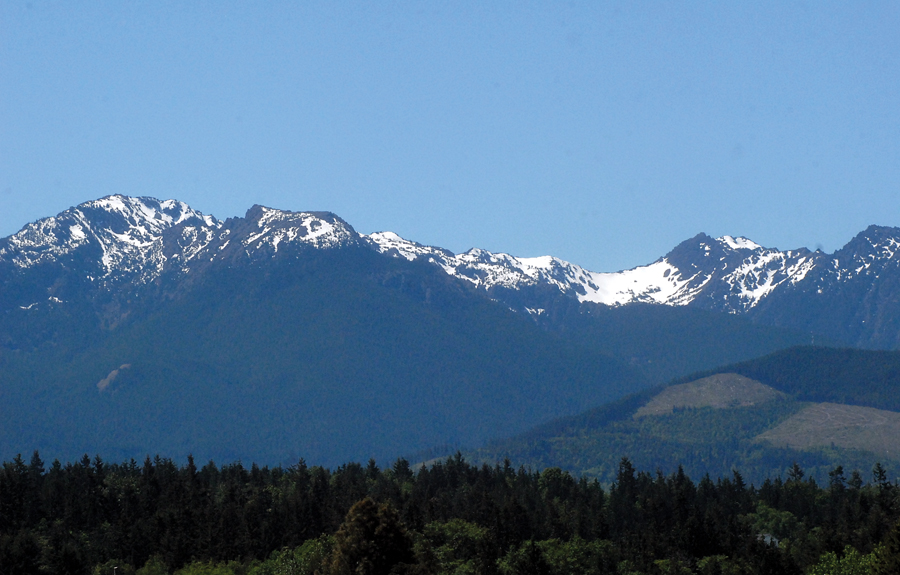
Record-high spring temperatures could trigger mild drought late this summer and raise the chances of another serious fire year in 2016, according to experts monitoring the region’s snowpack.
“The whole Pacific Northwest [snowpack] is melting at record rates,” said Scott Pattee, Natural Resources Conservation Service water supply specialist.
Spring temperatures averaging 6.4 degrees above normal are causing the snowpacks in the Olympic and Cascade mountain ranges to melt at accelerated rates, Pattee said.
Additionally, spring rains seems to have slowed down months ahead of schedule, he said.
Snowpack runoff for May through September is expected to be 75 percent of normal for rivers with sources in the Olympic Mountains — considerably less than the 99 percent of normal that was predicted in the April 1 outlook report, he said.
Pattee said with the early end to rain and snowfall, and with the remaining snowpack runoff expected to be exhausted by midsummer, water supplies should be fine through July, but there could be water shortages in some areas in August and September.
The effects are not expected to be anywhere near the record snow drought that impacted the region in the summer of 2015, he said.
The winter of 2014-15 produced the lowest snowpack on record when the mountain snow fell as rain and ran off before the summer peak water-use season.
Lower-than-normal river flows and higher-than-average water temperatures damaged some salmon runs during last summer and autumn.
Gov. Jay Inslee declared a statewide drought emergency in May 2015, and by midsummer, several North Olympic Peninsula communities, agricultural users and businesses were put on voluntary or mandatory water-use restrictions.
Dry conditions persisted through the summer, and some water-use restrictions remained in place through October.
A wet fall and a snow-heavy early winter helped restore groundwater levels and build early snowpack.
Mike McFarland, a forecaster for the National Weather Service in Seattle, said that after a wet winter, it has been a very dry spring.
Olympic Peninsula locations received about one-half to one-quarter of the normal rainfall in March, and there has been almost no rain so far in May, McFarland said.
On May 3, the Weather Service’s weather stations at Quillayute Airport measured seven-tenths of an inch of rain, Port Angeles’ official measurement showed nine-hundredths of an inch and the Quimper Peninsula got “drips and drabs,” adding up to three-hundredths of an inch, he said.
McFarland said fuel moisture in the forests around the Olympic Peninsula is only at about 23 percent — similar to what would be expected in July.
“This is at the low end of normal,” he said.
The data is showing a pattern reminiscent of the 2014-15 season, which had average rainfall during the winter season, but rains ended early and the fire fuels dried out quickly.
“We’re on a similar track,” McFarland said.
However, there is still a chance of rain returning late this spring or in the summer, he said.
The next chance of rainfall is Saturday, according to the Weather Service forecast.
Four SNOTEL (snow telemetry) weather stations in the Olympic Mountains measure snowpack and rainfall in river watersheds.
SNOTEL is a system of snow telemetry and related climate sensors operated by the NRCS in the western states.
The Buckinghorse SNOTEL site, which measures snowpack at 4,620 feet elevation in the southern Elwha River watershed, had 73 inches of snow, or 51 percent of average, on Wednesday.
The Waterhole site, on a ridge between the Morse Creek and Elwha River watersheds east of Hurricane Ridge, at an elevation of 5,000 feet, had 44 inches of snow, or 71 percent of average.
The Dungeness site in the Dungeness River watershed had no snow. The 30-year average is 3.34 inches. SNOTEL data showed the lower-elevation site, at 4,010 feet elevation, had a near-average snowpack until unusually warm spring temperatures in lower elevations melted the snow in late March.
In Jefferson County, the Mount Crag SNOTEL site, in the Dosewallips River watershed at 4,200 feet elevation, had 25 inches of snow, or 64 percent of average.
All of the sites have passed their average peak dates, meaning the snow has ceased accumulating for the winter and is expected to begin to melt to produce spring and summer runoff.
________
Reporter Arwyn Rice can be reached at 360-452-2345, ext. 56250, or at arice@peninsuladailynews.com.
