
Editors Note: This article originally contained incorrect information.
The proper ratio for a cleaning solution used to treat bird feeders is one part bleach to 10 parts water.
PORT ANGELES — Larger than usual numbers of seed-eating songbirds are spreading disease acquired at backyard feeders this winter in what the National Audubon Society is calling “a perfect storm of feast and famine.”
Recent reports of sick or dead birds at backyard feeders around the state have prompted the state Department of Fish and Wildlife to recommend that people temporarily discontinue feeding wild birds or take extra steps to clean and disinfect their feeders.
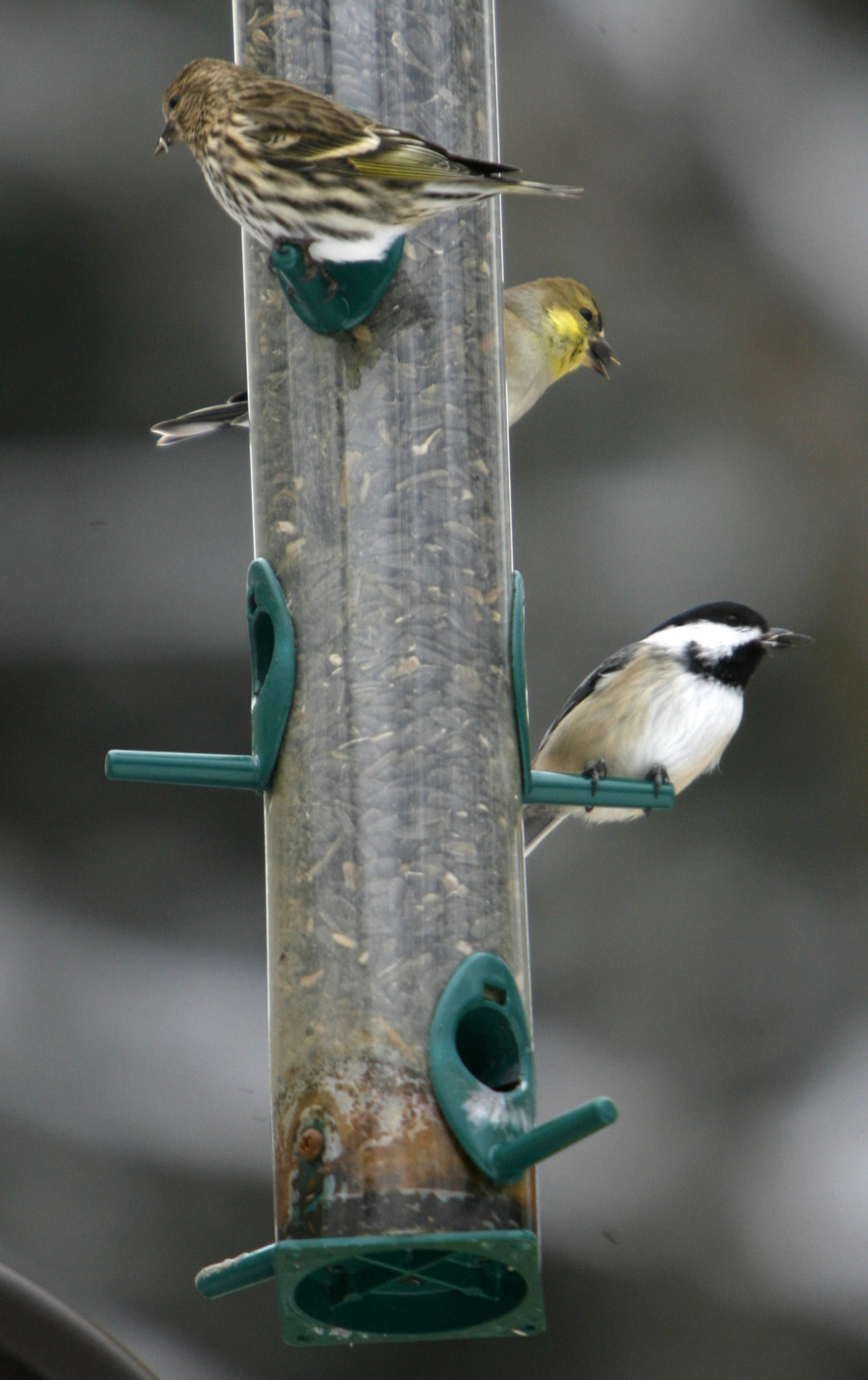
Wildlife organizations from the British Columbia Wildlife Rescue Association to the Portland Audubon Society and as far south as the San Francisco Bay Area are reporting a sharp increase in the number of sick and dying pine siskins, nuthatches, chickadees and other seed-eating backyard birds.
This wintertime die-off of pine siskins — small, heavily streaked, yellow-accented finches — as well as other songbirds, is attributed to salmonellosis, a common and usually fatal bird disease caused by the salmonella bacteria, according to Fish and Wildlife Veterinarian Kristin Mansfield.
“When birds flock together in large numbers at feeders, they can transmit the disease through [fecal] droppings and saliva,” Mansfield said.
Wet bird seed is part of the problem, said wildlife rehabilitator Cynthia Daily of Discovery Bay Wild Bird Rescue.
“At this time of year, there’s lots of dampness out there, and if the seed gets wet, they grow bacteria. People have to keep their feeders dry and clean, and keep the seed dry. That way, bacteria doesn’t have a chance to grow.”
A weekly cleaning of feeders and bird baths with a solution of one part bleach to ten parts water can keep feeders clean, but Mansfield and Daily both recommended removing feeders to take away gathering spots and potential disease vectors for these birds.
“What I have been telling people is you have to rest your feeders,” Daily said. “Anywhere there’s a big gathering of birds, they can spread diseases — just like us humans.”
Daily said there is plenty of other food sources available, even during the seemingly lean winter months.
“Let them forage on their own naturally; there’s plenty of food sources for them to find,” Daily said.
The spread of the disease this winter could be boosted by what appears to be a food-driven migration of winter-roaming finches — an anomaly where finches and other species that generally winter in the northern forests of Canada move south and are spotted in areas in larger numbers than in normal years.
This bird migration has been described by the National Audubon Society as “the biggest irruption of northern finches in recent history.”
Pine siskins and other finches are typically year-round residents on the Olympic Peninsula, owing to the region’s mild climate.
But numbers are up here, as well.
A record-breaking 9,000 pine siskins were recorded in Christmas Bird Counts conducted by the Olympic Peninsula Audubon Society in December, 2,300 more than the previous record of 6,700 set in 2007.
The first indication of the disease for bird watchers to look for is often a seemingly tame bird on or near a feeder.
The birds become very lethargic, fluff out their feathers and are easy to approach. That kind of behavior is generally uncommon to birds, Mansfield said.
Daily said she has heard of people who have seen birds in that condition and tried to intervene.
“People find them just sitting there and think, ‘Oh, how cute this little bird is, and pick them up and put them on their fingers,” Daily said.
That should be avoided since it is possible, albeit uncommon, for salmonella bacteria to transfer from birds to humans through direct contact with infected birds, droppings or through domestic cats that catch sick birds.
When handling birds, feeders or baths, it is best to wear gloves and wash hands thoroughly afterward.
Salmonella in humans is among the most frequently reported causes of food-related illnesses.
Similarly, it attacks the digestive system of infected birds, making feeding and digestion difficult. It is transmitted through fecal contamination of food and water — making baths and feeders crucial in the outbreak — as well as contact with other birds.
If people discover a bird they believe to be sick, Daily has advice.
“Put it in a shoe box or a little box in a warm, dark, quiet place, and leave them alone,” Daily said. “You can give us a call at 360-379-0802 and we would be happy to take them.”
Treatment doesn’t provide much chance at successfully rehabbing the birds, Daily said.
“These birds are so susceptible to salmonella that beyond providing antibiotic treatment and giving them fluids, there’s little we can do to turn things around, even with antibiotics. And I’ve tried many different types, seeing if I could find the right combination. But most of the time we are not successful.”
Mansfield agreed.
“Unfortunately, at this point, there is very little people can do to treat them,” Mansfield said. “The best course is to leave the birds alone.”
Fish and Wildlife asks the public to report dead birds they observe at https://tinyurl.com/PDN-ReportWDFW, and it asks the public to avoid handling them if possible.
Other tips to avoid problems, provided by bird experts:
• Use feeders made from nonporous material like plastic, ceramic or metal. These are less likely than wood to harbor bacteria and other diseases.
• Clean feeders, water containers and birdbaths at least weekly by rinsing with soapy water and then dunking the feeder in a solution of one part bleach to 10 parts water.
• Clean up old seed hulls and waste below the feeders by raking, shoveling or sweeping, then discarding in the trash.
• Spread your feeding over several areas or feeders so you’re not encouraging birds to congregate in one place.
• Clean feeders more often if you have large numbers of birds at your feeders.
• Visit with your neighbors who also feed birds and share this information.
________
Sports reporter Michael Carman can be contacted at 360-406-0674 or mcarman@peninsuladaily news.com.
