
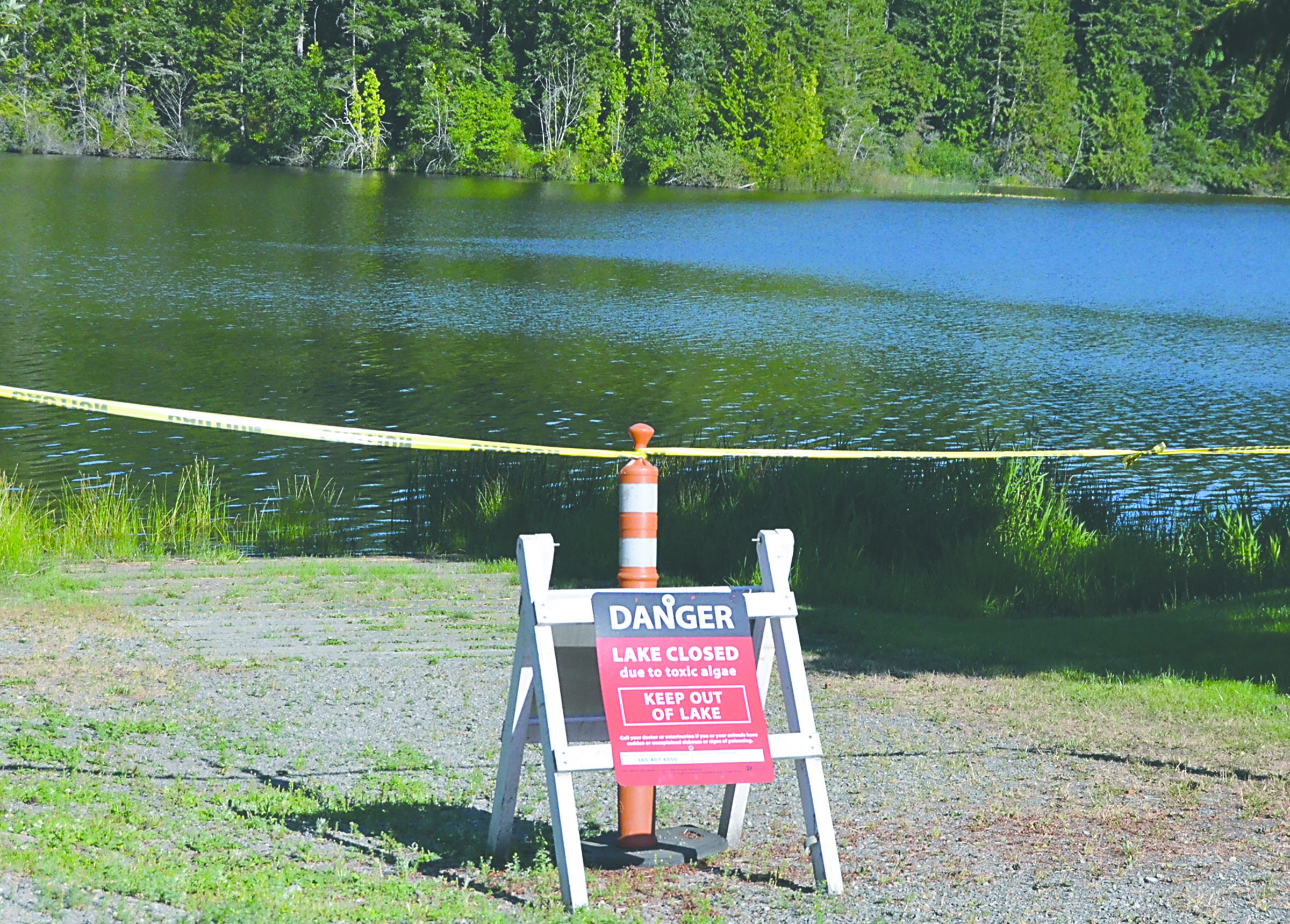
CHIMACUM — Anderson Lake and its blue-green algae is getting widespread attention.
A report from researchers at the University of Oregon and the Centers for Disease Control and Prevention in Atlanta — which is expected this fall at the earliest — could set the stage for a solution to the lake’s historically high level of anatoxin-a, a potent nerve toxin created by some types of blue-green algae.
Samples of algae from the popular trout-fishing lake, which is within Anderson Lake State Park between Port Townsend and Chimacum, are undergoing genetic analysis to determine if the species living in Anderson Lake are commonly found in similar lakes across Northwest Washington.
Also, a paper about animal deaths and poisoning in proximity to lakes around the nation, which is now under review by the Centers for Disease Control, or CDC, is expected to include data from Anderson Lake, where routine testing for toxins began after two dogs drank the water and died on Memorial Day weekend in 2006.
“This is an interesting case,” said Joan Hardy, a toxicologist with the state Department of Health about the studies of algae DNA.
“We want to find out why Anderson Lake is so much more toxic than the other lakes in the region.”
She added that she did not know when the animal deaths study would be published.
The lake, which closed this year since May 17 after only three weeks of the fishing season, has been found during the seven summers it has been tested to contain high levels of anatoxin-a, which can kill within four minutes of ingestion.
In June 2008, the 60-acre lake set a world record: 172,640 micrograms of anatoxin-a per liter. The safety threshold for the toxin is 1 microgram per liter.
If the algae, also known as cyanobactria, is unique to the lake, that could account for high toxin production, Theo Dreher, chairman of the Department of Microbiology at Oregon State University and lead researcher, has said about the study begun earlier this year.
This information could help local health officials devise a plan to combat the specific type of cyanobacteria and potentially reduce Anderson’s toxin levels, he said.
“Right now, the tests are conducting a genetic analysis of the lake’s algae and trying to determine how it differs from other strains,” said Michael Dawson, lead environmental health specialist at the Jefferson County Public Health Department, last week.
“The question is still how Anderson Lake seems to produce so much anabaena [a species of cyanobacteria], which is the active ingredient in the toxin.”
Anatoxin-a and microcystin, a slower-acting toxin commonly found in East Jefferson County lakes, are produced by blue-green algae, which occurs naturally but which can begin suddenly to produce toxins.
The reason is a mystery to scientists worldwide. What is known is that algae growth is fueled by the sunshine and warmth of summer and nutrients such as phosphorus.
Dawson said Anderson Lake is a “eutrophic” lake, meaning it has high quantities of nitrogen, phosphorus, and other nutrients.
It’s an old lake and does not have a steady flow of water in and out, which can result in unusual algae patterns, he said.
One possible solution would be to channel water from another source into the lake to freshen the water, Dawson said, although the possible source hasn’t been determined.
Hardy said that one of the factors in determining the nature of the toxicity will be to study how the surrounding land was used in the past.
A county report released in February noted a high amount of phosphorus in Anderson Lake as opposed to other lakes in East Jefferson County, such as Gibbs or Leland.
A dairy farm was operated near the lake for more than 50 years, according to Dawson and Greg Thomason, Jefferson County environmental health specialist, in the report.
“Cow manure is very high in phosphorus and is probably the major source of the high phosphorus levels in this small lake,” the report said.
While budget cuts have cut the frequency of sampling for tests of toxin levels, state funds from boat licensing for toxicity tests is subsidizing the genetic analysis tests, Hardy said.
“We are lucky that program is in place. Otherwise we would not be able to pay for the testing of the water, which can cost $400 each time,” she said.
For more information from the state, see www.nwtoxicalgae.org.
________
Jefferson County Editor Charlie Bermant can be reached at 360-385-2335 or cbermant@peninsuladailynews.com.
Reporter Jeremy Schwartz contributed to this report.
