
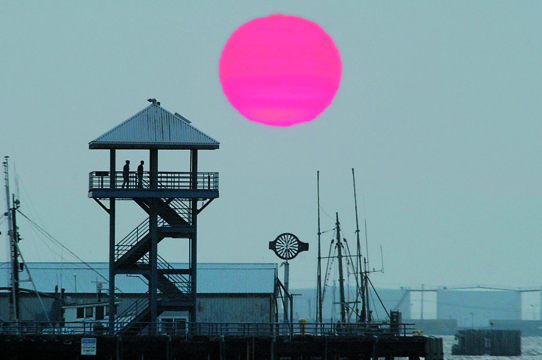
If the sunsets have looked especially colorful in recent days, the National Weather Service says it’s probably because of smoke originating from wildfires in Siberia.
“You can really only see it in the morning and at sunset,” said Chris Burke, a meteorologist for the National Weather Service in Seattle.
“There are a lot of big fires in Siberia right now.”
“It’s making for some pretty nice sunsets.”
Burke said the afternoon haze visible over the Olympic Mountains is probably just moisture.
The smoke is too high in the atmosphere to affect people with breathing difficulties, Weather Service meteorologist Jay Neher added.
“I don’t see any reason for it to come down once it got here,” Neher said.
Phil Swartzendruber with the Puget Sound Clean Air Agency told KPLU public radio that the Asian smoke is not posing problems for human health.
University of Washington Atmospheric Sciences Professor Cliff Mass wrote about the smoke in a Saturday post to his blog, www.cliffmass.blogspot.com.
Mass attached a satellite image of Washington taken Friday that shows the leading edge of the smoke over the North Olympic Peninsula.
Mass updated the post Sunday night, saying the trajectory of the smoke put it 16,400 feet over Port Angeles.
“Examining the flow aloft, it really appears unlikely to be coming from any of the western U.S. fires,” Mass wrote.
“The air over us can be traced back to Asia at low levels.”
Computer models show the smoke’s course from east Asia to the Aleutian Islands to the eastern Pacific.
The smoke makes an abrupt left turn off the coast of Northern California and moves north to Western Washington.
“I believe many of you . . . particularly those near the coast and northwest Washington will be [able] to see the smoke, particularly at sunset, where the sun should look redder than normal,” Mass wrote.
Burke said the smoke appeared to be dissipating on Monday, but it still created a colorful sunset on the Peninsula.
“It’s pretty unusual,” he added.
Images taken by the nation’s newest Earth-observing satellite tracked aerosols from the fires taking six days to reach the U.S., according to a NASA news release.
The Voice of Russia reported that more than 42 square miles of forests in Siberia were on fire in May.
The Russian Ministry of Emergency Situations said roughly 80 percent of these fires are intentionally set to clear land for farming.
“This smoke event is one example that shows that what happens over one area of the earth can easily affect another area thousands of miles away, whether it’s from Asia to North America or North America to Europe, and so on,” said Colin Seftor, an atmospheric physicist working for Science Systems and Applications, Inc. at the NASA Goddard Space Flight Center, in Greenbelt, Md.
Reporter Rob Ollikainen can be reached at 360-452-2345, ext. 5072, or at rob.ollikainen@peninsuladailynews.com.
