
PORT ANGELES — At the former Elwha Dam site, a thick layer of straw protects native grass and flower seed on the slopes around the area where the dam’s hydroelectric power plant once stood.
The seeds were collected by the National Park Service from native plants in the area, and spread over the slope by construction crews, said Joshua Chenoweth, Olympic National Park restoration botanist.
The straw prevents erosion of the recently built-up hillside, and maintains moisture in the soil, while allowing the grasses to grow through it.
Replanting is the latest — and longest — stage of the $325 million river restoration project that began in September with the beginning of the demolition of the Elwha Dam, built in 1913, and the Glines Canyon Dam, constructed in 1923.
The Elwha Dam removal was finished earlier this year, and Lake Aldwell behind it has drained.
Lake Mills has started draining behind Glines Canyon Dam, which is expected to be completely demolished next year.
Before the Elwha Dam and its attendant buildings were removed, the hillside was a grassy slope dotted with occasional bush or tree.
Work on that slope is the most obvious of the growing changes to the moonscape-like ring around the former lakes, thanks to the public lookout and webcam installed with a view of the former Elwha Dam site.
What is less obvious is the work in the fall and winter in which 30,000 native plants were planted both at the Elwha Dam site 5 miles from the mouth of the Elwha River and 8 miles upstream from there, near the Glines Canyon Dam.
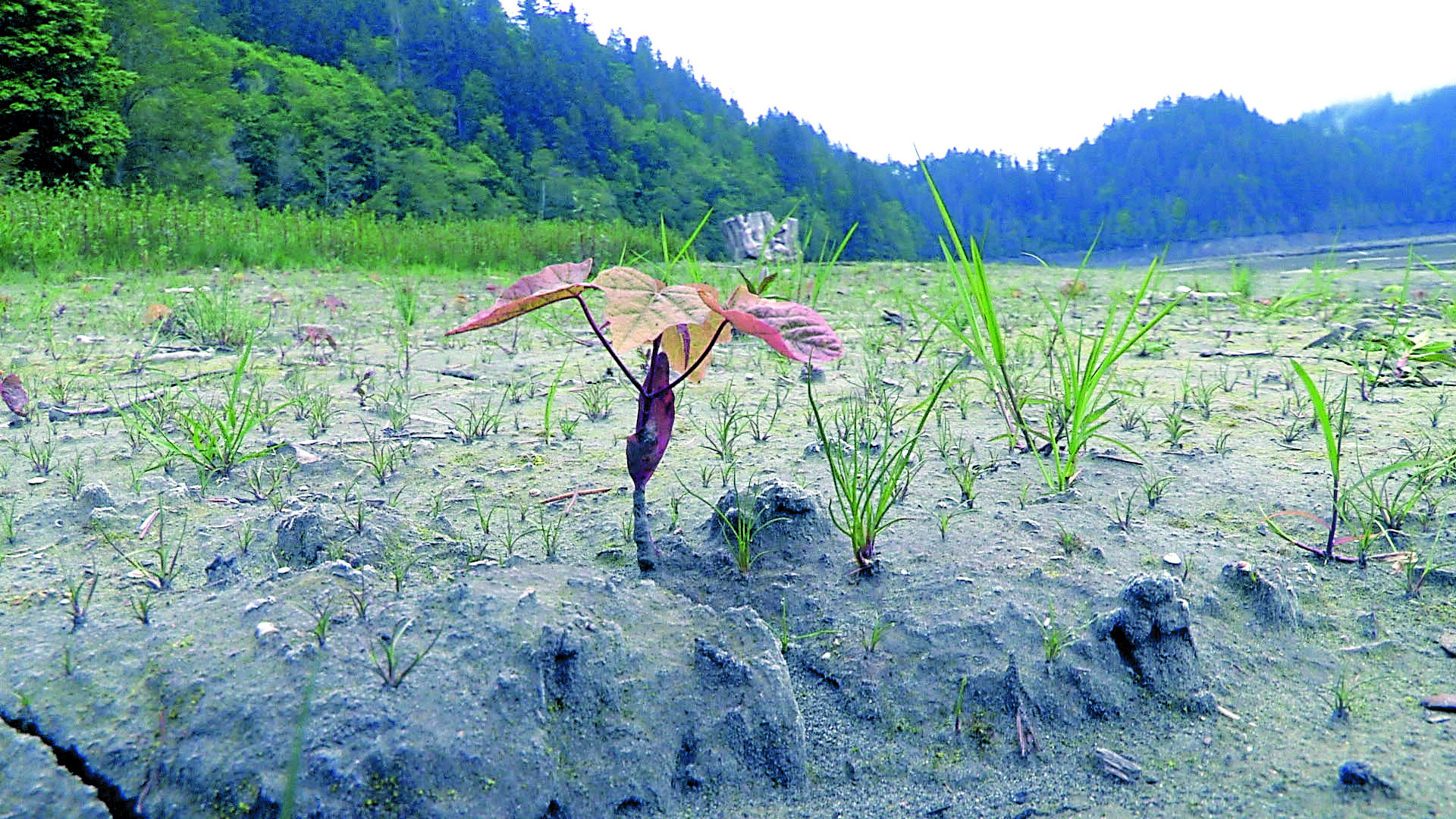
Small wild plants have begun to emerge among the recently uncovered tree trunks that were submerged for 100 years.
Don’t get too excited about those small signs of life growing on and near those stumps, Chenoweth said.
Most of them will die off as the clay and sandy soils dry out for the summer.
The seedlings on top of the stumps are almost certain to die off, because the stumps are too-well preserved, Chenoweth said.
“The stump must be very well rotten,” he said.
Chenoweth explained that the seedlings at the base of the stumps have the best chance of surviving because they are protected from the elements.
The silt in some places is as much as 40 feet deep, which limits what can be planted in those areas.
In soil, 10 percent is a lot of clay, Chenoweth explained, and some places have 20 percent clay in the sediments, and 80 percent rocky silt.
When the area dries out, much of it will crack into scaly plates, and there won’t be enough water in the ground for seedlings to survive, he said.
Later this summer, Chenoweth’s crews will begin formal monitoring of 63 plots of land, to see what survives and thrives, and in what conditions.
Already crews have noticed a high mortality among Douglas fir in some locations, he said.
There is no replanting at all within 150 feet of the edges of the old lake beds, where the water met forest.
In the year since water levels dropped, the 18 feet of shoreline that was initially exposed is already naturally reseeding, with a wide ring of green growth, Chenoweth said.
Areas that are replanted are receiving seedlings and young plants bred from specimens collected in the lower Elwha watershed, and grown in seed farms to produce the amount of plant material needed for the massive project.
This method is used to preserve local plant genetic materials, and to avoid introducing genetics of similar plants from other regions.
They include conifer tree seedlings, willow, cottonwood, red osier dogwood, and other woody species and bare-root stock of many native tree and shrub species.
Many species will return on their own within a few decades, but it could take as long as 200 years before the soils are reestablished, Chenoweth said.
Plants and seed for revegetation are from the Matt Albright Native Plant Nursery at Clallam County’s Robin Hill Farm County Park between Port Angeles and Sequim.
_________
Reporter Arwyn Rice can be reached at 360-452-2345, ext. 5070, or at arwyn.rice@peninsuladailynews.com.
