
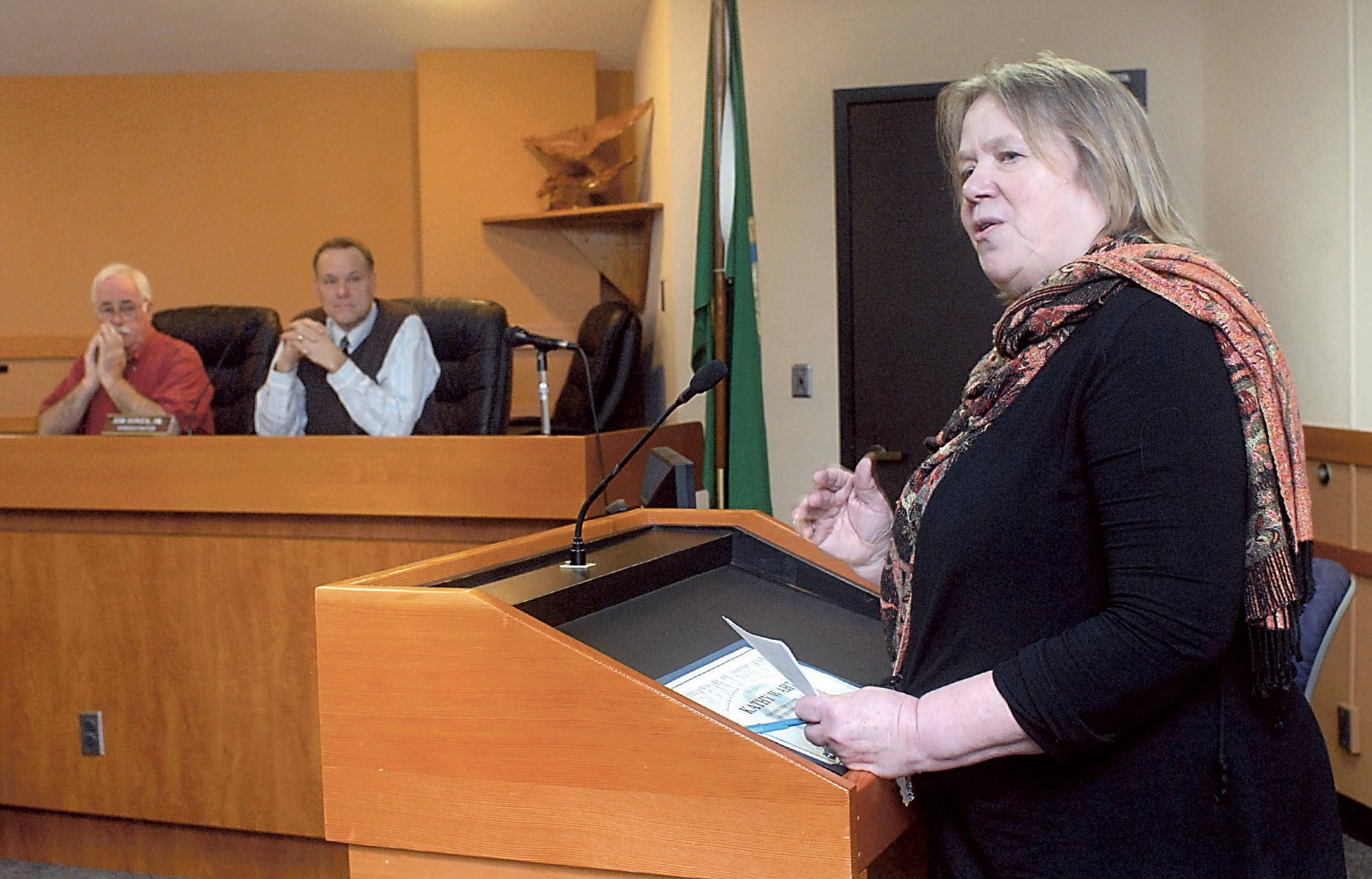
PORT ANGELES – Homelessness: America created the problem; now it’s up to the nation to solve it.
That’s the challenge Kathy Wahto throws down as she leaves after 13 years as executive director of Serenity House, Clallam County’s nationally noted effort to provide permanent shelter for everyone.
The present predicament started in the 1970s and ’80s, when federal policy dictated that mental health should be a community-based effort but provided communities with no money to accommodate the exodus of brain-disordered people from mental institutions, Wahto said.
Add to them the people who were turned onto the streets by abusive partners and parents, by illnesses, job losses — and the nation faced a crisis as it stepped into the 21st century.
That’s when Wahto, who retired Friday at age 67, joined Serenity House, which then focused on sheltering people and families in crisis.
Today, its mantra is preventing homelessness — or at least providing the stable shelter that’s necessary if unhoused people can re-enter mainstream society.
On the way, Serenity House became famed in the Northwest and the nation as the benchmark program for what Wahto calls “remote, rural and frontier communities.”
“I think that people take us seriously,” she said last week in the Housing Resource Center in Port Angeles that houses the Dream Center for homeless teens, the Tempest apartments, classrooms and support programs that include veterans outreach.
“I think of this as the point of the spear,” Wahto said as students of a job-readiness class filed out of the 535 E. First St. building that once housed a motel and restaurant.
That spear once was wielded on behalf of about 900 clients in Port Angeles when Wahto — who had previously worked as the controller at the Peninsula Daily News, overseeing accounting operations — joined the agency in July 2002.
Now, Serenity House and its offspring agencies serve about 4,000 clients from Forks to Sequim, she said.
It’s where the path starts to permanent housing.
“We’re no longer focused on the Band-Aid,” Wahto said
She said she’ll retire to Bellingham — from where she’s shuttled to and from Port Angeles each week — but probably keep and rent out her home here and return someday.
She won’t become wholly inactive in fighting homelessness but will consult with Grays Harbor officials on their 10-year plan, as she previously did for Island County.
Every city beset by the problem probably thinks it originates somewhere else and arrives via a route like U.S. Highway 101, she said.
That’s not true, according to Wahto.
“We have so few people who come up from the south on 101,” she said, and only 8 person to 10 percent of Clallam County’s homeless come from Jefferson and Mason counties.
The rest once had homes here.
“The money [for Serenity House programs] is being spent on local people,” Wahto said.
The stream of people seeking shelter never stops, although annual Point in Time censuses have tracked an 80 percent decline in chronic homelessness in Clallam County since 2002, Wahto said.
Serenity House tracks its clients for up to three years. It has about a 10 percent rate of recidivism, mostly chronically homeless people who cycle through its emergency shelter.
Serenity House isn’t without its critics — especially people who have been ejected from its shelter for not obeying the rules.
Among them recently were three families with children whose parents were actively doing drugs.
“Evergreen Village is a clean-and-sober project,” Wahto said.
Drug users get a second chance but no more.
Still, Serenity House doesn’t turn its back on people, Wahto said.
“We know that they’re still ours to serve and to help,” she said.
“We start the process all over again. We’re still trying to put plans together for [the three families].
“We don’t want to create homelessness. It’s not compassion; that’s just common sense.”
In any case, if addicts are homeless, “they’re not more likely to give up drugs,” she said.
Putting a safe roof at the top of people’s needs is the foundation of returning them to the community, to school, to work, she said.
“If they have a platform that’s stable — that is, electricity, hot water and locking doors — their health improves,” be it physical, mental or, most often, both, she said.
“We act like it is a privilege sometimes. As much as we need food and clothing, we need to have a stable place.”
________
Reporter James Casey can be reached at 360-452-2345, ext. 5074, or at jcasey@peninsuladailynews.com
