
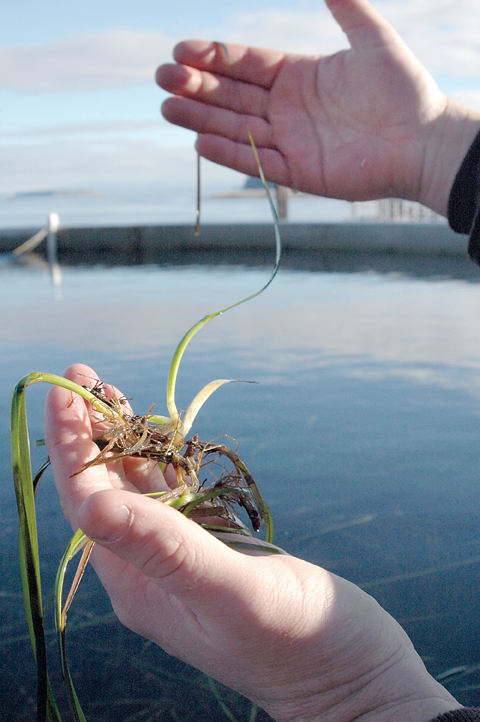
SEQUIM — Local scientists are lending their expertise to offset the global decline of seagrass by studying and restoring eelgrass throughout Puget Sound.
To help address this decline, scientists at Pacific Northwest National Laboratory’s Marine Sciences Lab in Sequim are working with the state on restoring eelgrass throughout the Puget Sound.
“The amount of eelgrass that is being lost is huge,” said John Vavrinec, senior research scientist and dive officer at the Marine Sciences Laboratory.
“In 2009, it was estimated about 30 percent the eelgrass meadows in the world had been lost since the 1940s.”
Eelgrass is recognized by the Puget Sound Partnership as both critical habitat and a vital sign of Puget Sound because changes in its abundance or distribution reflect changes in environmental conditions.
As the amount of seagrass, including eelgrass, disappears on a local and global scale, so does an important piece of the overall marine habitat that supports many ecosystem processes, researchers said.
The flowering and rooted eelgrass is the most widespread species of seagrass and provides a variety of ecosystem functions, said Ron Thom, lead for the Coastal Ecosystem Research technical group at the Marine Sciences Laboratory.
Examples include its ability to act as feeding ground and food source, provide habitats for invertebrates and microbes, be a nursery and spawning area for some fish and shellfish, protect shorelines from erosion and improve water transparency.
It can also provide oxygen to the water, trap nutrients and cycle it and sequester carbon.
Hold carbon
Seagrass meadows occupy less than 0.2 percent of the area of the world ocean, but it’s estimated that they bury roughly 10 percent of the ocean’s carbon, Thom said.
“This is important for climate change and really important for sequestering carbon in sediments,” he said.
Reasons for the overall decline in eelgrass beds “are not yet fully understood,” according to Puget Sound Partnership, but such stressors as shoreline alteration, pollution and direct physical damage have impacts on the amount and health of eelgrass.
State goal
The state goal is to increase the area of eelgrass in Puget Sound by 20 percent by 2020.
“In places I think it [restoration] has gone well, but to make that goal by 2020 is going to be pretty difficult,” Vavrinec said.
For the past five years, scientists at the Marine Sciences Laboratory have worked with state agencies to try to achieve this goal, Vavrinec said, but both his and his colleagues’ work with eelgrass prior to their collaboration with the state account for many more years.
If met, the goal would total 64,000 acres of eelgrass throughout Puget Sound, relative to the 2000-08 baseline of about 53,300 acres of eelgrass estimated to be within the Sound.
According to the 2015 State of the Sound, an annual report of analysis and findings, the 2011-13 estimate is approximately 7 percent higher than the 2000-08 baseline but has a wide range of uncertainty.
“We looked all around Puget Sound for good [restoration] spots, and the areas we’ve pursued are just the ones that floated to the top of our list,” Vavrinec said.
“We’ve been targeting the larger areas first, but we need to continue to improve our methods because most of the easy sites have been addressed.”
Projects in progress
The eelgrass beds near Sequim are fairly healthy and seemingly self-sufficient, but the work and research done at the lab supports restoration projects throughout the sound, including two projects underway in Port Gamble and Quilcene bays.
Eelgrass near the Marine Sciences Laboratory has allowed scientists at the lab to study established eelgrass beds and create long-term data sets, Vavrinec said.
The lab also is equipped with large outdoor tanks fed with water from Sequim Bay to temporarily hold eelgrass intended for a restoration project, sometimes propagate plants and occasionally conduct experiments to better understand the physiological response of eelgrass to temperature, light, flow or amount of carbon dioxide given climate change.
Because of the space limitation of the tanks and the scale of most of the restoration projects, the eelgrass used to plant and restore an area is taken from natural donor sites, Vavrinec said.
Although scientists err on the side of caution when taking plants from donor sites, there’s a study underway to establish the threshold for the amount of plants that can be removed from a healthy eelgrass population before it’s negatively impacted.
Improve data
Modeling is used when selecting areas to restore eelgrass, Vavrinec said.
After modeling the shorelines, potential areas are identified, a field survey is conducted, test plots are placed and evaluated — and, if successful, Vavrinec will pursue a full-scale restoration.
“Science is a process,” he said. “We’re always trying to improve our chances for success, and one of the biggest problems we run into with the model is the data.”
Although modeling can target areas ideal for eelgrass, the data used isn’t always reflective of the actual nearshore environment where eelgrass is able to grow, given its sensitivity to both light and temperature.
To improve the data used by the models, Vavrinec hopes to install light sensors throughout Puget Sound.
Funding for the supplies and installation still is needed, but Vavrinec hopes to pilot the project this year with five sensors.
To regularly maintain and collect the information gathered by the light sensors, Vavrinec plans to network with such existing organizations as the Port Townsend Marine Science Center, Feiro Marine Life Center in Port Angeles, Seattle Aquarium, universities and citizen scientists.
“The idea is to get continuous data,” he said. “This would provide two things.”
First, Vavrinec said, it would provide much better estimates of where eelgrass would most likely thrive.
Second, it would provide long-term data sets.
“That same data also could help us monitor changes in water quality,” he said.
Beyond the hands-on efforts and research being done to restore eelgrass beds, Vavrinec said, the biggest thing that would help eelgrass is to increase both nearshore habitat restoration and water quality.
________
Alana Linderoth is a reporter with the Olympic Peninsula News Group, which is composed of Sound Publishing newspapers Peninsula Daily News, Sequim Gazette and Forks Forum. Reach her at alinderoth@sequimgazette.com or 360-683-3311, ext. 55249.
