
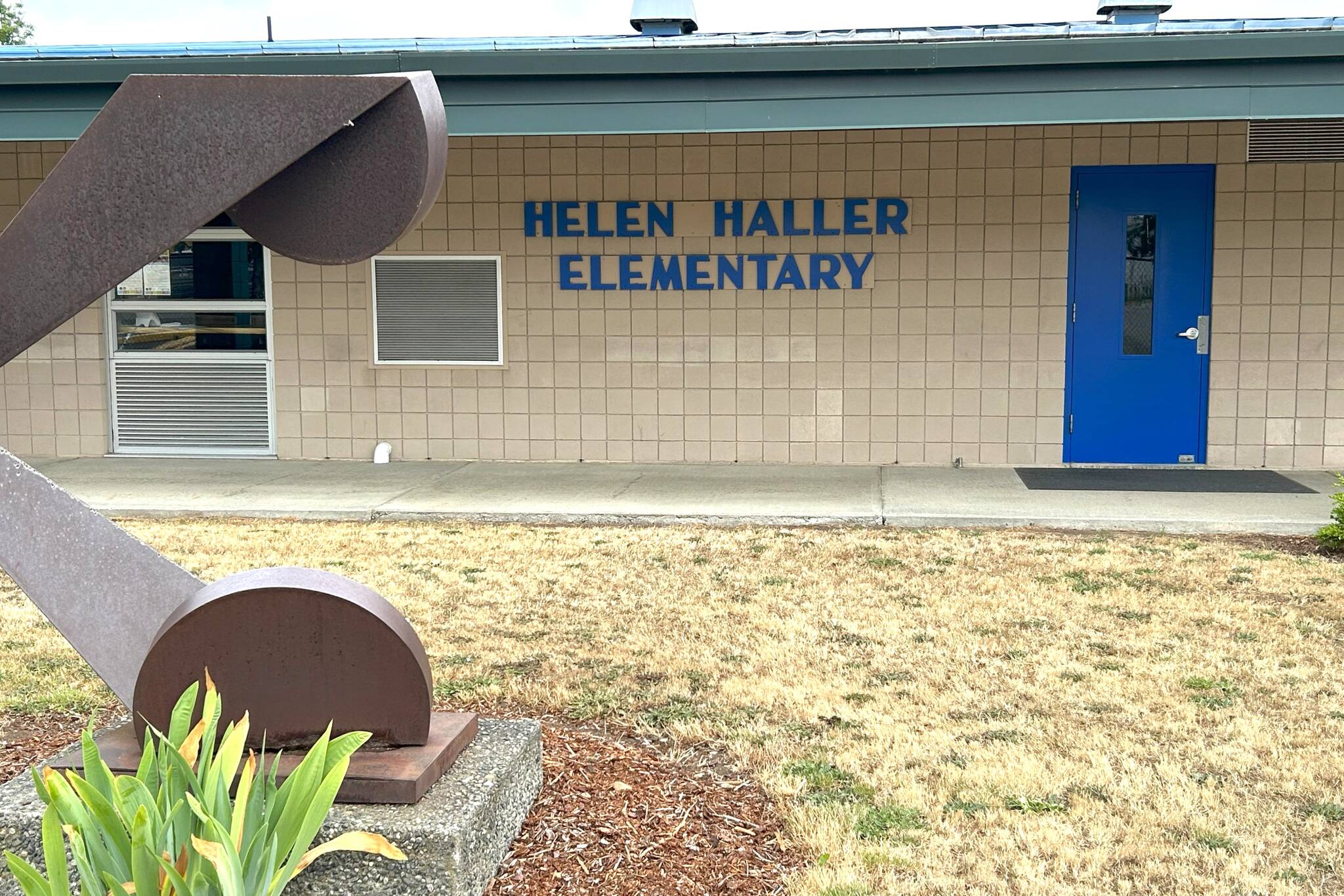
SEQUIM — Mike Santos, Sequim School District’s director of facilities, said the most common question he receives about voter-approved construction projects, including a new elementary school and renovated high school, is their completion dates.
While voters approved a $146 million, 20-year construction bond in the Feb. 11 special election, Santos and Superintendent Regan Nickels said progress could take upwards of 2½ years to break ground on the two largest projects, while smaller projects could be started sooner.
“It depends on how fast we get in front of the (state’s Public Review Commission), and it depends on how much back-and-forth we have with the design committees,” Santos said.
“It depends on how much back-and-forth we have with staff and other stakeholders. It depends on how long (the Office of Superintendent of Public Instruction) takes to review the (project).
“There’s just a lot of procedure; there’s a lot of pre-construction work that has to be done.”
Voters approved construction through a supermajority with 9,256 yes votes (65.6 percent) to replace Helen Haller Elementary School (HHE), build interconnected wings at Sequim High School (SHS), add a cafeteria at Greywolf Elementary School (GWE) and update its bus loop, parking lot and heating, ventilation and air conditioning (HVAC), upgrade the district’s athletic field and stadium facilities with an expanded track, improved bleachers and bathrooms, improve or replace the district’s transportation center, create a new bus loop through the district’s main campus, and improve safety and security at all schools with vestibule entrances.
Nickels said the safety and security component and transportation center could be turned around more quickly than building new schools, and “Greywolf’s cafeteria only has so many places that it can go.”
District leaders will spend the next two years to “focus on planning and preparation before any construction begins,” according to the district’s “Kaleidoscope” magazine.
“This includes hiring construction management, architectural, and engineering teams to help design the new and improved facilities,” district staff wrote.
A design advisory committee also is helping to guide the recommendations for a to-be-determined architecture firm to design concepts.
“Things are actually happening,” Santos said. “We cannot afford for the projects to go badly. There’s not enough room for error in the budgeting for us to get this wrong.”
District leaders announced that the first of three sales for construction bonds were sold for the voter-approved projects.
D.A. Davidson & Co., the district’s underwriter for its obligated bonds, opened the bond order on June 10 and received 80 orders from 13 different institutional investors across the nation, according to district documents. District staff report they secured about $49.7 million in funding. The sale closed on June 24.
Nickels said they chose to do three bond sales instead of two due to the “volatility in the market and because we didn’t need half the bond money in the first 18 months.”
She said they can change their mind if more funds are needed and market rates are more favorable.
Nickels told school board directors and staff at a June 16 meeting that the sales show confidence in the district and that it’s “a viable investment for folks to make.”
Selections
Santos said they anticipate a recommendation in the next 30 days for a Source Selection firm to Nickels and then the school board to help the district prepare its documents for the Public Review Commission and in selecting a firm to build the construction projects.
Four agencies applied and two will present to the Source Selection Committee some time this month, he said.
The Source Selection Committee firms and committee members are anonymous under state law, Santos said.
“The firm will help us formulate the case and fill out the forms required to present ourselves in front of the PRC,” he said.
That could take months, Nickels said.
The PRC also only meets at certain times, takes on only so many cases, and agencies must submit at least a month in advance, Santos said.
District staff said they’ll also consider only bringing certain projects to the PRC at a time instead of the whole bond program list.
“We’re going to strategically select the projects that we need to get started,” Santos said.
He said that will entail district leaders and the construction firm deciding the order of projects.
Nickels said the firm also will help the district select design firms, architects and general contractors.
“Each one of those (bond program projects) is initiated, managed and designed independently, and every project practically in the portfolio is mutually exclusive to the other,” Santos said.
Nickels said they’re considering a progressive design-build process that collaborates design and construction.
“It leads to a faster project delivery in the end and has cost certainty to it,” she said. “We want that because it has so many projects, and we don’t want cost overruns.”
Santos said a different architectural and design team could be chosen for every single project in the bond program portfolio because they will be competed separately.
“You never want to put all your eggs in one basket like that because there’s just too much risk,” he said. “Because if they fail, the whole program fails, and we can’t have that.”
CTE building
A planned career and technical education (CTE) building also will be included in the portfolio of construction projects for the construction management firm, just not as part of the bond program, Santos said.
“It’s a little bit more mature from the aspect that we have the conceptual design done,” he said.
Phase one of the Ramponi Center for Technical Excellence will include a 10,000-square-foot building with classroom space and two large open bays for industrial grade training on site for automotive and construction.
Marylaura Ramponi of Sequim donated $1 million in honor of her late husband Louie, a TV store owner, and the school district received nearly $5 million from state legislators in the 2024 supplemental budget. The center initially was imagined as a $15 million to $17.5 million facility.
Santos said geotechnical engineering will need to be done for the project to determine if the Hendrickson Road Field north of Sequim High School is a viable location for it.
For all of the projects, Santos said geotechnical engineering, environmental assessments and hazardous material assessments “drive practically everything else that happens after that.”
“You can’t decide on a building site until the (geotechnical work) is done,” he said.
The construction timeline is extended as the reports must be reviewed through multiple local and state entities, too, Santos said.
He said project cost estimates for the bond program are estimated through 2027, and that “bottom-up numbers” for construction include soft costs such as engineering, permitting and more.
Santos said the building processes the district is considering transfers costs risks predominately from the district to the builders to keep costs in check.
As designs are readied, district leaders said town halls are anticipated for the designs as they progress.
Updates will continue to be posted online at sequimschools.org/bond_program.
________
Matthew Nash is a reporter with the Olympic Peninsula News Group, which is composed of Sound Publishing newspapers Peninsula Daily News, Sequim Gazette and Forks Forum. He can be reached by email at matthew.nash@sequimgazette.com. He has family employed by and enrolled in Sequim School District.
