
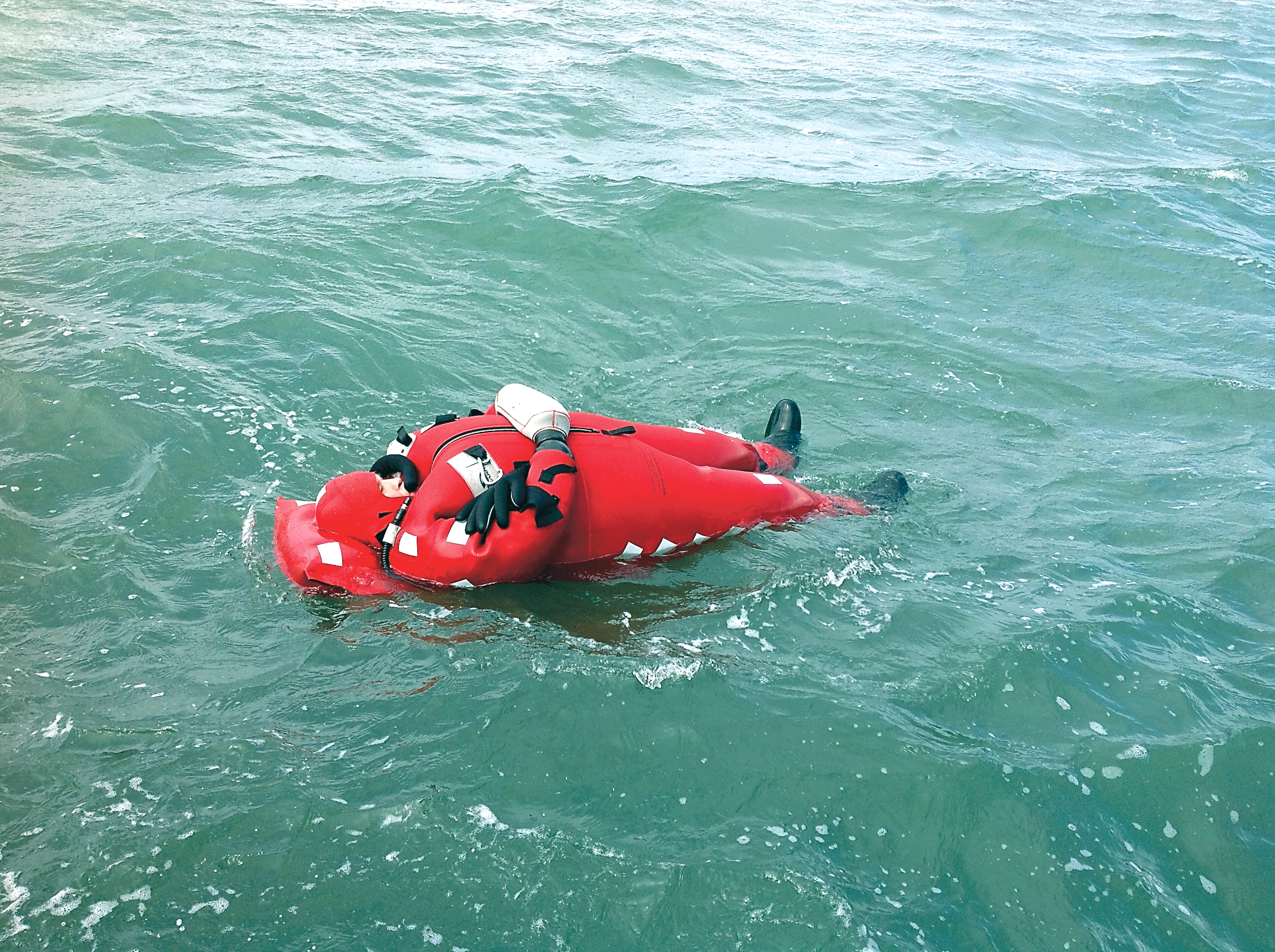
SEQUIM — The worst has happened: You are a commercial fisherman or private boater who has fallen off your vessel into the frigid waters of the north Pacific.
Sure, you are wearing a traditional immersion suit — a waterproof garment that staves off hypothermia and will keep you alive in the cold water for up to about six hours.
But now you have been in the drink for seven hours — well past the limit of most immersion suits — your rescuers are nowhere in sight and hypothermia has set in.
Generally, this means “game over” for people who find themselves in such situations, but a Sequim-area man has another idea.
Robert Duncan invented an award-winning immersion suit designed to keep those alone and stranded in cold water toasty and alive for more than 24 hours.
The suit — Thermashield 24+ — “keeps people alive for days, not hours,” said Duncan, whose business partner, Sequim-area resident Robert Groff, is in charge of marketing.
“Our suit does some amazing things as far as keeping people alive in cold water,” Duncan said.
“Any suit on the market today, beside ours, will only keep a person alive for between six to eight hours in 32-degree water.”
Without a suit, a person who is immersed into freezing water will lose consciousness in less than 15 minutes and die of hypothermia — presuming the person doesn’t drown first — within 45 minutes, according to the U.S. Search and Rescue Task Force.
Wearing a Thermashield 24+ suit dramatically increases survivability, Duncan said.
“We have independently tested our suit with human subjects out to 24 hours in 32-degree water with just a slight core temperature drop,” he said.
“This has the potential to save a lot of lives.”
The suits cost about $1,500 each.
Immersion suits of the appropriate size and fit for each person on a commercial vessel are required by law in portions of the ocean above 32 degrees latitude — which runs through Baja California just south of San Diego.
The further north, the colder the water, so the more important a suit becomes.
Any water 70 degrees or cooler is considered “cold” by the search-and-rescue task force.
Duncan has been lauded by the mariner industry for his invention, recently receiving the Samuel Plimsoll Award for Innovation presented by Professional Mariner magazine of Connecticut.
“That is a big deal for us here in the U.S.,” Duncan said.
“But something we think is even bigger: We have been selected as a finalist in the ‘Safety at Sea’ category for the SeaTrade Awards.
“This represents the World Cup of marine safety awards. We find out if we win May 6 in London. We are honored just to be a finalist.”
But the desire to save lives, not win awards, is what led Duncan to an epiphany while vacationing in Hawaii in December 2001, he said.
Air is exhaled from human lungs at about 88 degrees. Duncan theorized the air could be trapped and circulated through a series of vents wrapped around a person’s body to keep the person warm while floating in cold water.
After returning to his former home in Anchorage, Alaska, Duncan bought a pair of chest waders and cut off a piece of old hose, which he stuffed down into one of the boots.
“Then I asked my daughter, Clara, to bury me in the snow,” he said.
“I endured the bone-chilling cold for seven minutes, and then I started to breathe into the hose that was running down my left leg to my heel.
“After 20 minutes, my entire left leg was warm. The rest of my body was terribly cold.
“The remarkable results of this simple experiment inspired me to continue.”
Fourteen years later, Duncan perfected the technology, which has been certified by the U.S. Coast Guard and is now being manufactured by the Stearns company, based in Golden, Colo.
So how does it work?
“You have a snorkel mouthpiece, and what you are doing is recapturing the air” that would normally be expelled back into the atmosphere, Groff explained.
“We basically channel that air down into the suit.
“It took us a long time to figure out a bladder system to make sure we could make sure the air [was] being channeled correctly,” Duncan said.
“It exits down at the feet into the rest of the suit, so we do create this cocoon-like thing of 78-degree air.”
The suit is also unique in that it allows the user to perform delicate tasks with ungloved hands, which can be warmed in a built-in cuff.
According to the Coast Guard, immersion suits are designed for “abandon ship” situations and “are extremely awkward to work in.”
“If you have seen a regular immersion suit, a lot of them are three-fingered suits,” Groff said.
“It is all one piece, so guys don’t put them on because guess what? They can’t try and save the boat or the ship. Some can’t even get the door open.
“So this allows you to have your hands free but still warm.”
The business duo had initially hoped to manufacture the suits near their homes in Clallam County, but the cost of manufacturing them on a large scale was beyond their means, Groff said.
Stearns, owned by Coleman, “was a good fit for us,” he said.
“We own the patent, and we gave them the rights to put our system in one of their suits and worked with them.”
“We are excited,” Groff said, noting that the suit has also been certified for use in Europe and Canada. “It is good to go worldwide.”
For more information about the suit, go online to www.latitude98.com.
________
Sequim-Dungeness Valley Editor Chris McDaniel can be reached at 360-681-2390, ext. 5052, or at cmcdaniel@peninsuladailynews.com.
