
By Matthew Nash
Olympic Peninsula News Group
SEQUIM — Stopping an oil spill could be as simple as the shake of a bottle and lighting a match thanks to some local scientists.
A team with the Pacific Northwest National Laboratory near Sequim, sponsored by the Department of the Interior’s Bureau of Safety and Environmental Enforcement, continues to fine-tune a product that pulls and holds an oil spill together so it can burn, specifically in low temperature areas such as the Arctic. Two scientists in the Richland facility are working with them.
George Bonheyo, senior research scientist for the laboratory and a research professor of biotechnology for Washington State University in Pullman, leads the team and said the product could be a year away from going to market and made available to agencies such as the U.S. Coast Guard.
“There’s eventually going to be an accident whether [the U.S.] drills or not,” Bonheyo said.
Robert Jeters, project manager for the product, called an aggregator, concurs.
“There’s a vast amount of oil in the Arctic, and more countries are drilling there as ice sheets shrink,” Jeters said. “This project will help agencies mitigate spills in the future.”
The aggregator is a wood flour — fine dust from wood processing — modified by chemists who attach oil-attracting chemicals to the surface, Bonheyo said.
It’s all-natural, renewable and non-toxic, he said, adding that it repels water, prevents ice formation and works in high winds.
One methodology for burning oil in water involves spraying chemicals to create an oil slick to make it easier to burn, but the oil needs to be at least 3 millimeters thick and in low wind and the chemical, which contains toxins, diffuses quicker, Bonheyo said.
In icy conditions, he said, skimmers and oil booms don’t work as well either.
The laboratory’s wood aggregator acts like a candle wick, continuing to draw the oil up to the surface, with scientists’ objective to burn and remove at least 90 percent of the oil, Bonheyo said.
Response crews can pick up any residual oil and/or it can break down over time.
“[The aggregator] promotes microbial growth to help break it down,” Bonheyo said. “It can remain on the water for up to four months and sunlight, oxygen and micro-organisms will help break down the oil.”
Jeters said they continue to seek the best ratios of aggregator to oil.
In studies, scientists use pre-weighed pads to collect residue and they weigh each pad to see how much residue was left.
The water is pumped through activated charcoal to remove any residual hydrocarbons as part of a cleanup process so the water is pure seawater, Bonheyo said.
“It’s part of the reason Sequim is unique is because we make sure experiments don’t impact the environment,” he said.
In October, scientists performed large-scale tests of the aggregator at the Joint Marine Test Facility in Mobile, Ala. It and Sequim are one of four labs in the nation where oil burn experiments at this level are done, Bonheyo said.
In Mobile, researchers burned about 1.5 gallons of crude oil with aggregator attached to measure surface area.
Jeters said the tests gave them good ratios for the product-to-oil ratio after they measured the burn efficiencies.
But they’ll continue to test those ratios along with efficiency in different environments and the best strategies for applying the material.
Back in Sequim, scientists will continue to study the oil in icy conditions, whereas in Alabama, it’s too warm to replicate Arctic conditions, Bonheyo said.
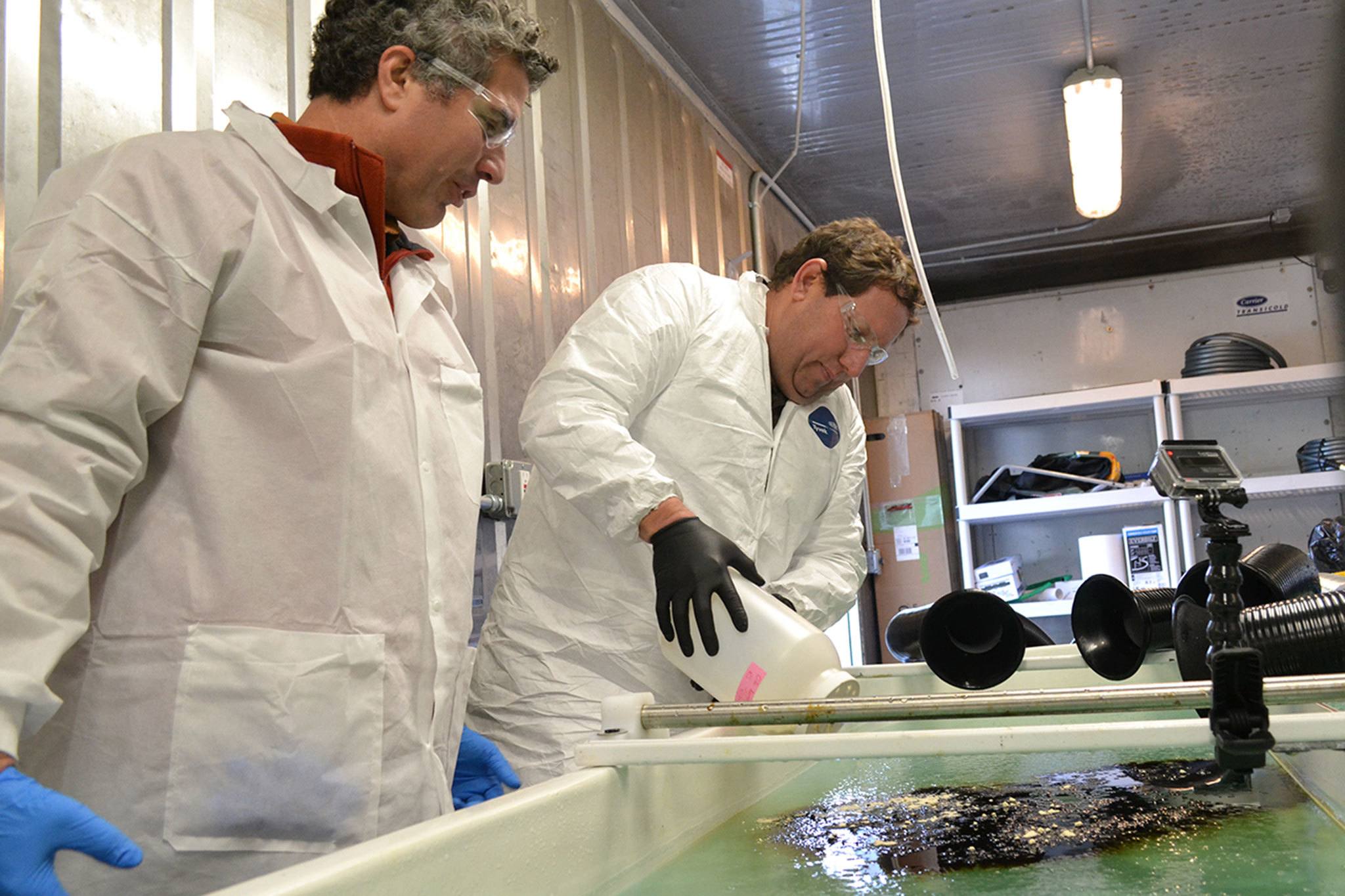
They use a 320-square-foot freezer laboratory that can go as low as minus 15 degrees Celsius.
In the coming months, Jeters said, scientists will do more analysis of the aggregator’s efficiency and laboratory staff will work through the intellectual property rights to the product.
“If patented, it will be licensed out to a company that will use it in the real world,” Bonheyo said.
“Our role as scientists is to develop the technology and transfer to others to turn into a commercial product.”
Agencies such as the federal Environmental Protection Agency will evaluate the product’s environmental and human safety impact and give recommendations before it is approved.
Ideally, the aggregator would go to shipping containers with oil response kits in critical harbors in the U.S., Bonheyo said.
One of the focuses of the laboratory has been on studying oil spills and their effects since the 1960s, but Bonheyo said they’ve shifted throughout the years to focus more on cleanup methodologies.
He said the push for the aggregator was to find a technology that burns oil as effectively as the Deepwater Horizon oil spill in 2010 in the Gulf of Mexico that saw 210 million gallons discharged.
So far, Bonheyo said, the aggregator project has received a lot of attention.
“It’s exciting to bring things into real-world application,” he said. “It makes you feel good.”
He also feels a sense of pride for doing a large portion of the research in Sequim.
The Pacific Northwest National Laboratory is owned by the U.S. Department of Energy and operated by Battelle.
The laboratory’s ability to burn for experiments has been approved by the Olympic Region Clean Air Agency, Bonheyo said.
For more information on this research and others, visit www.pnnl.gov.
________
Matthew Nash is a reporter with the Olympic Peninsula News Group, which is composed of Sound Publishing newspapers Peninsula Daily News, Sequim Gazette and Forks Forum. Reach him at mnash@sequimgazette.com.
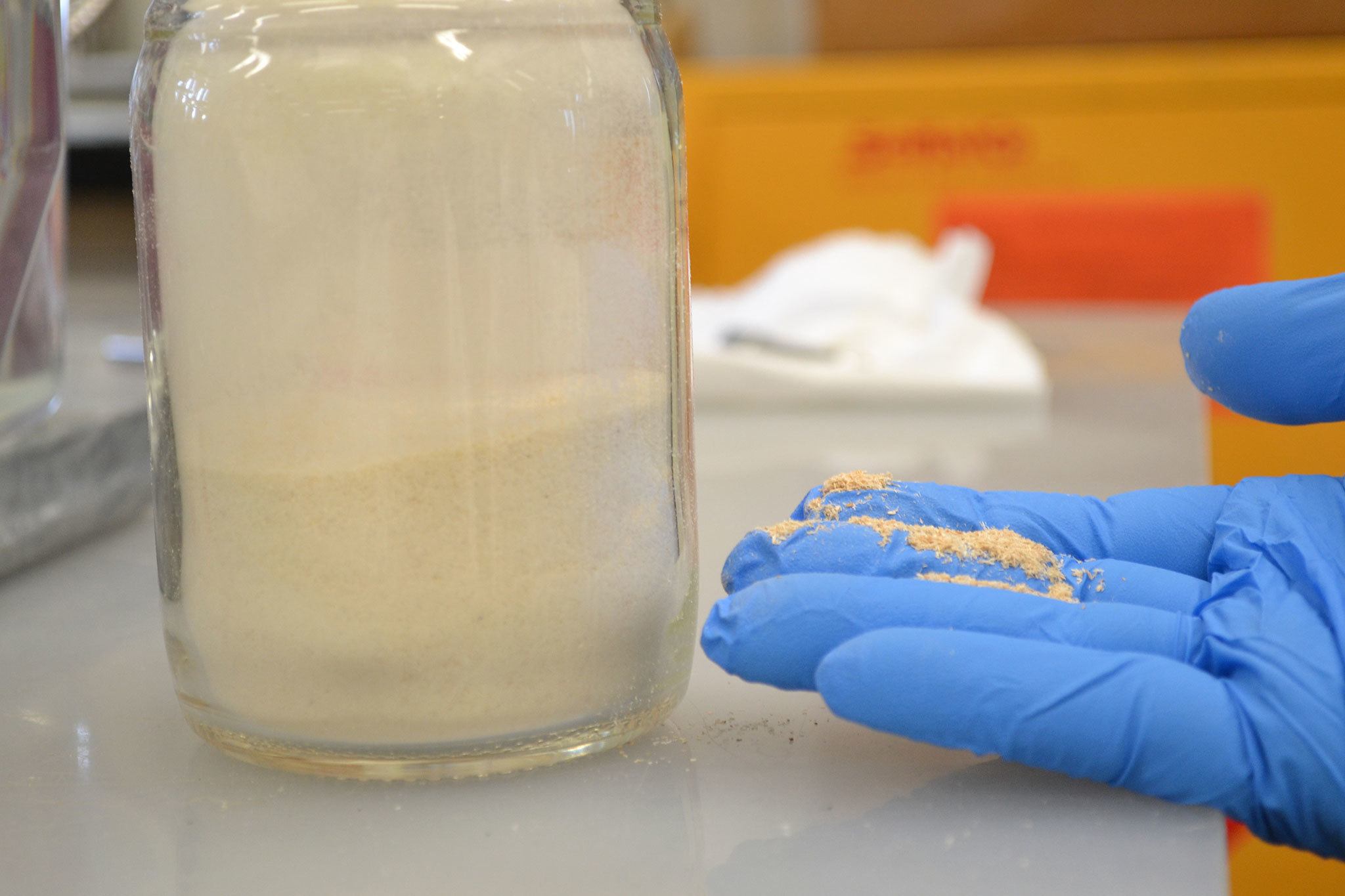
This wood flour is fine dust from wood processing that chemists modified to attract oil, repel water and prevent freezing so it can more effectively help burn oil in icy conditions. (Matthew Nash/Olympic Peninsula News Group)
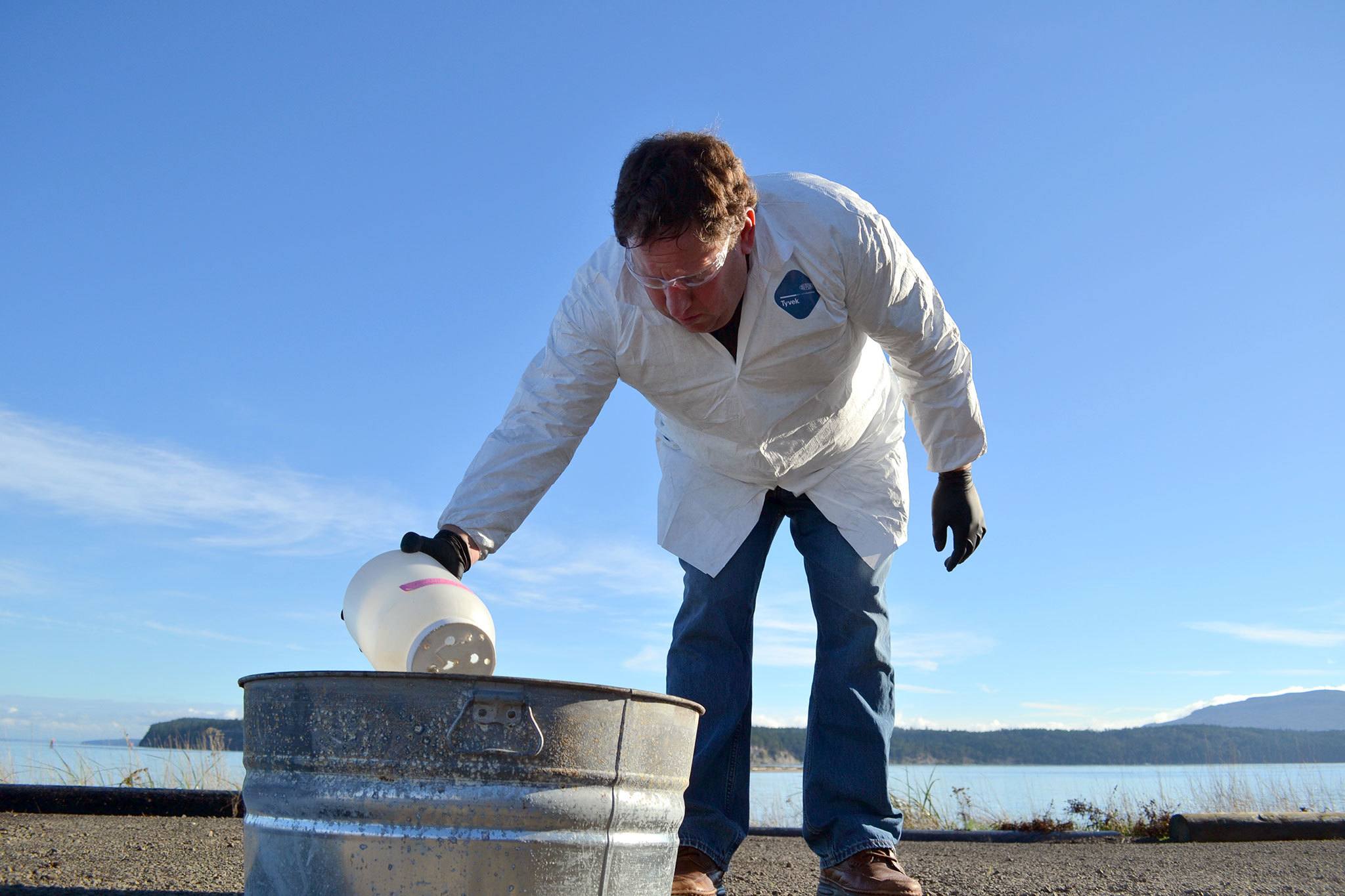
Scientist Robert Jeters, project manager for the Pacific Northwest National Laboratory’s aggregator product, applies the product to an oil slick to gauge how much of it is needed to effectively burn the oil out of the water. (Matthew Nash/Olympic Peninsula News Group)
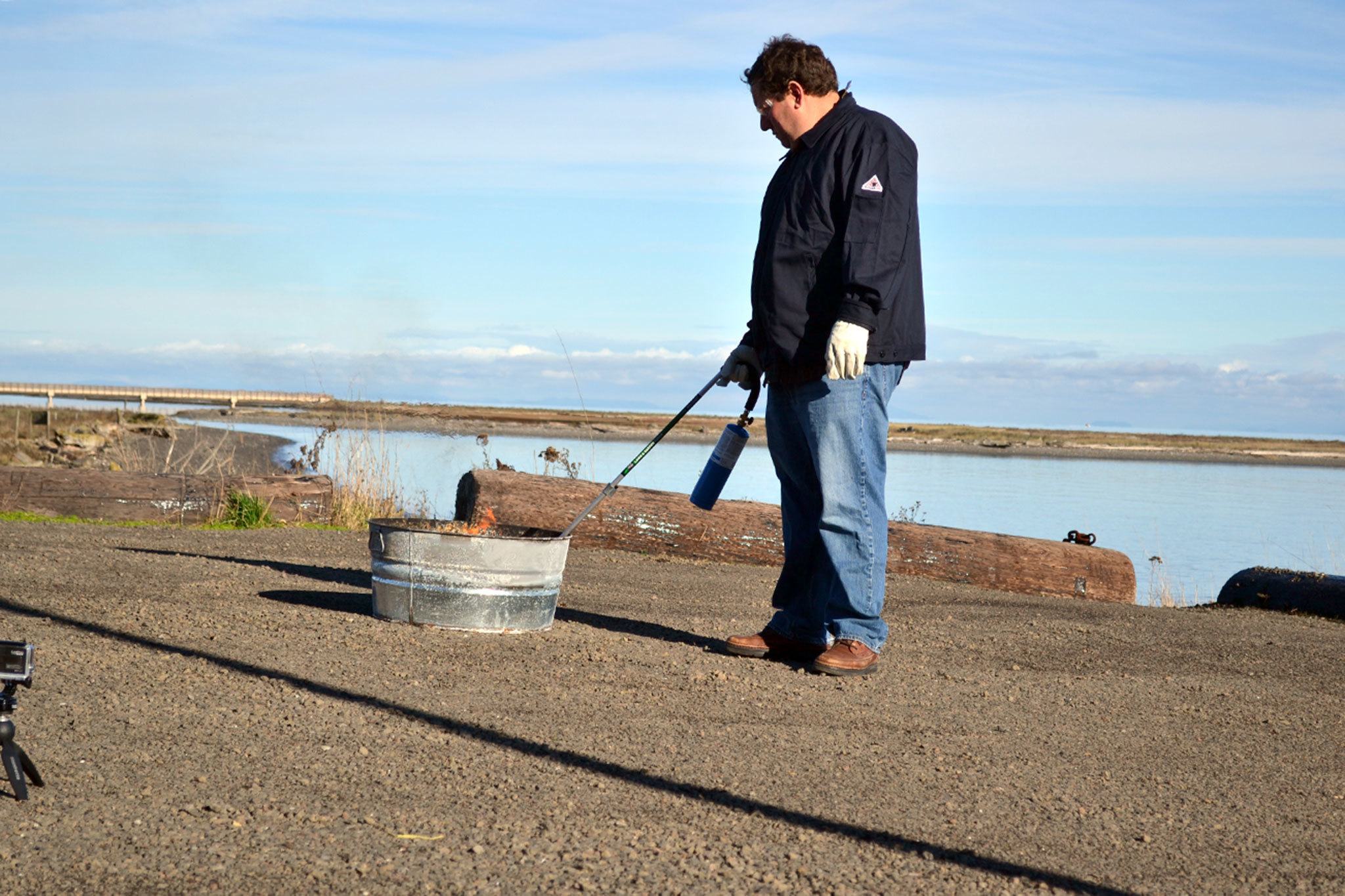
Scientist Robert Jeters, project manager for the Pacific Northwest National Laboratory’s aggregator product, uses a propane burner to light an oil slick on fire during a recent demonstration. (Matthew Nash/Olympic Peninsula News Group)
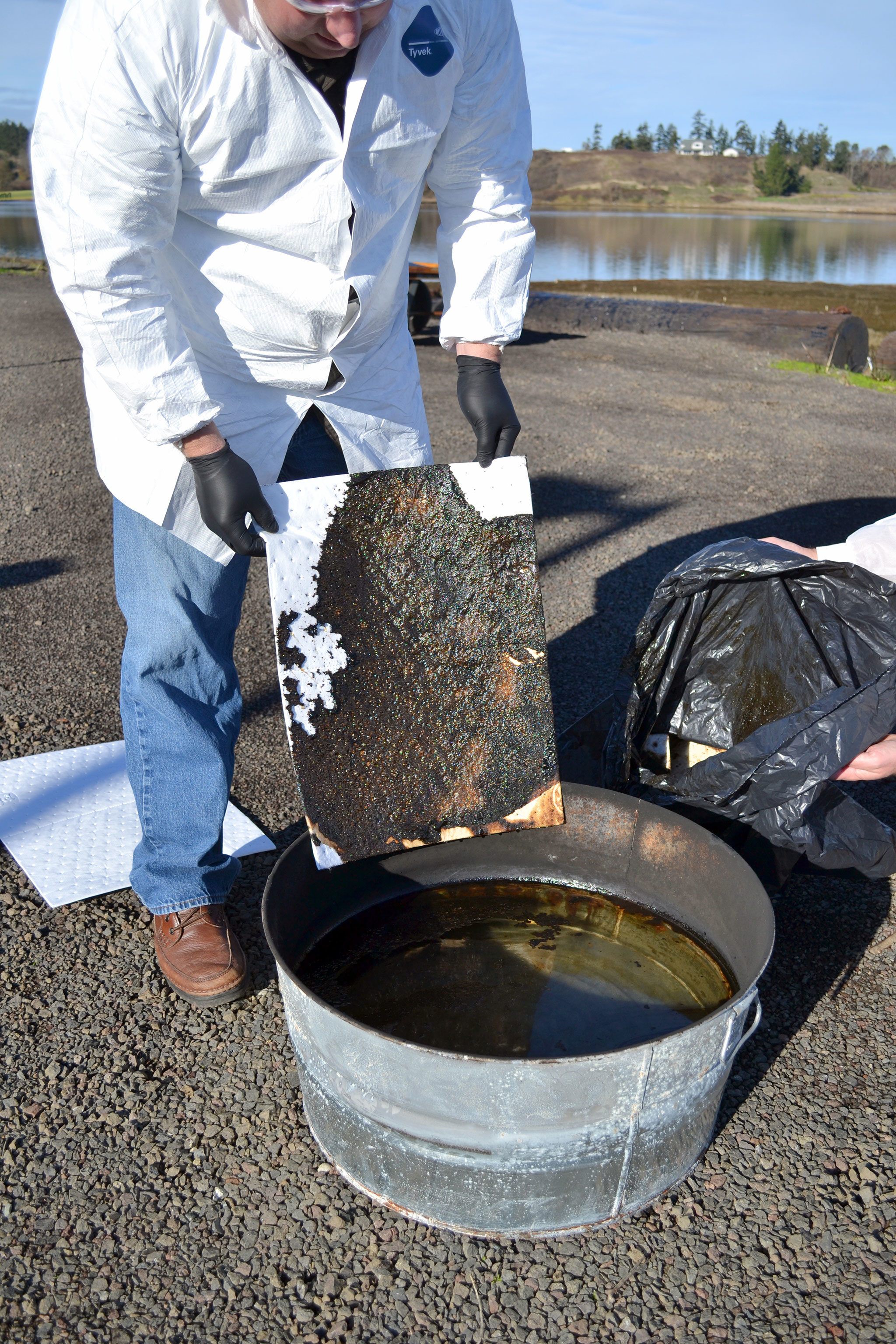
These absorbent pads measure how much oil is left over after it’s burned using a wood product scientists created with wood shavings. Their goal is to burn at least 90 percent of the oil of the water. (Matthew Nash/Olympic Peninsula News Group)
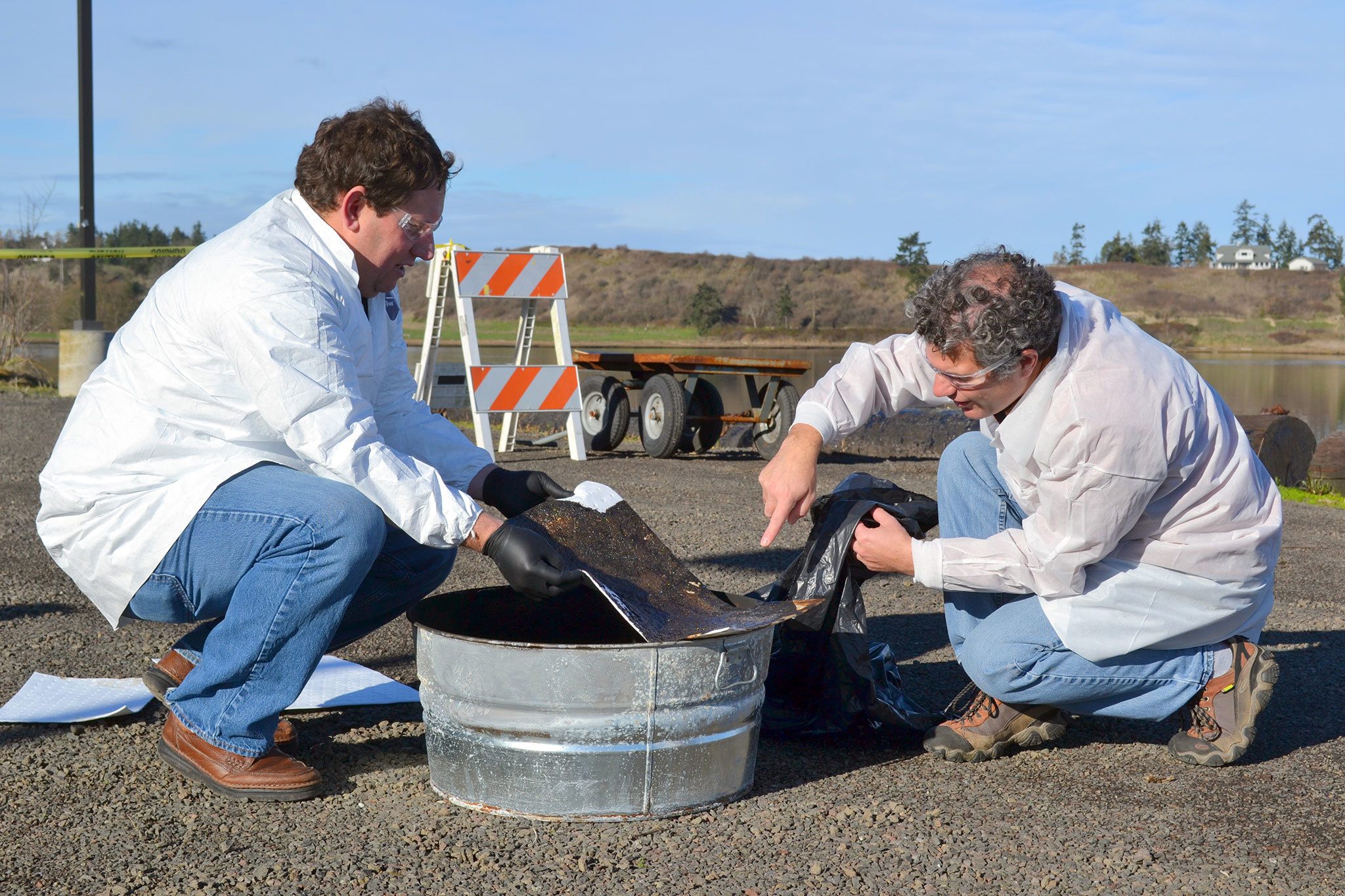
Scientists Robert Jeters and George Bonheyo with the Pacific Northwest National Laboratory in Sequim investigate an absorbent pad to see how much oil is left over after it was burned using an aggregator product to promote burning. (Matthew Nash/Olympic Peninsula News Group)
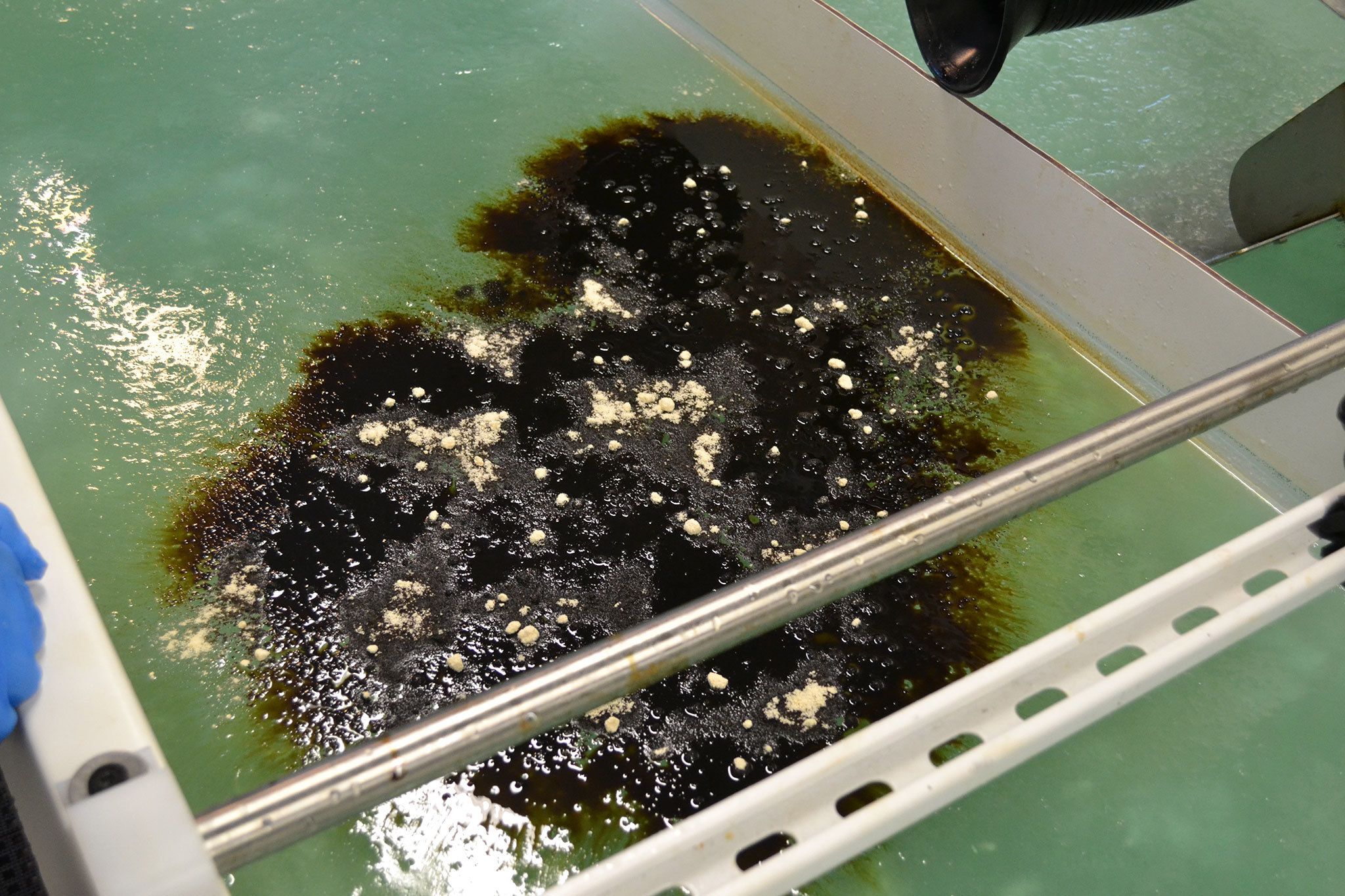
Inside a freezer laboratory at Pacific Northwest National Laboratory, scientists examine a wood product that draws oil slick together in icy conditions for more efficient burns for oil spill situations. (Matthew Nash/Olympic Peninsula News Group)
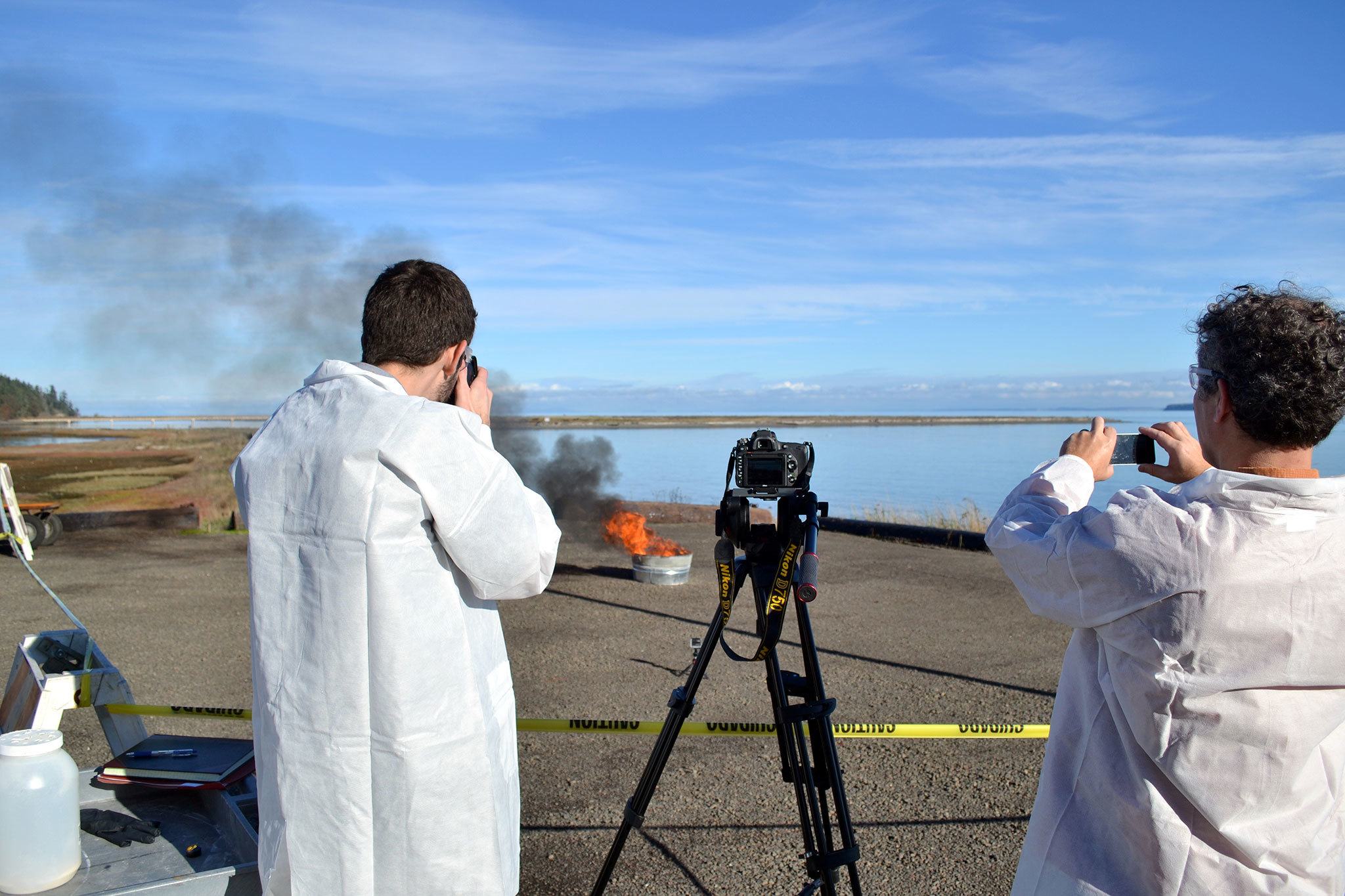
Staff with the Pacific Northwest National Laboratory watch an oil slick burn during a demonstration of how an aggregator wood product helps burn oil more efficiently in cold conditions. (Matthew Nash/Olympic Peninsula News Group)
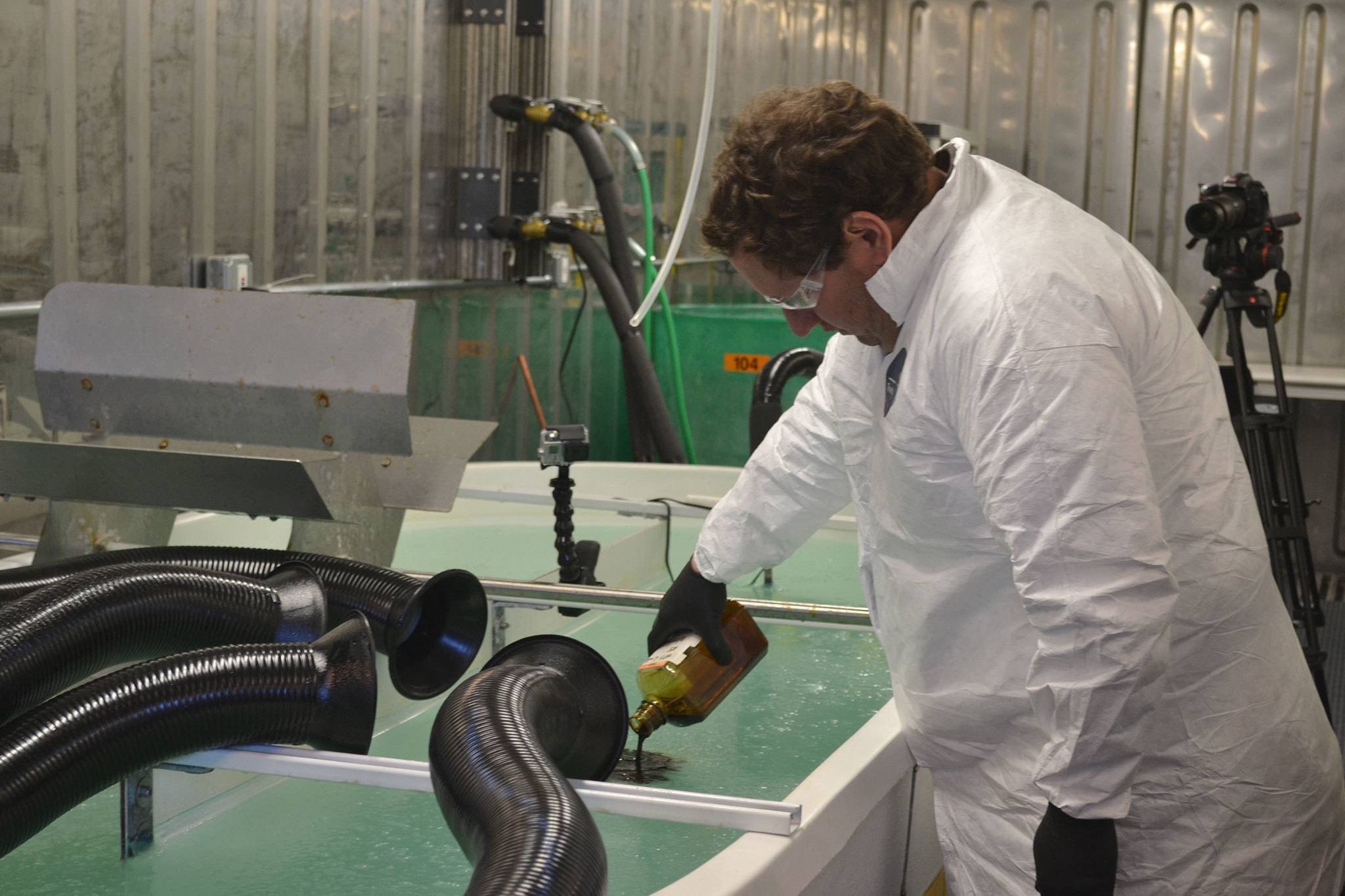
Scientist Robert Jeters places crude oil in the freezer laboratory prior to shaking aggregator wood product over the top that helps bring the oil together for a more efficient burn. (Matthew Nash/Olympic Peninsula News Group)
