
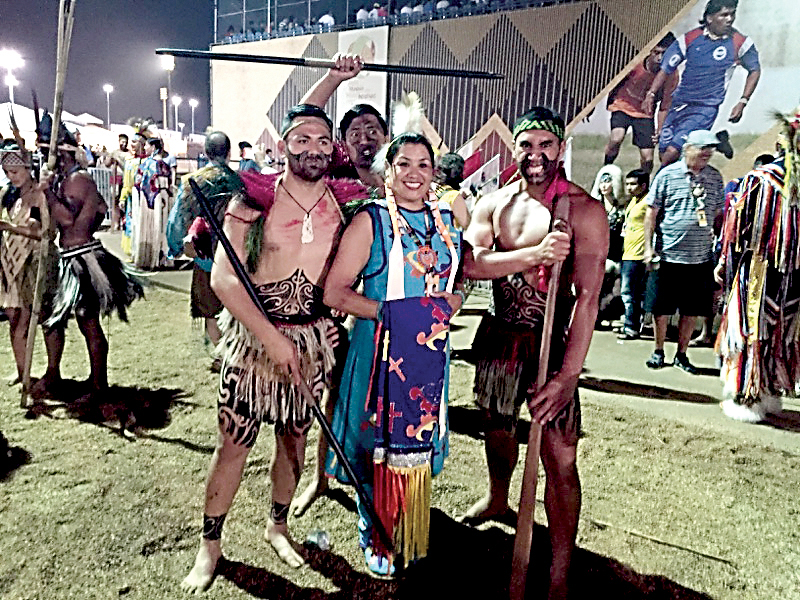
SEQUIM — A Sequim fitness instructor has found herself in the center of two global events — the international climate talks and the World Indigenous Games.
Today, Shelley Haupt, 51, is traveling to Paris to observe the United Nations 21st Conference of the Parties, a meeting that began Monday among world leaders and which is intended to set new greenhouse gas emission standards to slow climate change.
She is going as a representative of the Indigenous Environmental Network to observe, work with other indigenous people attending the conference and to report back the results of the talks.
Haupt was also the athletic director and an athlete for the U.S. contingent in the 2015 World Indigenous Games, held Oct. 23 to Nov. 1. in Palmas, Tocantins, Brazil.
While it may not seem obvious to connect the two events, they are closely related, she said.
Indigenous people are culturally and politically tied to their lands, and the nature of those lands leads to what athletic activities and lifestyles become traditional to each people, she said.
It’s unlikely the forest-dwelling, seagoing Makah need people who can speed across deep sand in a 100-yard-dash, she explained, while a tribe from inland grasslands or sand dunes has little use for war canoes.
Haupt said that, despite the differences between their lifestyles, they are united in many ways, including effects of climate change.
The games brought them together in the spirit of that brotherhood, and for a friendly competition in the activities that help their people to survive in their natural climates, she said.
October’s games selected traditional athletic activities shared by many cultures — archery, spear throwing, canoe racing, spear tossing, wrestling, swimming and foot races, plus demonstrations of sports unique to one or a few cultures.
The one modern sport that was included was soccer, which was determined to be universal enough for all to field teams, Haupt said.
Brazil has held indigenous games for the country’s tribes for more than two decades, and founders of the games had wanted to expand the games to all indigenous people of the world — anyone whose distant ancestors come from the lands where they live today.
“Brazil was in the making for 30 years. These people did it, they set the tone,” Haupt said.
Organization for the games included efforts from the United Nations, the Brazil Ministry of Sports, and state and local officials, she said.
The 2015 games included entries from indigenous people from 22 countries in North America, South America, Asia, Europe and Africa and Oceania.
Except in soccer, most of the teams competed barefoot and in traditional dress, and wore traditional ceremonial regalia for ceremonies and for nightly drum circles and dance demonstrations.
“It was like I was living in a National Geographic magazine,” she said of the wide variety, which she said ranged from a Russian in furs to some tribes who wore little more than paint and briefs.
All of the equipment had to be traditionally made — no metal spear tips, modern canoes, or composite arrows, she said.
The U.S. contingent included 16 athletes representing the Apache/Comanche, Crow, Hidatsa (North Dakota), Lummi, Navajo, Northern Cheyenne and Sault Saint Marie tribes.
Haupt is a member of the Sac and Fox Nation of Oklahoma and the Midwest.
“I was in a unique position, both as an athlete and behind the scenes with the thinkers and advisors,” she said.
She competed in the tug of war, in which the team won two rounds before losing several members and falling in the third round, she said.
None of the U.S. entries were successful in the athletic competitions, she said, but the Canadian women took first place in the soccer tournament.
Initially about 35 U.S. athletes wanted to attend, but only 16 were able to travel, due to a combination of a lack of funding and a lack of time to prepare, Haupt said.
An early misunderstanding of the nature of the invitation to the games resulted in few U.S. native athletes learning of the games, and many of those who traveled weren’t actually athletes, but joined the trip as a cultural exchange, she said.
Now that the U.S. tribes and nations understand the nature of the games and have two years to prepare, the U.S. contingent will be ready to represent with their best athletes in 2017, she said.
The Muskogee/Creek bowmen, the Pacific Northwest nations’ war canoe pullers, and other elite Native American athletes who have their own networks of athletic events, including Olympians, will have the opportunity to compare their traditional skills with members of other people around the world.
Instead of competing as a combined U.S. contingent, each Native American nation may decide to compete under their own name, she said.
Haupt said when the 24 Brazilian tribes entered the arenas, they competed as tribes, rather than as a single Brazilian entry.
She said that while the competition between athletes was fierce, the tone was one of people with similar goals and challenges coming together.
“There was love on the field,” she said.
Canada, which also has held national indigenous games since 1971, will host the second World Indigenous Games in Toronto, Ontario, in 2017.
Russia and New Zealand contingents have spoken up with a desire to host a future games, Haupt said.
Haupt said a meeting of the participants at the Brazil games determined the games will be held every two years.
“We want to keep the momentum going,” she said.
________
Reporter Arwyn Rice can be reached at 360-452-2345, ext. 5070, or at arice@peninsuladailynews.com.
