
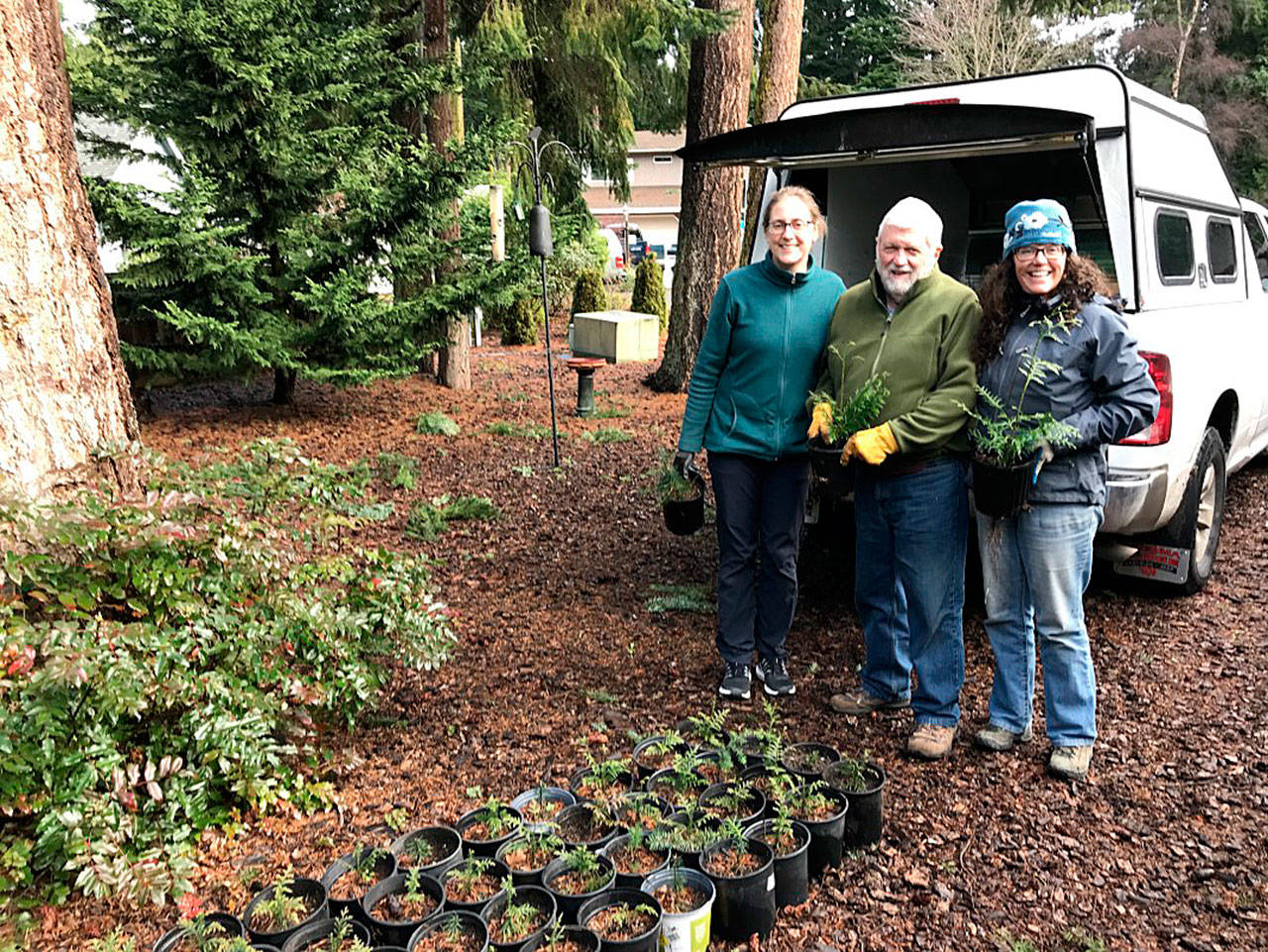
SEQUIM — A Sequim couple’s green-thumbed community contributions are coming to a close, but their legacy of giving can be found along riverbanks, floodplains and streams across the North Olympic Peninsula.
After more than a decade of harvesting, growing and donating thousands of potted seedlings of Douglas Fir, Cedar, Noble and Hemlock trees to the Lower Elwha Tribe for river restoration efforts, Bruce and Pam Busch are “retiring” their project this May.
The Busches are headed for warmer climes in Arizona this month.
“We can’t handle the cold here,” Bruce said.
The project began, Bruce recalled, when he was volunteering for a park system-funded nursery and heard about people doing stream restoration.
The Busches noticed a number of seedling cropping up on their quarter-acre property off Towne Road.
“I was pulling them up and I had no place to put them,” Bruce remembered.
Each year, he’d pull a couple of hundred seedlings, put them in a pot and look after them for a year or two, then donate them to the Lower Elwha Tribe for their restoration efforts.
In 2021, the couple delivered more than 3,000 plants. This year’s haul brought the 1- year total to more than 12,000 seedlings for the restoration projects on the Dungeness, Elwha, Pysht and other North Olympic Peninsula rivers.
“This (kind of donation) is definitely uncommon; they are such giving, unique, wonderful people,” said Allyce Miller, a natural resource technician from Lower Elwha Klallam Tribe’s revegetation team. “Lots of gratitude to them.”
Tending to trees
Bruce Busch said his background in soils came early: “I was a grunt for my mother’s gardens. I learned soil preparation by ‘dig and turn, dig and turn.’”
He’d raised dahlias and marigolds and read a bit about Douglas firs, but noted things grown on the property “in spite of” his efforts, not because of them.
The only crop that grows better on the Busches’ property, Bruce joked, are the weeds.
“We’re surrounded by Douglas fir,” he said, while the cedar seedlings blow in from the neighbors’ yard.
“Occasionally we get a hemlock; where it comes from, we haven’t a clue,” he said.
The Busches find the young trees and mark them with small flags to track their growth. To foster care for the seedlings, Bruce makes up a soil mixture with earth, fertilizer and compost mix, stir it up, and then fill up dozens of pots about a quarter full.
Then he’d dig up the scattered seedlings from the front — so commonplace on the property that a shovelful could brings in 20-30 individuals — and place them in 1-gallon pots, about 600-800 of them at a given time, in the backyard.
While Bruce funds the fertilizer and compost mix, he’s received donations of pots over the years from the former McComb Nursery, Dungeness Nursery, Airport Garden Center, Around Again, Ivan Hueter and Jim and Anne Robbins.
At one point he had to stop, Bruce noted, as the Lower Elwha Tribe didn’t have enough room for all of them.
During summer months, the Busches would water the seedlings every 10-15 days or so and twice a year pull weeds from the pots.
After one or two years, they’d be ready to donate, Bruce said, and were normally picked up in January or February.
“They need to be 8-10 inches tall,” he said. “And they will do well — about 90 percent survival (rate).”
This most recent donation took the tribe’s watershed restoration crew members three or four trips to get all of the potted trees, he said.
These trees can live for 200 or 300 years, Bruce said; unless high winds or erosion takes them out, their place near rivers and streams usually makes for a long life.
The donations are a big help, Miller said, as the tribe’s program is reliant on grants and they sometimes supplement tree planting projects by buying from sources such as local nurseries and the National Park Service.
“A conifer could be $4 a tree so (the Busches’ donation) really has helped a lot,” Miller said.
Bruce said he hopes the legacy of donation trees will continue.
“I’m hoping people who bought this place are green-thumbers,” he said.
Bruce said he’ll miss the project but hopes he and Pam will get involved with a hospice organization in their new Arizona hometown.
“Yes, I’ll miss it, definitely. It fills the days, gets you out in the yard, gets (you) fresh air,” he said.
For more about the tribe’s river restoration efforts, see elwha.org/departments/river- restoration.
________
Michael Dashiell is the editor of the Sequim Gazette of the Olympic Peninsula News Group, which also is composed of other Sound Publishing newspapers Peninsula Daily News and Forks Forum. Reach him at editor@sequimgazette.com.
