
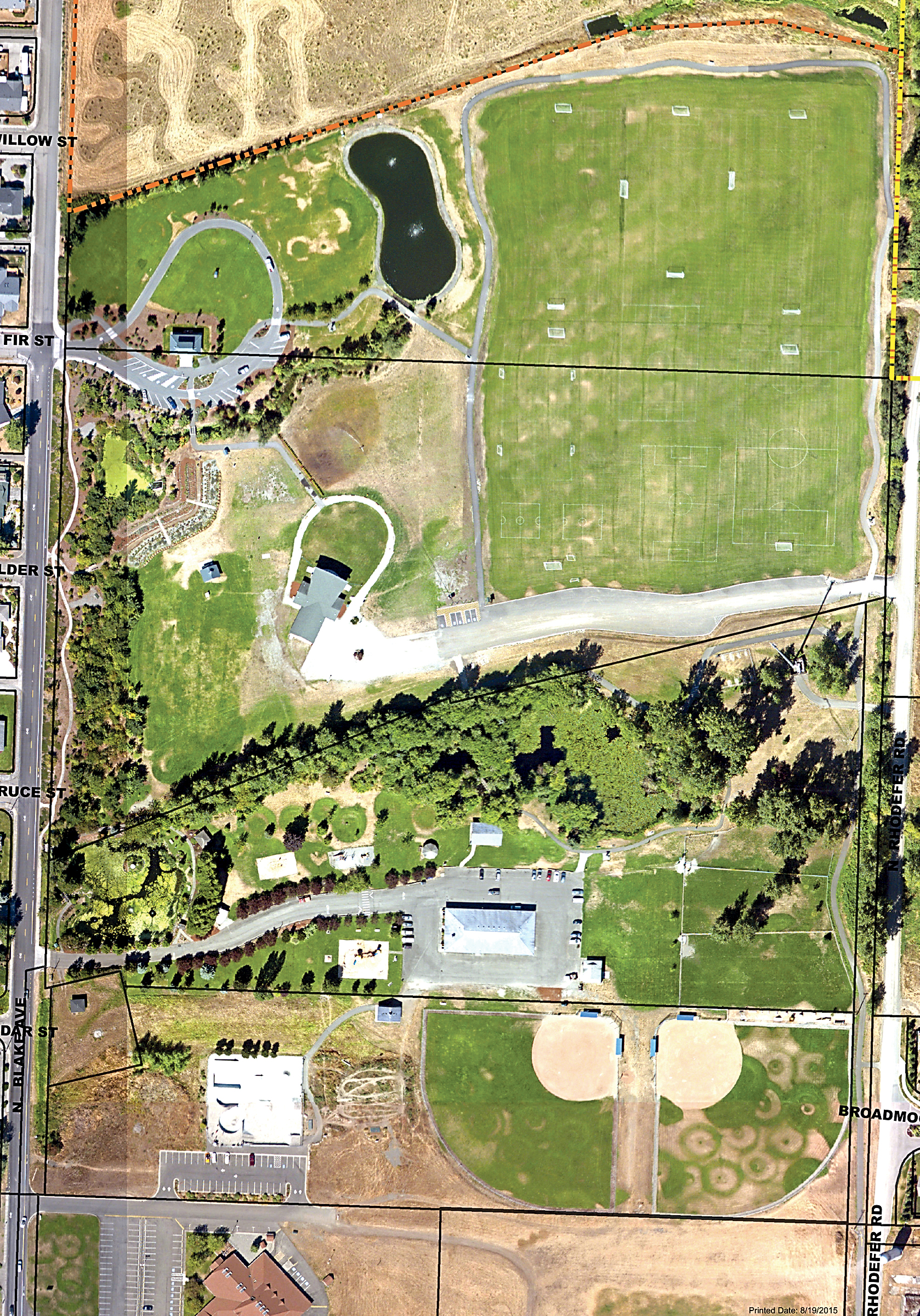
SEQUIM — The City Council has directed staff to work with Sequim Family Advocates to develop options for adding parking places for the Albert Haller Playfields on north Rhodefer Road.
The move came during a joint meeting with the City Council and Parks and Recreation Board on Monday evening at City Hall after months of public comments stating the existing parking areas servicing the playfields are unsafe and disorganized during public events.
“Obviously, we heard clear direction from council to go forth and figure this out,” City Manager Charlie Bush said after the meeting.
“We are taking a fresh look at it. We will look at all kinds of alternatives and options and come back to council with likely a recommendation off of that list.”
Bush didn’t know when the issue will go back to the council.
Historically, park development improvements in the city have taken place through mutual agreements between park enthusiasts and the city.
Over the past five years, the city and Sequim Family Advocates have worked together in this manner, resulting in the construction of 12 acres of playfields in Sequim’s Water Reuse Demonstration Park.
This achievement was made possible through $120,000 in local cash donations; a $102,500 grant from the Albert Haller Foundation; in-kind donations of equipment, professional labor and materials worth $200,000; and thousands of hours of volunteer labor.
But the playfields, which opened in 2012, lack adequate parking for users and other basic amenities, advocates say.
To remedy the situation, Sequim Family Advocates in May 2014 presented city staff, the city Parks and Recreation Board and the City Council with a site development proposal.
It called for the addition of a 1,350-square-foot restroom and storage facility, a 90-foot-diameter turnaround and 64 new parking spots in front of the James Center for Performing Arts, 29 parking spots on Rhodefer Road to the east of the fields and Olympic Discovery Trail improvements at the mouth of the driveway at Rhodefer Road.
While a portion of the improvements were approved in concept by the council July 14, 2014, none have been built.
Following the May 2014 meeting, Sequim Family Advocates received cost estimates for the 64 new parking spaces and determined that those estimates exceeded funding available from the Haller Foundation.
The organization modified its plans prior to the July 2014 council meeting and no longer proposed on-site parking as part of the improvements but began exploring the option of adding parking spaces along Rhodefer Road.
The City Council approved a motion to accept the development proposal, and construction was anticipated in the spring of this year, but on June 15, city staff received notice of a change in plans from Sequim Family Advocates that included a proposal to construct 64 parking spaces around the James Center with gravel and to abandon efforts to place parking along Rhodefer Road.
During a June 30 special meeting with the Parks and Recreation Board, staff recommended denial of the proposal based on Sequim Municipal Code chapters 18.24 and 18.48.
“It was the gravel parking” that failed to meet city codes, which requires parking lots to be constructed of asphalt concrete, Portland (Ore.) cement concrete or low-impact development materials such as grass-pave material, said Joe Irvin, assistant to the city manager.
Grass-pave material is a porous mesh that allows grass to grow but prevents vehicles from compacting the vegetation or causing ruts in the soil.
During the July 27 council meeting, Dave Shreffler, president of Sequim Family Advocates, criticized the city’s stance on gravel parking and said the nonprofit organization had raised $164,000 to fund the gravel parking lot but had no choice but to return it to donors because of the board’s recommendation.
During Monday’s special meeting, Shreffler said he had a simple solution but that it would require additional funding from the city.
“The gravel parking lot that we would build for you is exactly what would have to go underneath a grassy-paver parking lot anyway,” he said.
As such, “we would be getting you 80 percent of the way there,” he continued.
“You just have to understand that our funding stream doesn’t allow us” to afford grass-pave material.
“It basically doubles the project cost [from] about a $200,000 project to a $450,000 project,” Shreffler said.
Councilman Ted Miller said he was concerned about the cost to the city.
“We have a plan, and basically the only reason it is not going to fruition is you just don’t feel you can raise enough money for it, so you are trying to get the city to bail you out,” he said.
He added that “over 80 percent” of the people using the playfieds “live outside the city limits and aren’t going to be paying a dime to the city for it.
“If we are going to be asked to contribute a substantial amount of money when most of the benefits goes to people outside the city limits, I would have to say I object to that.”
Councilman Erik Erichsen said he favored the project, pointing out that out-of-town guests of the fields shop and eat at Sequim establishments while in town, boosting the economy.
“The fact is that one of the things that makes this whole process attractive was the fact that we draw people from outside the city,” he said.
Councilwoman Laura DuBois said “the timing is probably very good” to provide funding for the project as part of the next annual budget being prepared by the city.
________
Sequim-Dungeness Valley Editor Chris McDaniel can be reached at 360-681-2390, ext. 5052, or cmcdaniel@peninsuladailynews.com.
