
By Phuong Le
The Associated Press
MOUNT RAINIER NATIONAL PARK — The elusive weasel-like mammal poked its head out of the wooden crate, glanced around and quickly darted into the thick forest of Mount Rainier National Park — returning to a landscape where it had been missing for seven decades.
One by one, 10 Pacific fishers that had been trapped in British Columbia were set free at the park south of Seattle as part of a multiyear effort,which began in Olympic National Park, to reintroduce the native species to its historic range.
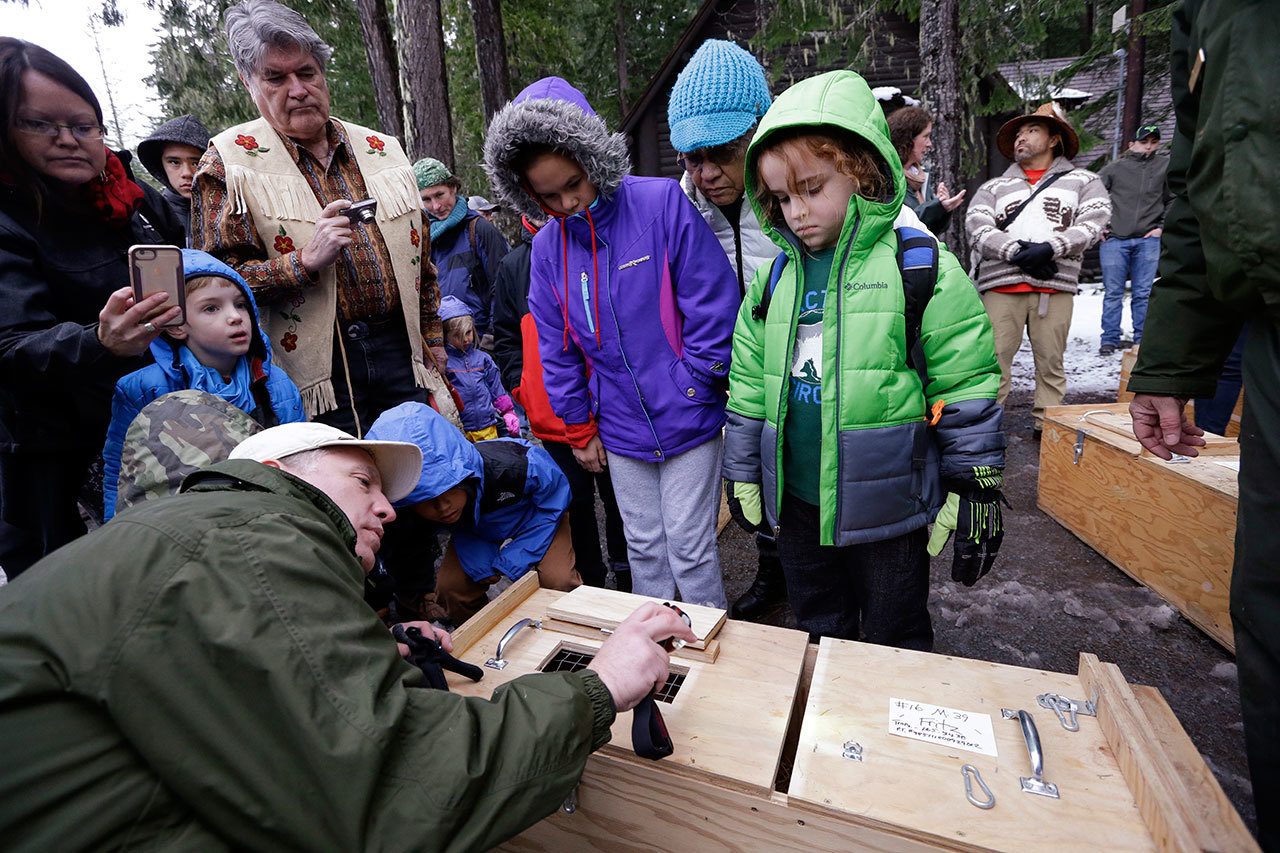
A large crowd gathered Friday to herald the return of the dark-brown member of the weasel family with its lush fur and bushy tail.
They cheered, clapped and hooted, and First Nations and American Indian tribal members sang and drummed, as each crate door was lifted and a fisher streaked out of sight across the snowy ground.
“We’re correcting something that we mismanaged a long time ago before we knew enough to manage wildlife populations,” said Jeffrey Lewis, a biologist with the state Department of Fish and Wildlife.
“Now we can fix that because we know how to. We know we’ve got a lot of habitat here. All we were missing were the fishers.”
The first fishers, about 90 in all, were reintroduced in Washington state in Olympic National Park starting in 2008. Those animals are reproducing and expanding the species’ geographic range.
The second phase of the project involves relocating fishers from British Columbia into the southwest Cascade Mountains and later into the North Cascades. The goal is to reintroduce 80 fishers to each region.
“We feel like we’re making headway and we’re getting good positive results. It’s too early to say that we’re establishing a self-sustaining population but it sure is looking positive,” Lewis said.
“These animals were here before us and so it’s our duty to take care of them,” Hanford McCloud, a Nisqually Indian Tribe council member, said during a ceremony before the fishers were released on park land designated for the tribe’s use.
Several First Nations people traveled with the fishers, some that were captured on First Nations land in British Columbia.
The recovery efforts, however, come as conservation groups have sued the U.S. Fish and Wildlife Service, alleging the federal agency failed to consider the best scientific evidence when it decided not to provide the fisher protections under the Endangered Species Act.
Fishers historically were found throughout much of the forested areas of the West Coast. But they declined in numbers due to trapping in the 1800s and early 1900s, and the loss of forest habitats.
By the mid-1900s they were eliminated from Washington state. The solitary animal, which hunts snowshoe hares, rodents and small mammals, were listed as state endangered species in 1998. They’re one of the few predators of porcupines and are found only in North America.
While common in the Northeast and Midwest, they’re rare in the Northwest. Population estimates of West Coast fishers today are anywhere from a couple hundred to a few thousand, mostly in southern Oregon and Northern California.
More recently, West Coast fishers have faced threats from illegal pesticide use by marijuana growers and other threats.
But they’re slowly making a comeback in Washington through reintroduction efforts involving WDFW, Conservation Northwest, the National Park Service and other partners.
Fish and Wildlife had proposed listing the forest-dwelling mammal as threatened in 2014 over concerns about logging practices, illegal pesticide use by marijuana growers and other threats.
In April, the agency acknowledged the creatures no longer occur in their historical ranges in Washington, Oregon and California but concluded they were not in danger of extinction.
The agency said the best available science showed current threats aren’t causing significant declines in West Coast populations. It also cited conservation measures such as reintroduction efforts in Washington.
“We’re heartened by reintroduction efforts, but they alone are not going to be sufficient to save the fishers,” said Tom Wheeler, Environmental Protection Information Center, one of the groups that sued.
He said the animals need greater federal protections because they still face ongoing threats.
Tara Chestnut, a Mount Rainier park ecologist, said the return of fishers to the Cascade Mountains will restore biodiversity to the ecosystem.
“But there’s also cultural significance,” she said. “Fishers are part of our natural history and our natural heritage. There are also spiritual aspects of their return that are really important.”

Elaine Thompson/The Associated Press A Pacific fisher takes off running after being released into a forest at Mount Rainier National Park.
