
By Gene Johnson
The Associated Press
SEATTLE — The endangered orcas of the Pacific Northwest live very different lives from orcas in captivity.
They swim up to 100 miles a day in pursuit of salmon, instead of being fed a steady diet of bait fish and multivitamins.
Their playful splashing awes and entertains kayakers and passengers on Washington state ferries instead of paying theme park customers.
But the captive orcas are nevertheless providing a boon to researchers urgently trying to save wild orcas in the Northwest.
SeaWorld, which displays orcas at its parks in California, Texas and Florida, has recently published data from thousands of routine blood tests of its orcas throughout two decades, revealing the most comprehensive picture yet of what a healthy orca looks like.
The information could guide how and whether scientists intervene to help sick or stranded orcas in the wild.
“For us, collecting blood from free-ranging killer whales is exceedingly difficult, so it’s something we would rarely ever do,” said Deborah Fauquier, a veterinary medical officer at the National Marine Fisheries Service.
“Having partners that are in the managed-care community that can provide us with blood values from those animals is very useful. It’s giving us a very robust baseline data set that we haven’t had previously for these whales.”
The round-up of orcas for theme-park display in the 1960s and ’70s was devastating for the Pacific Northwest’s Southern Resident orcas: At least 13 were killed and 45 kept to awe and entertain paying crowds around the world, according to the Center for Whale Research on Washington’s San Juan Island. Only one of those orcas survives: Lolita, at the Miami Seaquarium.
Washington state eventually sued SeaWorld to stop the hunts. Today, 17 of SeaWorld’s 20 whales were born in captivity, including some descended from orcas captured near Iceland; the company hasn’t collected a wild orca in more than 40 years.
Under public pressure, it ended its captive breeding program and is replacing trained orca shows with what it describes as “more educational experiences where guests can still enjoy and marvel at the majesty and power of the whales.”
It took decades for the Southern Resident orcas, which spend several months every summer and fall in the marine waters between Washington state and Canada, to recover from the hunts. By the mid-1990s, their population reached 98.
Half a century later, the orcas are struggling against different threats: pollution, vessel noise and, most seriously, starvation from a dearth of Chinook salmon, their preferred prey. There are just 75 left, and researchers have said they’re on the verge of extinction.
Gov. Jay Inslee has proposed $1.1 billion in spending to help the orcas, with much of the money going toward protecting and restoring salmon habitat. The National Marine Fisheries Service, also known as NOAA Fisheries, is planning to propose expanded habitat protections this year for the orcas’ foraging areas off the Washington, Oregon and California coasts.
SeaWorld also has boosted its efforts to help the Southern Resident orcas, pledging $10 million to the National Fish and Wildlife Foundation’s Killer Whale Research and Conservation Program.
“Our stance is to do research with our animals to try to help this population now, and that’s what we’re doing,” said Todd Robeck, SeaWorld’s vice president of conservation research. “That’s why I got into what I do — to try to help animals in the wild.”
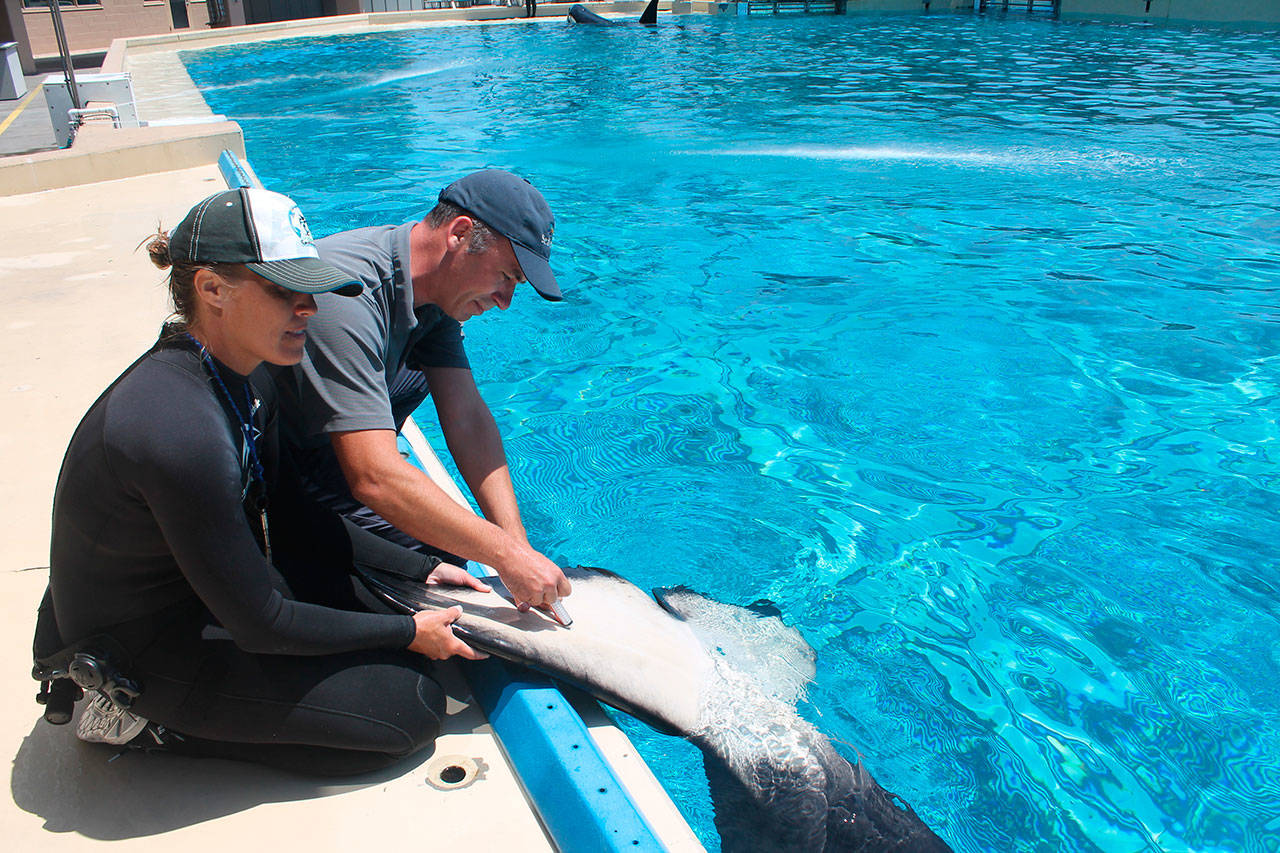
Robeck is one of the lead authors on the review of SeaWorld’s data, which included results of more than 2,800 blood tests on 32 whales from 1993 to 2013. Data from sick and pregnant whales were excluded to obtain a standard range for blood values, including cholesterol, platelet count, triglycerides and many other metrics. The whales were trained to present the underside of their tails for the blood draws, which were taken once or twice a month.
The results show that most of the values don’t differ much between male and female whales, but they do differ considerably with age and season, Robeck said. The study suggests that orcas lose some immune function as they age.
While there will be some difference between the values for captive and wild orcas due to differences in climate, diet and other factors, the research provides a template for understanding orcas, Robeck said.
Further, the values may be compared to data from blow samples or fecal samples to provide even greater insight, he said. Among the ongoing research projects at SeaWorld is studying the extent to which toxins that build up in the orcas due to pollution are transferred to calves from their mothers.
“It’s something that could only be done with our animals,” Robeck said. “It’s an example of how we are dedicated to participating in the well-being of killer whales in the Pacific Northwest and around the world, and how research with our animals is vital in answering some of these questions about how to address the needs of the animals in the wild.”
