
The Associated Press and Peninsula Daily News
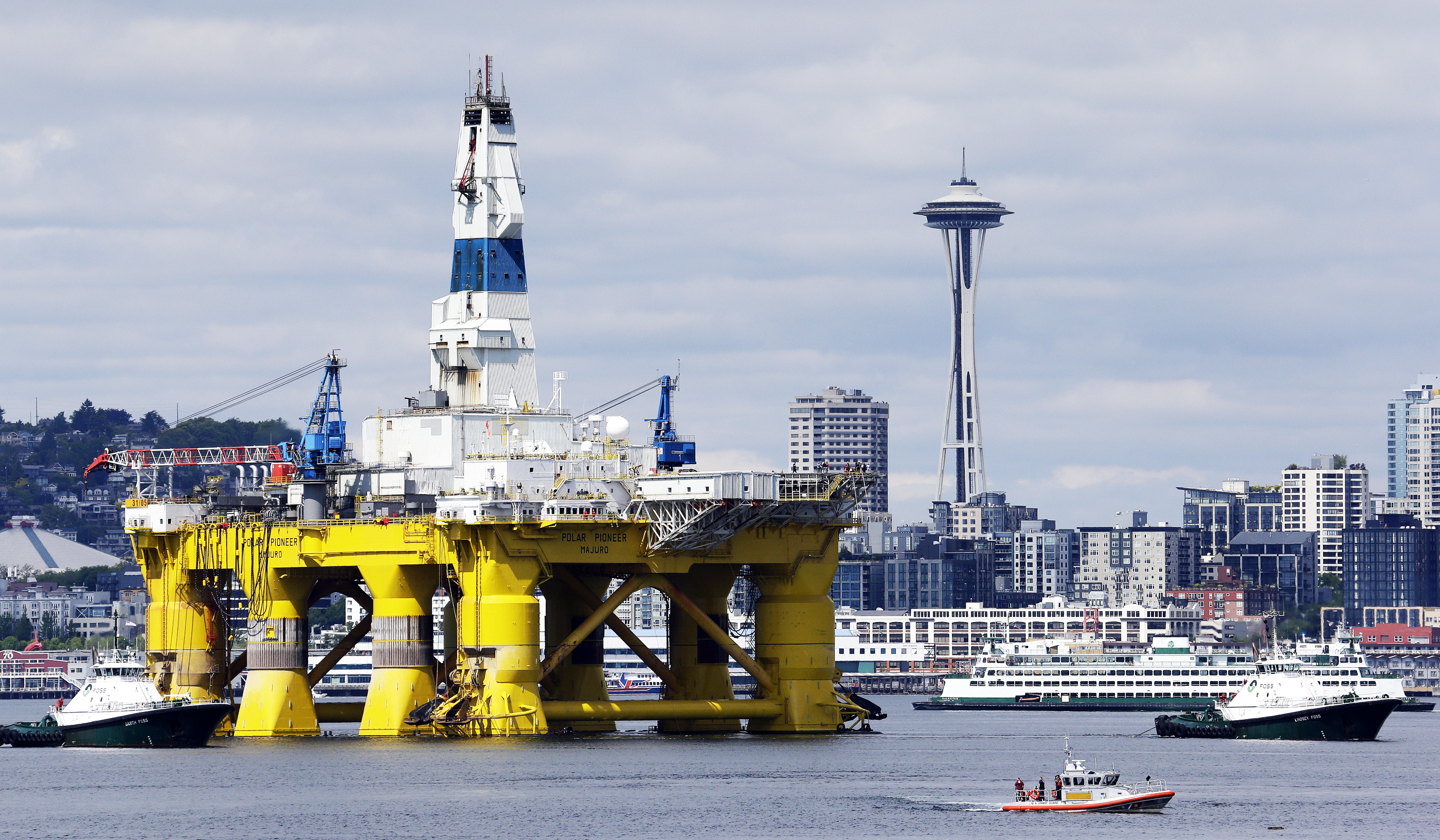
SEATTLE — The arrival in Seattle on Thursday of an oil rig Royal Dutch Shell is outfitting for oil exploration in the remote Arctic Ocean marks a pivotal moment for an environmental movement increasingly mobilized around climate change.
Activists paddling out in kayaks to meet the rig off Seattle’s picturesque waterfront said it’s their moment to stand against opening a new frontier of fossil fuel exploration.
“Unless people get out there and put themselves on the front lines and say enough is enough, then nothing will ever change,” said Jordan Van Voast, 55, an acupuncturist who was going out on the water to confront the Polar Pioneer.
“I’m hopeful that people are waking up.”
Polar Pioneer, a 355-foot-tall oil rig owned by Transocean Ltd., had been anchored in Port Angeles since April 17.
It was towed out of the harbor by tugboats shortly before 2 a.m. Thursday.
A few people were in tiny plastic boats in Seattle, dwarfed by the 400-foot-long oil rig soaring above them.
The image suggests how outmatched Shell’s opponents have been as they try to keep the petroleum giant from continuing its $6 billion effort to open new oil and gas reserves in one of the world’s most dangerous maritime environments.
But environmental groups in the Pacific Northwest are sensing a shift in the politics that surround energy production and have mobilized against a series of projects that would transform the region into a gateway for crude oil and coal exports to Asia.
“These proposals have woken a sleeping giant in the Northwest,” said Eric de Place, policy director for Sightline Institute, a liberal Seattle think tank.
“It has unleashed this very robust opposition movement.”
Shell still needs other permits from state and federal agencies, including one to actually drill offshore in the Arctic and another to dispose of wastewater.
But it’s moving ahead meanwhile, using the Port of Seattle to load drilling rigs and a fleet of support vessels with supplies and personnel before spending the brief Arctic summer in the Chukchi Sea, which stretches north from the Bering Strait between Alaska and Russia.
Hurricane-force winds and 50-foot seas can quickly threaten even the sturdiest ships in the seas off Alaska.
But Shell cleared a major bureaucratic hurdle Monday when the federal Bureau of Ocean Energy Management, after taking public comments and reviewing voluminous reports, approved the multiyear exploration plan.
If exploratory drilling goes well, Shell plans to invest billions more in infrastructure to open this new frontier, building pipelines under the ocean and onto the tundra of Alaska’s north slope, along with roads, air strips and other facilities.
Shell’s last effort to do exploratory drilling in the Arctic Ocean also left from Seattle and ended badly.
The Noble Discoverer and the Kulluk — a rig Shell had spent hundreds of millions of dollars to customize— were stranded by equipment failures in terrible weather, and the Coast Guard barely rescued the Kulluk’s crew.
Federal investigations resulted in guilty pleas and fines for rig owner Noble Drilling.
The Kulluk ended up on a scrap heap in China. Shell is leasing the Polar Pioneer in its stead, again backed by the Noble Discoverer.
But Shell says it gained has vital experience and can safely drill on its leases in the Chukchi Sea, as well as the Beaufort Sea, an even more remote stretch north of the Alaska National Wildlife Refuge where it also has leases.
Shell spokesman Curtis Smith called Monday’s approval “is an important milestone and signals the confidence regulators have in our plan.”
Officials in Alaska have welcomed the drilling, even flying to Seattle this week to lobby for Shell’s plan.
Labor groups representing port workers noted that Foss Maritime is employing more than 400 people already to service the Shell fleet.
Gov. Jay Inslee has proposed tough pollution limits on state industries and raised concerns about oil trains using the state’s rails.
Seattle Mayor Ed Murray, for his part, is strongly against hosting Shell’s fleet, warning that the port could face daily fines because it lacks the proper permit.
Those fines would amount to no more than $500 a day for the port — a tiny drop in a very large barrel if Shell, one of the world’s largest companies, manages to recover billions of gallons of oil from the Arctic Ocean.
Seattle’s environmentalists, however, have a sense that their time is now.
When the Kulluk was being prepared in 2012 for Shell’s last Arctic venture, “it wasn’t this big civic moment,” recalled KC Golden, a senior policy adviser for Climate Solutions, an organization advocating for renewable energy.
But “now it is,” Golden said. “That’s a measure of how the awareness has grown. I think it’s a moment for Seattle.”
The Noble Discoverer, which arrived in Everett on Monday, will remain there for another two to three weeks before traveling to Seattle to meet up with the Polar Pioneer, said Lisa Lefeber, Port of Everett director of public affairs.
