
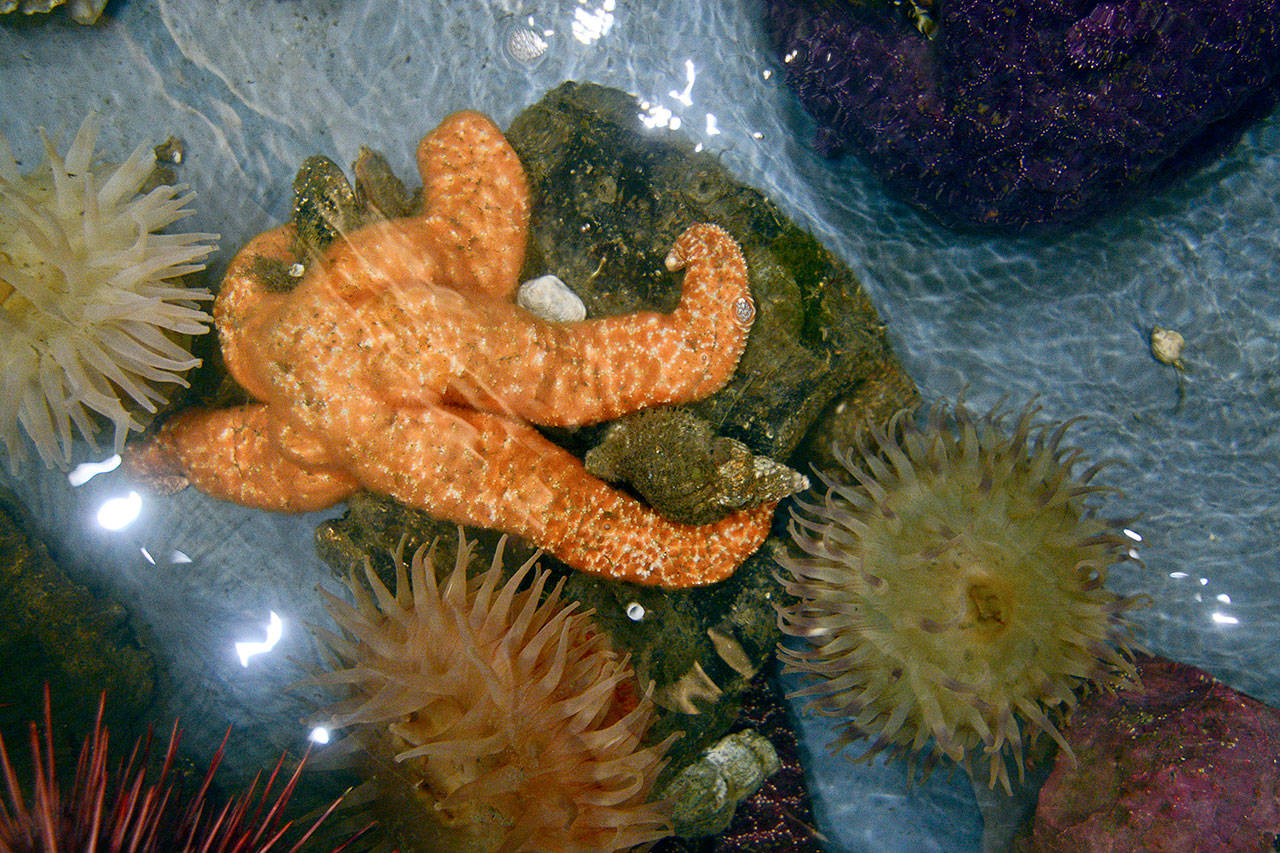
PORT TOWNSEND — Sea stars appear to be making a comeback on the West Coast four years after a mysterious syndrome killed millions of them, and local scientists continue monitoring with hopes populations will grow.
From 2013 to 2014, sea star wasting syndrome hit sea stars from British Columbia to Mexico.
The starfish would develop lesions and then disintegrate, their arms turning into blobs of goo.
“When you’re swimming along on the bottom and all of a sudden you see just an arm or a piece, or this white mass of goo going out in the shape of a star, that’s pretty depressing,” said Howard Teas, a citizen scientist who monitors sea stars in Jefferson County for the disease.
“It’s a roller coaster because you can’t help the emotional part when you’re looking at them and this thing is dead.”
Teas is part of the Port Townsend Marine Science Center’s effort to monitor starfish populations locally. He dives under the pier at Fort Worden, in Discovery Bay and in two areas at Indian Island.
The information he collects is sent to the University of California, Santa Cruz, which is heading the effort to collect data on the syndrome from across the West Coast.
Teas said he has seen a remarkable comeback, but he wants to wait a bit longer before celebrating.
The disease has persisted at a low level in British Columbia, the outer coast of Washington and north and central California, according to a November report from the University of California, Santa Cruz.
There have been “striking changes” at some reefs because of the decline of the sunflower star.
High numbers of urchins are now visibly present in some areas and are grazing in open areas, leading to a shift on some reefs from algal dominated communities to “urchin barrens” consisting largely of bare rock and crustose algae, the report says.
A team from Feiro Marine Life Center in Port Angeles that has been monitoring Freshwater Bay reported finding sea stars showing symptoms of the syndrome Aug. 20, according to the University of California, Santa Cruz.
Two species were reported to be showing symptoms at Feiro Marine Life Center on Oct. 14.
“We thought maybe we were out of the woods because we didn’t have anything in our tanks for several years,” said Melissa Williams, Feiro’s executive director. “The disease is by no means gone from our area.”
Williams said populations appear to be slowly returning. Researches counted 31 stars at Freshwater Bay in August, the highest number they’ve seen since the outbreak.
Feiro researchers found that the disease had killed 98 percent of sea stars in the Freshwater Bay area west of Port Angeles.
“It used to be that when you go out to the tidepools you would see piles of sea stars,” Williams said. “That was an iconic picture of the Pacific Northwest.”
Teas recently counted 11 sunflower stars living under the pier at Fort Worden, a spot that just three years ago didn’t have any.
“It’s a long-term thing,” he said. “Another warm summer would help suggest whether it’s over or not. We just don’t know.”
The cause is unclear but researchers say it might be a virus.
Similar die-offs of starfish on the West Coast were reported in the 1970s, ’80s and ’90s, but the latest outbreak was far larger and more widespread, according to a report by researchers at the University of California, Santa Cruz.
Beginning with ochre stars off Washington state, the disease spread, killing off mottled stars, leather stars, sunflower stars, rainbows and six-armed stars.
It hit Southern California by December 2013.
Betsy Carlson, citizen science coordinator at the Port Townsend Marine Science Center, said that while sea star populations appear to be improving, the syndrome is still being found in the Salish sea, though at lower number than before.
Teas found one sea star this year that definitely had Sea Star Wasting Syndrome and another that probably had the disease.
“The question is: are we not seeing it because all the susceptible animals have died off … or are we not seeing it because whatever came through and hit them all is gone?” Carlson said. “Chances are it’s probably not done.”
Carlson, who started at the Marine Science Center in 2015, recalled when sea stars on display in tanks were literally melting as visitors came in anxious to learn about marine life.
“Sometimes they would get better, but a lot of times they would melt,” she said. “It’s really awful to see.”
She said that in recent months there haven’t been any sea stars at the Marine Science Center that had the syndrome.
“It hit so hard and so fast that maybe this becomes a cyclical thing or maybe this is a one-off event,” she said. “It’s nice to think they are coming back, but I’m going to wait and see.”
________
Reporter Jesse Major can be reached at 360-452-2345, ext. 56250, or at jmajor@peninsuladailynews.com.
The Associated Press contributed to this report.
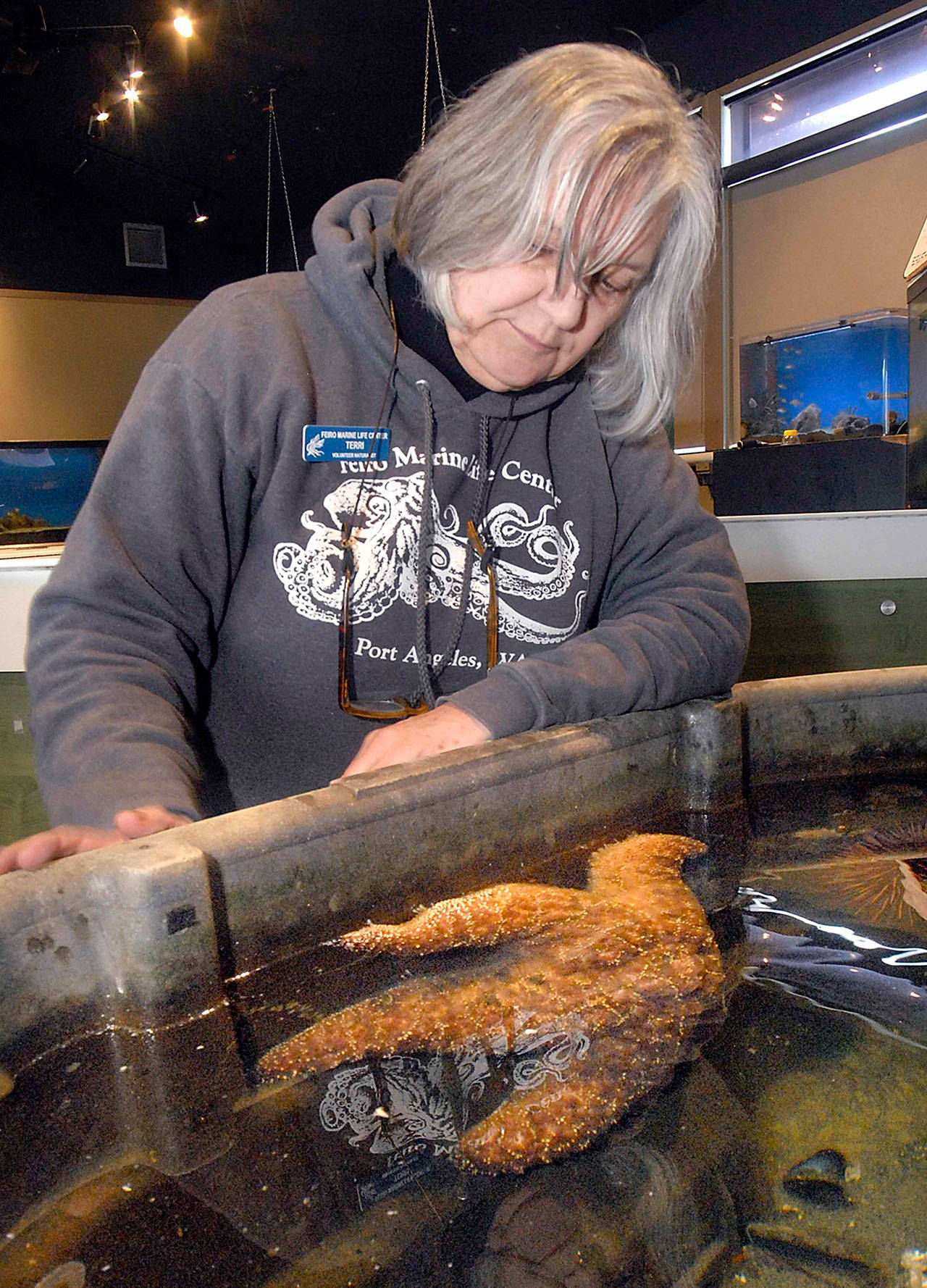
Terri Nogler, a volunteer at the Feiro Marine Life Center at Port Angeles City Pier, looks on Wednesday at a sea star in one of the center’s touch tanks. (Keith Thorpe/Peninsula Daily News)

Howard Teas, a citizen scientist who helps track sea star populations in Jefferson County for sea star wasting syndrome, cleans a tank at the Port Townsend Marine Science Center on Friday. (Jesse Major/Peninsula Daily News)
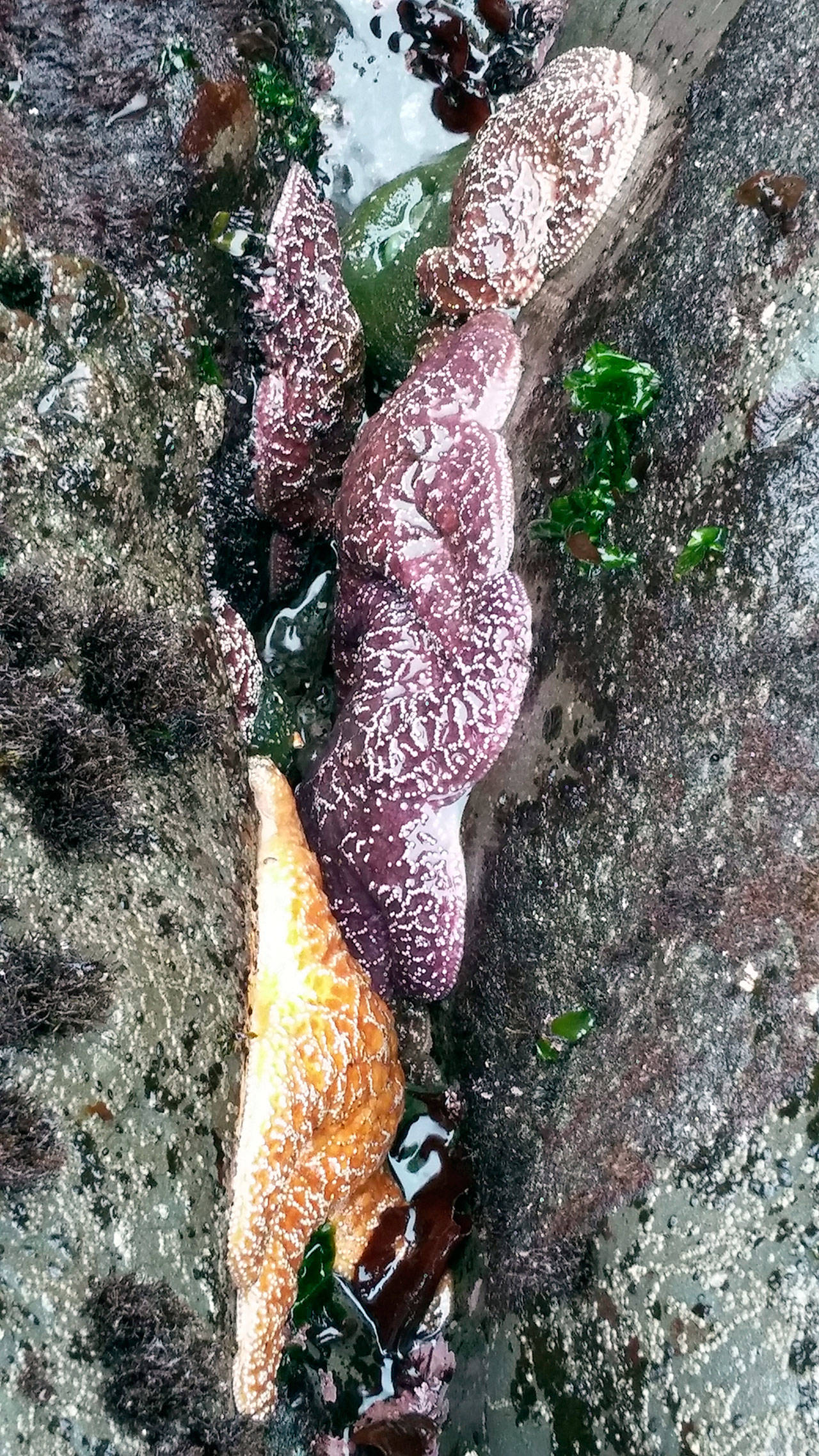
Sea stars cling to rocks at low tide at Rialto Beach in Olympic National Park this summer. (Michael J. Foster/Peninsula Daily News)
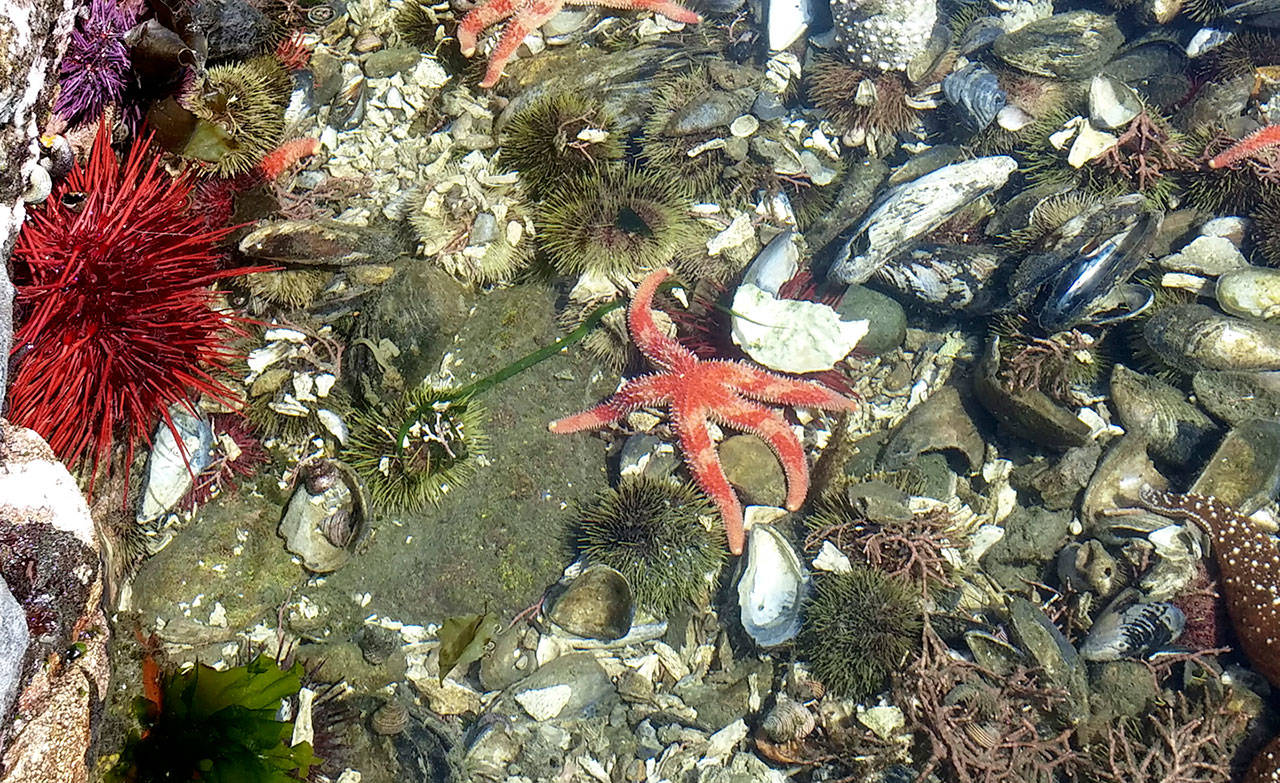
Rainbow sea stars are seen among urchins and other tide pool inhabitants at Freshwater Bay County Park west of Port Angeles this spring. (Michael J. Foster/Peninsula Daily News)
