
The disease that killed millions of the once-ubiquitous sea stars seems to be fading.
Marine biologists are zeroing in on the combined factors — including a rise in water temperature — that resulted in the devastation of the sea star population on the Pacific Coast, from Mexico to Alaska, beginning in 2013.
In late 2014, a densovirus was identified as the pathogen most likely to be the cause of millions of sea stars to begin “melting” into a white goo.
“We knew that in itself, the virus could not account for it all,” said Helle Andersen, a marine biologist at Western Washington University who works with the Feiro Marine Life Center to survey sea star populations near Port Angeles.
Sea star wasting disease has been documented in sea star populations for more than 40 years, including serious outbreaks on the Atlantic coast in 1972 and on the Pacific Coast in 1978, 1983 and 1998, but none was as devastating as the outbreak that began in 2013.
Marine scientists believed there were additional conditions that didn’t exist during past outbreaks and were thought to have caused the virus to be more virulent.
More than 20 species of sea stars from Mexico to Alaska have been affected and a few nearly obliterated from coastlines.
The disease is still being found among the few remaining survivors.
Andersen said she didn’t know what to expect in the coming summer.
Warm water trigger
However, a new study indicates a primary stressor may have passed.
Warmer-than-usual seawater, combined with a commonly occurring waterborne densovirus, was likely partially responsible for the severity of the densovirus outbreak, according to researchers at the University of Washington’s laboratories in Friday Harbor.
In a study titled “Ochre Star Mortality During the 2014 Wasting Disease Epizootic: Role of Population Size, Structure and Temperature,” published Feb. 12 in Philosophical Transactions of the Royal Society B: Biological Sciences, a peer-reviewed international science journal, researchers said they determined the virus is more likely to infect and kill sea stars when the water is warmer than 54 degrees.
Other possible contributors, such as freshwater runoff contaminants, are also under study.
The study also found that infected adults show symptoms sooner after being exposed to the densovirus but live longer, while juvenile sea stars resist showing symptoms longer but die more quickly once infected.
According to National Oceanic and Atmospheric Administration climatologists, in a typical summer, water temperatures in the Strait of Juan de Fuca top out at about 53 or 54 degrees and are about 10 degrees colder in winter.
Rising temperatures
The water temperatures in recent summers have ranged from 54 to 58 degrees, Andersen said.
In some areas of the North Olympic Peninsula, sea star mortality from 2013 through 2015 was as high as 95 percent, according to surveys of sea star populations at locations on the Pacific Coast, at Freshwater Bay on the Strait of Juan de Fuca and on Indian Island in Port Townsend Bay.
According to UW research, “The Blob,” a mass of warm water off the coast of Washington, Alaska and British Columbia that was first detected in 2013, raised water temperatures by up to 7 degrees above the seasonal normal.
The Blob faded in December, and the North Pacific water is expected to have temperatures more similar to the average this summer, according to the research.
In January, surveys of sea stars found infected individuals in the southern Hood Canal, on Whidbey Island and near Seattle, despite the colder winter water.
Freshwater Bay
But during the last sea star survey at Freshwater Bay in January, volunteers found no signs of the disease among the small surviving population at the western tip of the bay.
During the survey, only six adult ochre stars — among the hardest-hit species — were found during low tide, Andersen said.
None of the giant sunflower stars or multi-colored painted stars has been seen by volunteers at Freshwater Bay since the height of the outbreak in 2014, she said.
Andersen said there are still plenty of the small red blood stars, which are recovering, and the six-armed stars are doing well.
The January survey found only a single mottled sea star, another species that was hard hit by the virus, she said.
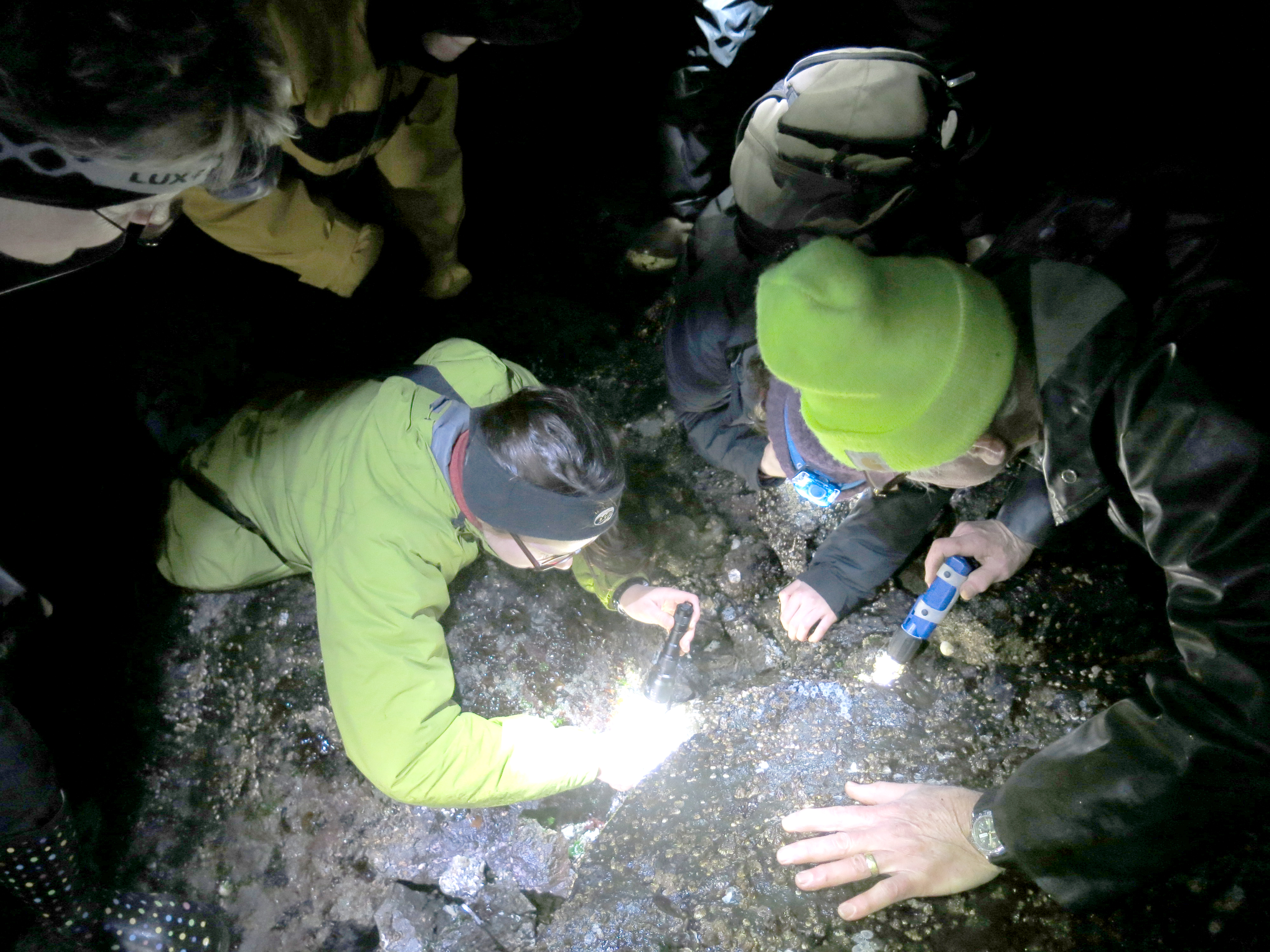
Surveys have to be done during very low tides, she said, so survey volunteers can reach the rocky intertidal areas where sea stars are most likely to be found.
The next survey at Freshwater Bay will be held during low tide April 10.
At Feiro, there have been no recent infections among the remaining sea stars, and new young stars are showing up in Port Angeles Harbor, said Melissa Williams, executive director.
One sea star at the center has been isolated because it seemed to be ill, but it has not developed additional symptoms of the wasting disease, she said.
Two juvenile ochre sea stars were found in Port Angeles Harbor, one on a creosote piling being removed by the Port of Port Angeles and another on a City Pier piling, she said.
Both young sea stars — each about 4 inches from arm-tip to arm-tip — can be seen at the center.
Indian Island
Port Townsend Marine Science Center volunteers completed a survey on Indian Island in February.
They found no new disease among the wild sea stars, but there have been a few cases in the center’s tanks, said Betsy Carlson, the center’s interim citizen science coordinator.
The survey of wild sea stars, which focused on juvenile sea stars, found only healthy ochre stars and mottled stars in the plot the science center has been monitoring for the past few years, Carlson said.
“We saw a sunflower sea star just outside the plot,” she said.
Carlson said that while the wild sea stars seemed fine, two six-legged stars in the tanks at the science center have shown signs of the disease and one has since recovered.
“Two years ago, we had 75 or 80 sea stars in our tanks. Now we have about 15,” she said.
“We keep a close eye on those.”
________
Reporter Arwyn Rice can be reached at 360-452-2345, ext. 56250, or at arice@peninsuladailynews.com.
