
PORT TOWNSEND — Port Townsend’s residents complain about high rents and lack of housing, but last week about 1,450 denizens of the Point Hudson south breakwater not only received brand-new homes, they also got free moving services as well.
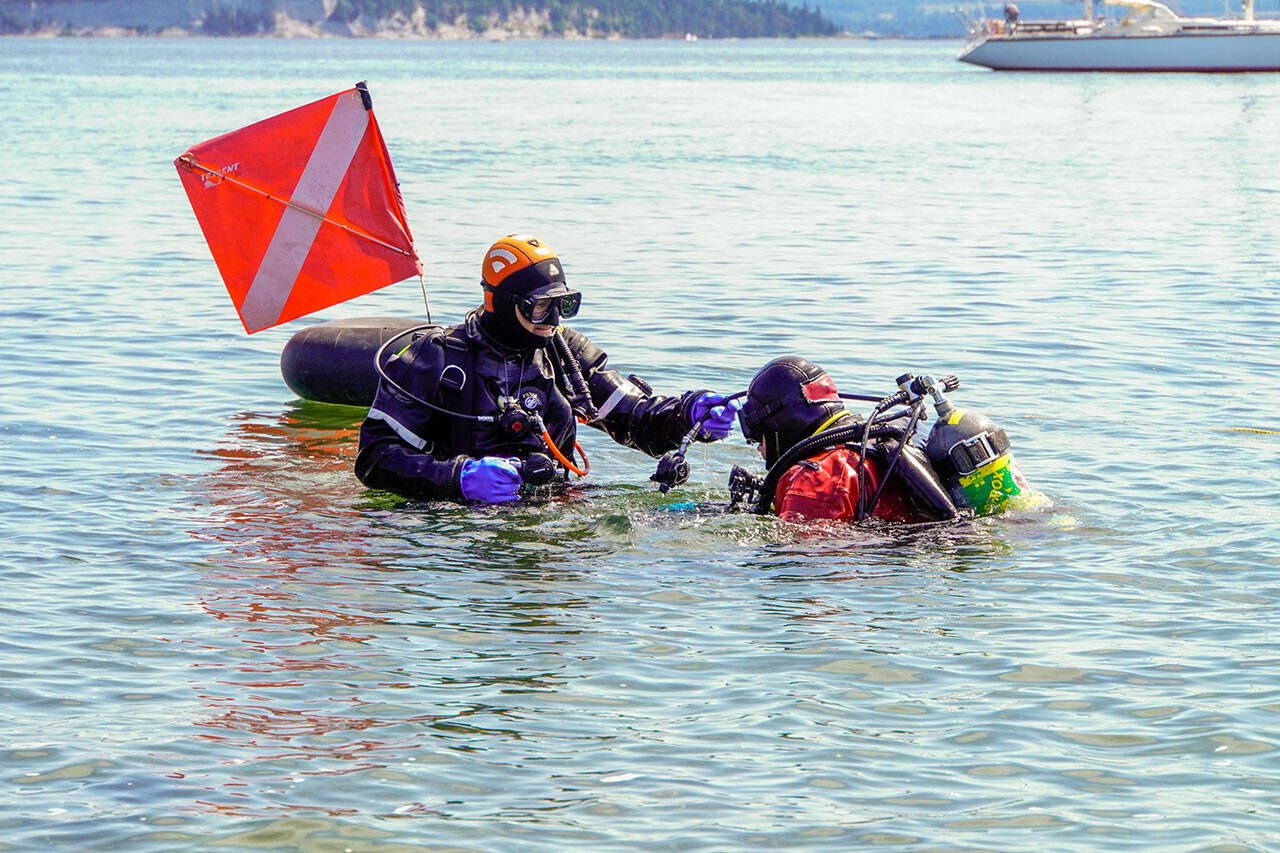
On Thursday and Friday, 16 scuba divers carefully removed a shiny orange sea squirt and a sponge clump, 40 anemone, six-rayed sea stars, leafy hornmouth snails, mussels, crabs and other invertebrates from their old haunts on Point Hudson’s south breakwater to an underwater pile of rocks nearby.
The Critter Relocation, as it was called, was a collaboration among the Port of Port Townsend, Washington Scuba Alliance, Northwest Maritime Center, the Port Townsend Marine Science Center and Octopus Gardens Diving to preserve marine habitat on the city’s shore.
It was an unanticipated but satisfying outgrowth of the port’s $15 million Point Hudson breakwater demolition and construction project that began last September. Removing and rebuilding the failing north and south breakwaters turned out to be an opportunity for conservation and environmental stewardship.
Eron Berg, the port’s executive director, said the idea for relocating the marine life initially began when a local diver suggested recycling basalt rock from the old north breakwater to use as a home for marine life.
“We were taking away rock habitat. Why can’t we put some back?” Berg said. “Everyone was nodding their heads that it seemed like a good idea.”
So, instead of taking the rock from the breakwater, hauling it to Mats Mats Bay and, in the process, killing all of the organisms that lived on it, the contractor simply moved it to a spot about 27 feet away.
Berg said any expenses related to the added time and extra permitting the relocation required was more than made up for in cost savings from not hauling the old rock away.
More rock is anticipated being added at some point to add to the 900 cubic feet of repurposed basalt.
Relocating sea slugs, snails and chitons wasn’t necessarily a simple task, however. A biological assessment had to be conducted and the port had to obtain additional permits.
“We already had a permit to demolish the breakwater that would crush everything in there,” Berg said. “My favorite permit of all on this project was the additional one we had to get to pick up marine life and relocate them and handle them.”
Environmental consultant Jeanette Widener began assisting the port last year on compliance and permitting related to the breakwaters, which involved a number of jurisdictional agencies, including National Oceanic and Atmospheric Administration and the state Department of Fish and Wildlife.
Divers were equipped with flashlights and plastic putty knives with rounded edges to gently pry marine life clamped to rocks and place them in sealable plastic bags. When bags were full, they deposited them on the new reef and then returned to start the process all over again. They recorded the species and number of relocated animals with a pencil on a dive slate.
They did not collect all of the marine life on the old south breakwater. Some populations that had already established themselves — like plumose anemone — were left, as were barnacles, which were susceptible to breaking when forcibly detached.
Amelia Allen and her husband, Lou Allen, collected and relocated more than 250 whelks on the first day of the event. Amelia Allen stayed on dry land Friday and daughter, Sarah Allen, 26, suited up with her father to continue the underwater work.
Sarah Allen grew up in Chimacum and learned to dive in the very location she was now helping.
“It’s a super popular place to dive,” said Allen, who now lives in Seattle. “There’s a lot of fish and octopus. You always see something.”
The Allens were among the divers who attended a July 9 training and orientation at the Port Townsend Marine Science Center.
Betsy Carlson, citizen science coordinator, said divers were familiarized with the kinds of marine life they would find and the priority species they should target for relocation.
“Things like what is movable, how do you move it and how do you put it back on the rocks,” Carlson said. “Some animals can’t be removed without the rock [they’re on] and some like the plumose anemone are already moving, so you don’t necessarily need to relocate them.”
They also learned some cool tips, she said.
“Like, you can put sea stars on your suit and they’ll stick there like Velcro,” Carlson said.
Randy Williams, vice president of Washington Scuba Alliance, said a Critter Relocation diver came across two sunflower sea stars, a major predator that NOAA has proposed for Endangered Species Act protections. On his dives, Williams found two active but empty octopus dens and just above them an active den in the new breakwater that had been established within the last year.
“They’ve moved on its own and they’re doing quite well,” Williams said. “If we’ve got enough food to support more than one octopus, then that’s a good thing.”
________
Reporter Paula Hunt can be reached at paula.hunt@soundpublishing.com.
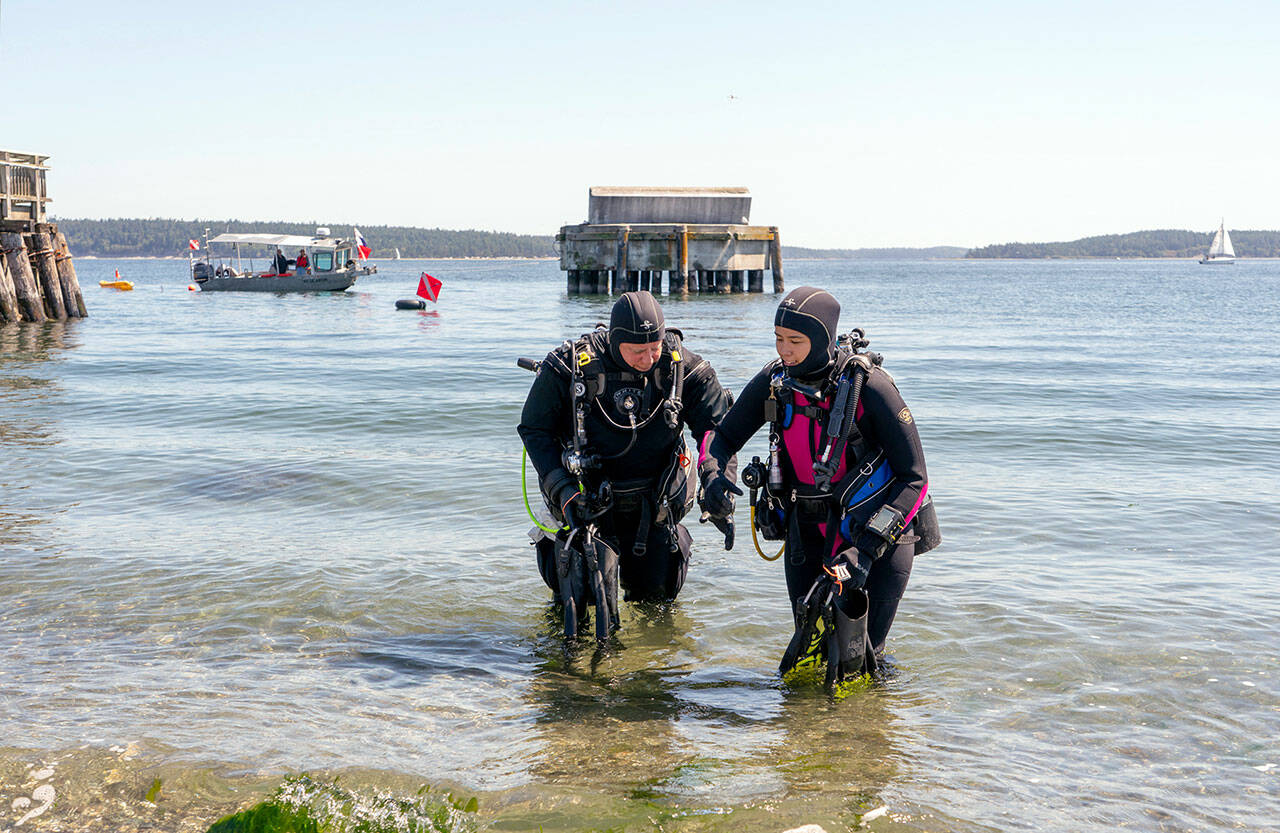
Lou Allen of Quilcene and daughter Sarah Allen of Seattle cautiously back into the cold waters of Port Townsend Bay to start their volunteer session for the Critter Relocation program, a program that removes and relocates invertebrates from the pilings and rocks on the south entrance to Port Hudson Marina. The south breakwater will be taken apart and rebuilt right after the close of the Wooden Boat Festival in September. A safety boat courtesy of Octopus Gardens Diving in Port Townsend is anchored behind them to prevent boats and other watercraft from the area while divers are in the water. (Steve Mullensky/for Peninsula Daily News)
