
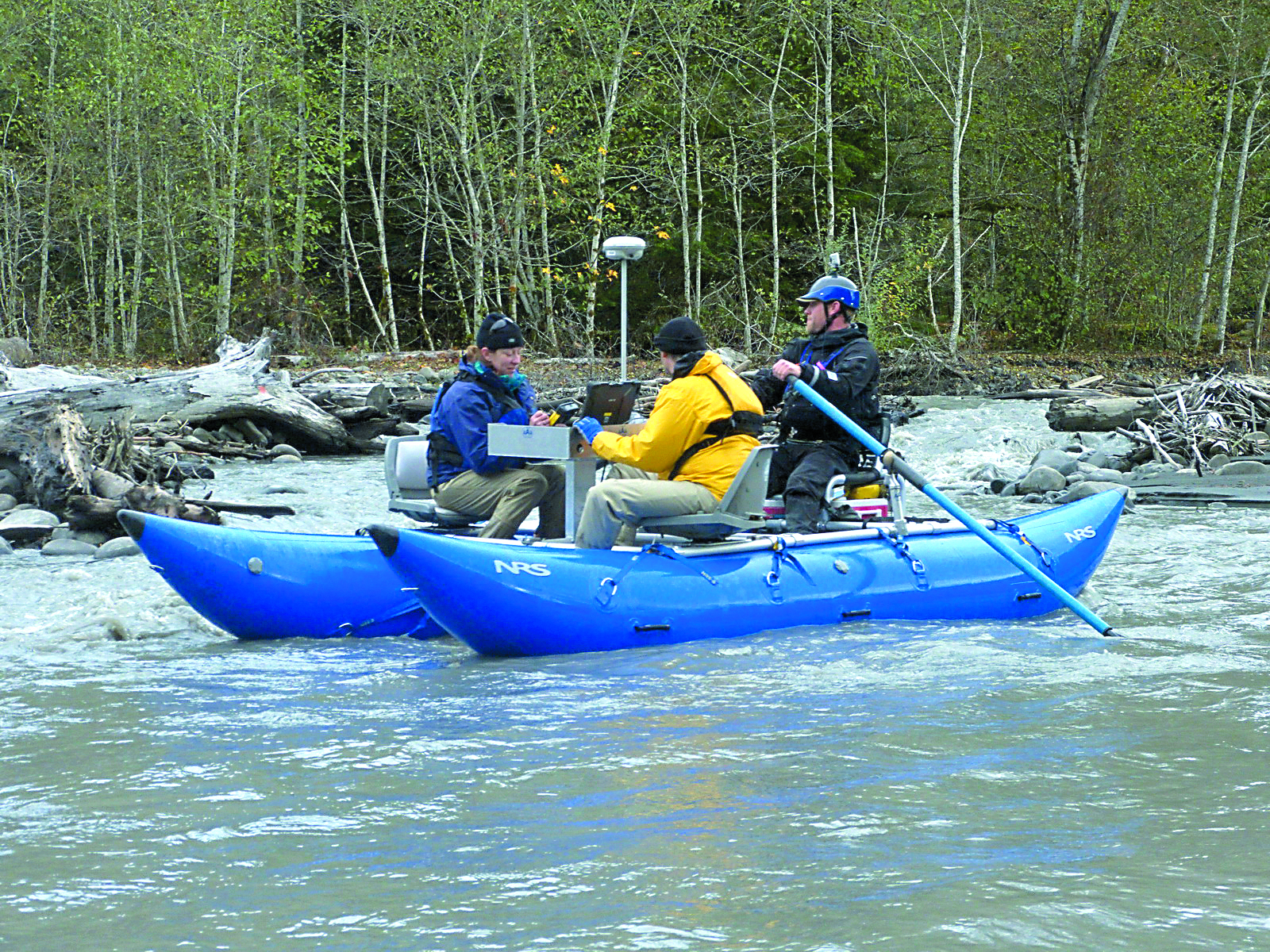
OLYMPIC NATIONAL PARK — Researchers donned rain gear and climbed into a raft earlier this month to study sediment released from behind the massive dams that once straddled the Elwha River to see how it will affect salmon spawning.
During the week of Nov. 5, a team of scientists from several federal agencies floated down the newly released Elwha River to study how sediment flowing down the river is changing the river’s bed and the bottoms of what used to be lakes Aldwell and Mills.
Scientists monitoring the $325 million federal project to restore the Elwha River to its wild state are keeping an especially close eye on the coarse sediment because the river’s once-famed salmon runs rely on that material for spawning, Olympic National Park spokeswoman Rainey McKenna said.
“For many of the fish species, this is the kind of habitat they need,” she said.
The 11-member team — comprising scientists from Olympic National Park, the federal Bureau of Reclamation, National Oceanic and Atmospheric Administration Fisheries, U.S. Geological Survey and the University of Washington — started their surveying work at the former Lake Mills, which is almost completely drained now that the once-210-foot-tall Glines Canyon Dam has been knocked down to about 60 feet.
Andy Ritchie, Olympic National Park’s hydrologist for the Elwha restoration project and one of the scientists on the sediment team, said researchers eventually will compare the sediment level results to surveys taken before the dams were removed to gauge exactly how the sediment is changing the layout of the river beds and old lake beds.
The team used research-grade GPS devices and other equipment to measure how much coarse-grain sediment is in the pools that make up the remains of Lake Mills, McKenna explained.
The team did the same at the former Lake Aldwell two days later, McKenna said.
The lake has been gone since demolition of Elwha Dam, built a century ago without fish ladders 5 miles from the river’s mouth, was finished in March after removal of the dams that formed the two lakes — the cornerstone of the restoration project — began in September 2011.
The researchers used an Elwha River raft trip on the day in between to measure how the river’s coarse-sediment loads are changing the river channel using equipment that measures river velocity and depth.
The surveys also will scrutinize the size of sediment flowing down the Elwha to better understand how the river-bound ecosystems will recover, Ritchie explained.
“Basically, we were trying to track sediment grain sizes flowing down the river,” he said.
Ritchie said the team chose November to coincide with the “fish window” that will end the first of January.
During that time, no sediment-release dam work can be done upstream so migrating fish are protected.
Surveying sediment flows during the fish window allowed the team to gauge how sediment courses down the river naturally, Ritchie explained, as opposed to the pulses of sediment that have been released when portions of the dams have been removed.
Ritchie said researchers are planning future sediment survey trips along the Elwha but have yet to nail down any dates.
The results of the surveys have yet to be analyzed, but Ritchie said the most drastic changes occurred in the middle reach of the river: between the remains of Glines Canyon Dam and Elwha Dam, the last remnants of which were removed last March.
Ritchie said the clearest example of this was at the McDonald Bridge gauge, which monitored the depth of a pool of water connected to the Elwha about 5 miles upstream from the junction of U.S. Highway 101 and Olympic Springs Road.
Depending on river levels, the pool had been between 12 and 16 feet deep for the past 80 years, Ritchie said, but was only 4 feet deep during the team’s most recent survey — filled with sediment released from the deconstruction of the concrete and metal behemoths that once stood up river.
The river’s turbidity, or level of suspended sediment measured in formazin nephelometric units, has spiked sevenfold since the summer, and McKenna said the peak for the week starting Nov. 12 was 1,800 fnu, or about 300 fnu up from the week before.
Ritchie said the Elwha will only have more to offer come this winter.
“The biggest thing [to expect] is the pace of [sediment] change in the river this winter,” Ritchie said.
“It’ll be pretty dramatic.”
________
Reporter Jeremy Schwartz can be reached at 360-452-2345, ext. 5074, or at jschwartz@peninsuladailynews.com.
