
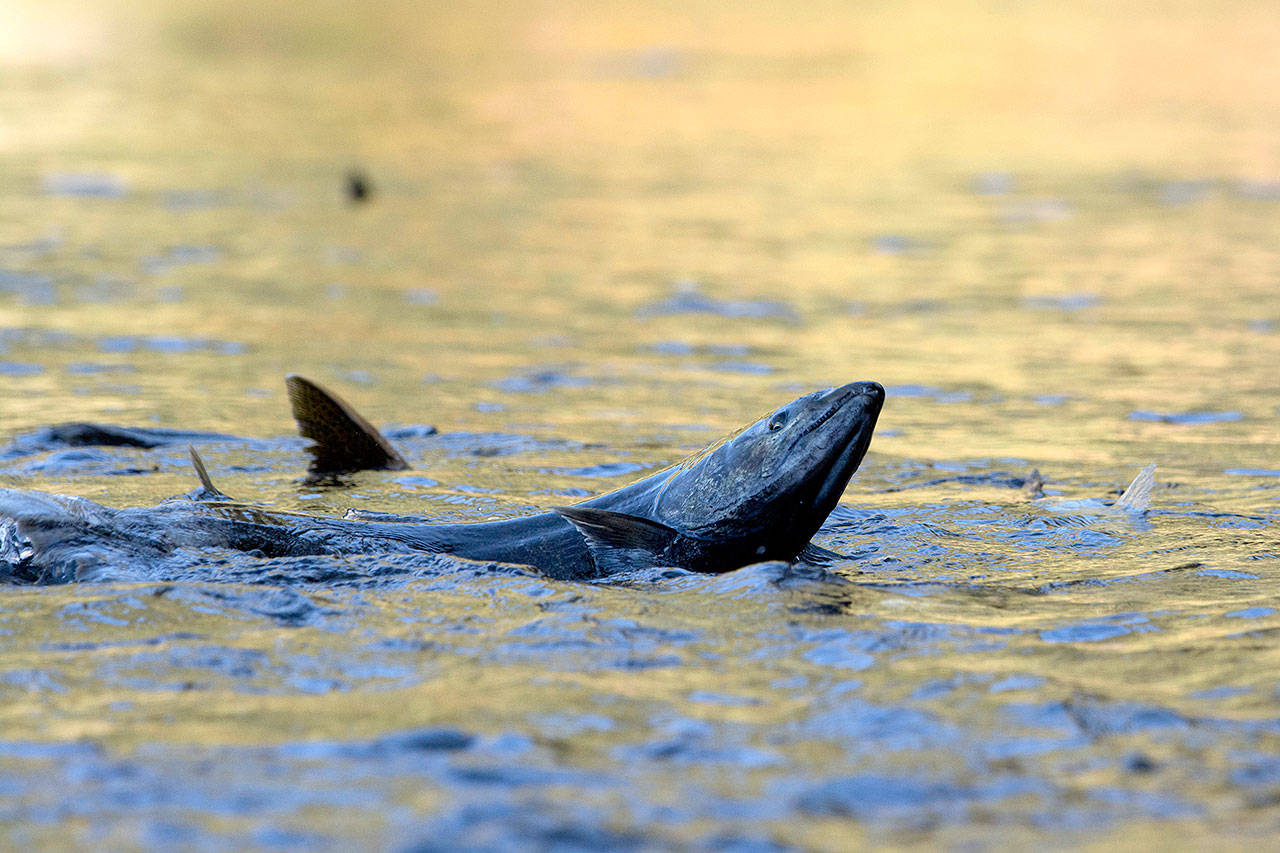
OLYMPIC NATIONAL PARK — Chinook salmon are now returning to the Elwha River in droves and the scientists who study them are excited about what they may learn this season.
Scientists now are collecting data that will determine what percentage of the chinook spawning in the Elwha were actually born in the river after the removal of two dams in 2014.
This is potentially the first year since the removal of the Elwha and Glines Canyon dams that they could see an increase in chinook salmon born in the Elwha River returning from sea to spawn, but scientists tracking that data said they want to see the data first before reaching any conclusions.
“We’re getting into that phase where we’re hoping to see a bump in natural production,” said Joe Anderson, a research scientist with the state Department of Fish & Wildlife. He said he and his colleagues are “keeping our fingers crossed,” and said the data will speak for itself.
Monitoring ecosystem recovery in the Elwha is a cooperative effort by Olympic National Park (ONP), Lower Elwha Klallam Tribe, U.S. Fish and Wildlife Service, U.S. Geological Survey, National Oceanic and Atmospheric Administration Fisheries, and state Department of Fish & Wildlife.
Chinook are spawning in the river right now with chum, coho and steelhead to follow later in the season.
Anderson said that in recent years about 95 percent of chinook salmon that have returned to the Elwha River have been from the hatchery and that he and his colleagues are hopeful to see a boost in naturally-produced fish either this year or in the coming years.
Watch: Chinook salmon spawn in the Elwha River near the former Altair campground in Olympic National Park. (Jesse Major/Peninsula Daily News)
He and others monitoring the Elwha River said it took about two years after the completion of dam removal for the river to settle down. Up until about 2016, the river was unstable and the turbidity at times approached levels harmful to fish, they said.
“The river seemed like it started to calm down in the last few years and we’re hopeful that as that happens the juveniles are exposed to a more benign environment as we’re getting into the next phase,” Anderson said.
“The next five years are going to be really telling.”
Determining how many fish were born in the Elwha River instead of at the hatchery isn’t easy. It requires staff from ONP, Fish & Wildlife and the Lower Elwha Klallam Tribe’s Department of Natural Resources to canvas the river for salmon carcasses.
They collect the ear bones from the spawned-out chinook salmon to determine where they were born. While most hatchery fish are identifiable by their cut adipose fins, chinook salmon raised for the Elwha River did not have their fins clipped.
The reason is to increase the chances of survival at sea, he said. In many fisheries fishermen look for the cut fins to determine whether they can harvest the fish.
Instead, chinook salmon are marked with a thermal otolith mark, a permanent mark to their ear bone before they are born at the hatchery.
The temperature of the water they are in as eggs is chilled for a couple weeks, leaving a mark on their ear bones. Anderson compared the mark to rings on a tree.
The ear bones being collected now will be examined at the state’s lab in Olympia. Anderson hopes to get the results from this spawning season back in February or March.
‘Record number’
Several scientists collecting data said based on what they’ve seen so far this season, the chinook run this year is doing well.
Officials have forecasted that 5,200 chinook salmon will return to the Elwha River this fall to spawn and what scientists have seen so far has them optimistic.
Researchers with the state, park and tribe have spent the last few weeks conducting an extensive riverscape survey to count fish and are now using sonar to count how many chinook are returning to the river.
ONP biologist Pat Crain said he is optimistic that once the numbers are in, they will be high.
“I think we’re going to be really, really happy with the way this year has turned out,” he said.
That seems to be the consensus of several scientists who are working on the project.
“From the reaches that the tribe did and what I’ve heard anecdotally from surveyors, we probably have record number chinook returning to the river since the inception of the project,” said Mike McHenry, fish habitat manager for the Lower Elwha Klallam Tribe’s Natural Resources Department.
McHenry said the tribe focused on Little River and Indian creek during the survey.
“Fish moved farther up Indian Creek than they have ever been observed before,” he said.
McHenry said the official number will be based on a sonar estimate. He expects that number to be available in December or January.
River survey
Sam Brenkman, ONP chief fisheries biologist, said that when crews recently conducted the extensive riverscape survey, they covered the majority of the river from its mouth to its headwaters. The only parts of the river excluded in the survey were Grand Canyon and Rica Canyon.
It’s the first time scientists have conducted such a survey since 2007 and 2008, he said.
Snorkelers counted 15,000 rainbow trout in September, more than double the 7,300 that were counted in 2007.
“One real success story has been the bull trout,” Brenkman said. “We’ve seen some really neat changes in their population.”
He said 262 federally threatened bull trout were counted during the survey, a number that is up 22 percent from the 2007 survey and is more than double the 2008 count.
The trout had been stuck in the Elwha River, blocked from going to sea by the two dams. Now, they are able to access the ocean where there is more food, he said.
Bull trout that were captured and radio tagged in the Elwha’s estuary have been tracked nearly 40 miles upstream, where they have navigated five major canyons to get to the headwaters.
“They were the first ones that we observed returning to the headwaters after the dams came out,” he said.
He said 216 summer steelhead were counted in the survey. They were found as far upstream as Buckinghorse Creek.
When people will be able to fish the Elwha River again will depend on how well the restoration process progresses, Brenkman said.
Sport and commercial fishing is currently closed until at least June. ONP, the Lower Elwha Klallam Tribe and the state Department of Fish & Wildlife will work together to asses fishing regulation as part of the pre-season planning process.
According to the Environmental Impact Statement for the dam removal, once the fisheries are restored the river could see more than 31,000 chinook per year, more than 34,000 coho per year and more than 10,000 steelhead per year.
It was predicted nearly 275,000 pink salmon would be produced in the Elwha River annually.
“We anticipate that increased natural production of salmonids and restoration of anadromous fisheries will take more time and are focused on maximizing protection of federally threatened stocks of chinook, steelhead and bull trout,” Brenkman said.
________
Reporter Jesse Major can be reached at 360-452-2345, ext. 56250, or at jmajor@peninsuladailynews.com.
