
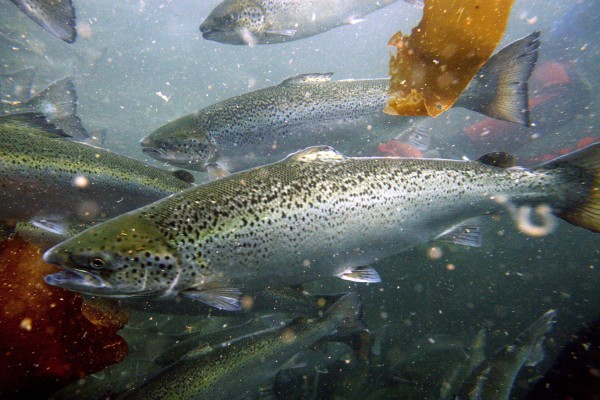
By Kirk Johnson Copyright 2013 New York Times News Service
SEATTLE — Like mariners scanning the horizon from the crow’s nest, scientists have for years been on the lookout in the Pacific Northwest for signs that a dreaded salmon-killing disease, scourge to farmed salmon in other parts of the world, has arrived here, threatening some of the world’s richest wild salmon habitats.
Most say there is no evidence.
But for years, a biologist in Canada named Alexandra Morton — regarded by some as a visionary Cassandra, by others as a misguided prophet of doom — has said definitively and unquestionably that they are wrong.
Infectious salmon anemia
Wild Pacific salmon, she has said, are testing positive for a European strain of the virus that causes the disease, infectious salmon anemia, or ISA
The virus, which has struck farmed salmon populations in Chile, among other places, is not harmful to humans who eat the fish, but could potentially pose grave threats in a part of the world where salmon plays a huge role in local economies and ecosystems.
If the virus, which is in the influenza family, mutates into a virulent Pacific strain in the crowded fish farms in British Columbia, where wild and farmed salmon are sometimes in proximity, fish populations on both sides of the farm/wild divide, Morton believes, could be devastated.
“It’s an uncomfortable truth,” she said.
But scientists and government testing groups in Canada and the United States have said repeatedly over several years that Morton’s findings were not sufficient to sound an alarm, and that the risks to wild salmon, even in the event of a fish-farm outbreak, are unclear.
After rounds of government hearings and millions of dollars spent on research, the two sides are in an increasingly bitter standoff.
“We’re trying to re-create the situation that she’s saying is out there, and to date we cannot re-create the results,” said Dr. Penny Greenwood, national manager of the domestic disease control program at Canadian Food Inspection Agency.
Now, Morton has new test results that she said are positive for the infectious salmon anemia virus — though not necessarily the disease — in farmed salmon she bought at a fish market in Vancouver late last year.
At the same time, the biggest effort ever on the American side of the border to find the virus is shifting into high gear, with fish samples arriving in labs in Idaho, Alaska and here in Washington State.
“I think we’re probably pretty close to having a definitive answer,” said Martin Krkosek, an assistant professor of ecology and evolutionary biology at the University of Toronto.
Much at risk
The stakes are enormous, and not least for reputations.
Salmon, in all their varied and usually pink-hued glory, have been an ecological anchor from Alaska to Oregon, intertwined with the region’s culture and economy since long before the arrival of Lewis and Clark.
The search for the virus raises questions that have swirled through commercial fishing and oceanography:
Has the growth of open-ocean fish farming over the last three decades and the vast netted pens of Atlantic salmon from Chile to Maine and Norway to Canada created a reliable source of sustainable, inexpensive protein?
Or, as critics contend, are the farms unsustainable because they pollute the seabed and because the close confinement of the fish raises the risk of disease?
Salmon farmers say that the broader controversy over aquatic farming has informed the narrower discussion of the salmon disease, and that Morton in particular has been out to get them, whether a virus is involved or not.
Adding further fuel — or at least, smoke — to the fire is a new documentary that accuses the Canadian government of deliberately covering up evidence that would support Morton’s conclusions.
A Web site has since emerged that tries to debunk to the documentary.
“She says one thing, everybody else says something different, and therefore, in her view they’re all in collusion, and not doing a good job,” Ian Roberts, a spokesman for Marine Harvest Canada, the biggest salmon farming operation in British Columbia, said of Morton.
He said his industry had sent upward of 8,000 samples for testing in recent years, without a single confirmed finding of the ISA.
And he said the survival rate at his company’s salmon farms was better than 90 percent.
New outbreak recently
There is no doubt that the disease can wreak havoc.
First described in Norway in the mid-1980s, it has flared on fish farms from Maine and the eastern coast of Canada to Scotland and Chile, which reported a new outbreak last month.
The virus is also capable of mutating rapidly, which scientists on all sides of the issue say increases the need to keep an eye on it.
Its victims can be seen gasping at the surface, lethargic and often swollen with fluids; mortality can reach 90 percent.
The global seafood industry, meanwhile, has become harder than ever for researchers to monitor, with well-established problems of labeling and provenance.
A recent study, for example, of fish purchased in markets and restaurants around the nation by a nonprofit ocean protection group, Oceana, found that about a third of the samples tested were mislabeled.
Dr. Greenwood of the Canadian food agency said that research to determine where one of Morton’s market-purchased samples came from produced conflicting accounts from people in the supply chain.
Without a clear chain of custody, she said, there was no point testing the fish at all.
She said there had been no attempt to cover up anything.
“We couldn’t even verify that that fish was in fact Canadian in origin,” she said.
B.C. concern
Wild fish coming into proximity with farmed fish is partly what raised disease concerns in British Columbia in the first place.
Some fish pens, notably near the Fraser River, straddle the very corridor through which millions of sockeye salmon pass each year, both during their juvenile outmigration to the ocean and upon their return as adults to breed.
Those anxieties skyrocketed in 2009, when the salmon run on the Fraser suddenly collapsed, leading to a government inquiry in which infectious salmon anemia was discussed but never definitively implicated as a factor.
(The Fraser’s sockeye salmon bounced back in 2010 with one of the biggest runs ever recorded, and have hovered around their long-term averages since then.)
James Winton, chief of the Fish Health Section at the U.S. Geological Survey’s Western Fisheries Research Center in Seattle, one of the labs involved in the new wave of tests, said that assessing disease risks to wild salmon went far beyond how close they get to their farmed cousins.
Climate change, habitat loss, contaminants, variability of food supplies and ocean acidification, among other factors, may also play roles in affecting the susceptibility of wild salmon to diseases, he said.
Wild salmon remains a popular choice among diners, in part for its omega-3 fatty acids, which studies have shown are important for heart and brain health.
The state Department of Health in Olympia sums up its advice in three succinct words and a bit of pro-wild caveat:
“Keep eating salmon!” the agency says in its Web site.
“Wild salmon is a great choice and farmed salmon is a good alternative.”
