
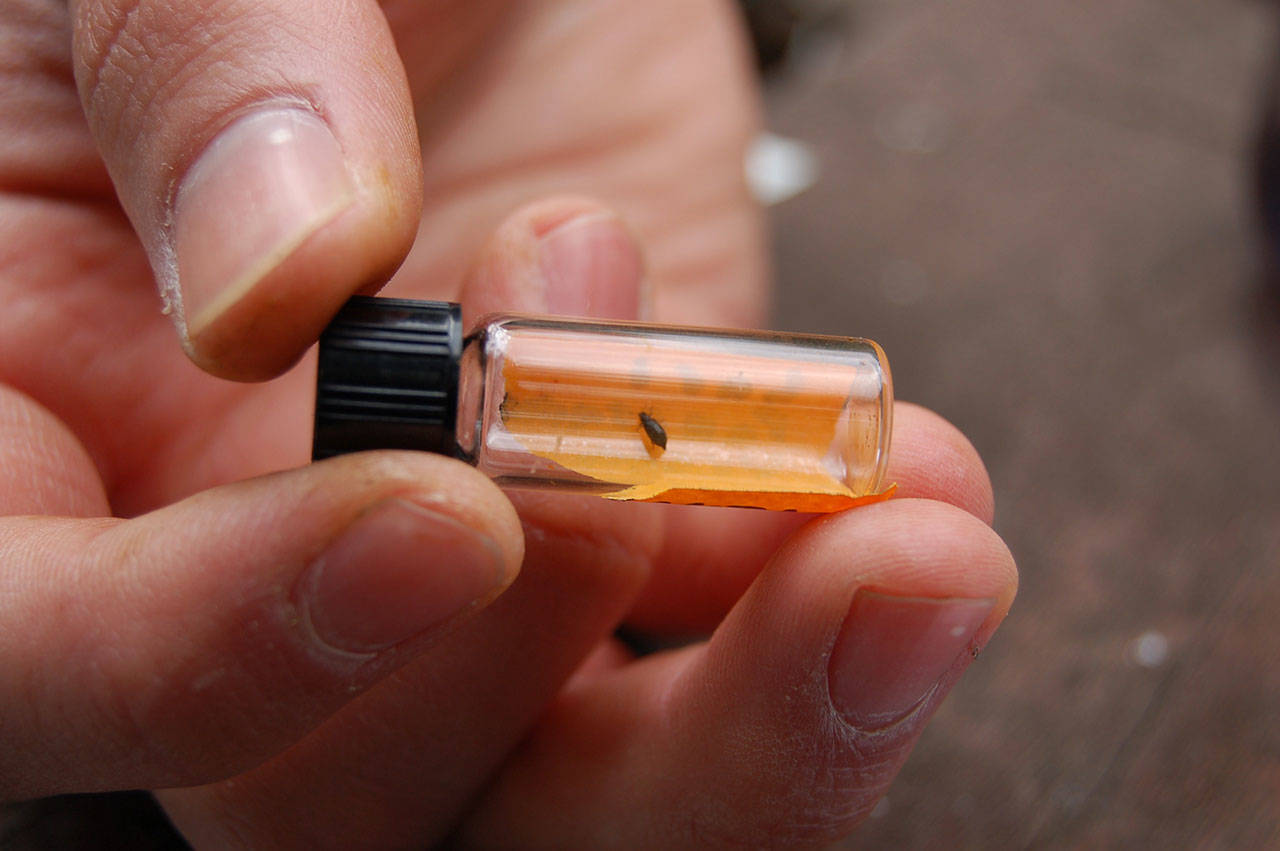
SEQUIM — Researchers are looking to western hemlock trees on the Miller Peninsula east of Sequim to collect data that could help save hemlock trees on the East Coast from dying at alarming rates.
Elizabeth Sussky, Ryan Crandall and Joseph Elkinton are all part of a biological control experiment funded by the U.S. Forest Service that is importing from the area natural enemies of an invasive insect that feeds on hemlocks.
Hemlock trees on the East and West Coast are predated on by small insects called hemlock woolly adelgid. This invasive insect originates from Asia and lives and feeds on hemlock trees with the ability to reproduce a hundredfold per insect every time females lay eggs. Left unchecked, these insects could drive hemlocks to extinction on the East Coast.
“We’re talking about an insect that’s killing trees by the millions across the forests of the eastern United States,” Elkinton said.
Elkinton is a professor for the Department of Environmental Conservation at the University of Massachusetts, Amherst, and has been conducting similar experiments at the Seattle Arboretum for the past three years.
According to Elkinton, eastern hemlock trees with heavy infestations of the adelgid are dying all across the East Coast. Eastern hemlocks have been dying over the span of 20 years, while western hemlocks found with infestations of the same species of insect — particularly on the Miller Peninsula — are thriving.
The team is collecting 680 samples of western hemlock with heavy infestations of the adelgid found on the Miller Peninsula so they can bring them to the Seattle Arboretum, where they will conduct experiments and collect data.
Elkinton explained the idea of the experiment is to try to find data that answers the question, “What is it that’s regulating the densities of the adelgid?,” particularly in the western hemlock.
Sussky is a University of Massachusetts, Amherst, graduate who Elkinton said pioneered this experiment in his lab for her master’s thesis. She will work part time for the U.S. Forest Service and lives on the Miller Peninsula, where she has been collecting samples of western hemlock.
“It’s so much fun to reconnect with this,” Sussky said.
Crandall is a graduate student at the University of Massachusetts, Amherst, who also will use this experiment for his master’s thesis. He also has been working under Elkinton as a research technician.
“It’s a big undertaking. Most people like us would be unwilling to do this kind of thing because it’s too difficult,” Elkinton said.
Theories
The team believes one possibility of the thriving western hemlock could be due to a natural predator that solely feeds on the adelgid, a specialized beetle called Laricobius nigrinus, which is native to the Pacific Northwest.
“The Forest Service is already spending millions of dollars to import these beetles, but without ever doing this kind of research, there’s no ‘does the beetle actually regulate these densities?’ ” Elkinton explained.
This predator is a specialized beetle that only feeds on the hemlock woolly adelgid, acting as a biological control agent.
“The beetle is specialized on the adelgid. It’s not going to become very common,” Elkinton said. “If it succeeds in knocking down the adelgid, it itself will decline to a lower density.”
Elkinton explained pesticides cannot be used on the adelgid killing the hemlocks because it would be too expensive.
“We are convinced these predators are regulating the densities of the adelgid out here. Our data suggests that,” Elkinton said.
“It is the only thing that could save the hemlocks in the eastern United States. There’s nothing else that can do it.”
The experiment
After the team collects enough samples of infested western hemlock, they will take the samples to the Seattle Arboretum, where they will inoculate 20 eastern and western hemlock trees when the adelgid eggs are ready to hatch.
They will tie mesh bags around some of the eastern and western hemlock branches — excluding predators — and put them side by side with branches that are not covered with the mesh bags and can compare the results.
Before the team inoculates the hemlock trees, they will count how many insects they put on each tree, estimating it will be in the tens of thousands. When the adelgid eggs hatch, they are estimating there will be about 5 million crawlers to infest the trees.
“That’s what we hope to answer and will help the Forest Service decide which of these natural enemies they want to focus on in terms of introducing them to the East Coast,” Elkinton said.
The team will then collect data and follow the populations over time.
Hemlock trees are a keystone species, Sussky said, meaning its abundance has a big impact on other species in an environment.
“The hemlock is an important tree ecologically in the eastern U.S.,” Elkinton said.
He said hemlock trees grow along stream valleys and are a good provider of shade. When hemlock trees die, they are replaced with other trees that do not provide the same amount of shade, and the result is stream temperatures go up, trout leave the stream and various things happen to the stream ecology.
“I never thought I would see this happen when I moved to Massachusetts back in 1980. None of these species were present,” Elkinton said of the invasive insects. “It could drive the hemlock to extinction.”
Hope
Crandall said he has personally seen the effects of these insects on hemlock trees in his backyard in Massachusetts.
“I had a line of hemlock trees in my backyard growing up, and they’ve been hit pretty hard,” Crandall said. “We cut a few down this year for the first time, which is really sad. I hate to lose those.”
He is hoping this experiment can help stop more hemlock trees from dying.
“If we could find something that could help the eastern hemlock here, that could be amazing,” he said.
“One of the things I love about the work we do is most ecologists study problems, and we fix problems,” Elkinton said.
The team will continue its research throughout the next couple of weeks, collect data and determine the next steps for the experiment. Elkinton said they could have good answers in the next year.
________
Erin Hawkins is a reporter with the Olympic Peninsula News Group, which is composed of Sound Publishing newspapers Peninsula Daily News, Sequim Gazette and Forks Forum. Reach her at ehawkins@sequimgazette.com.
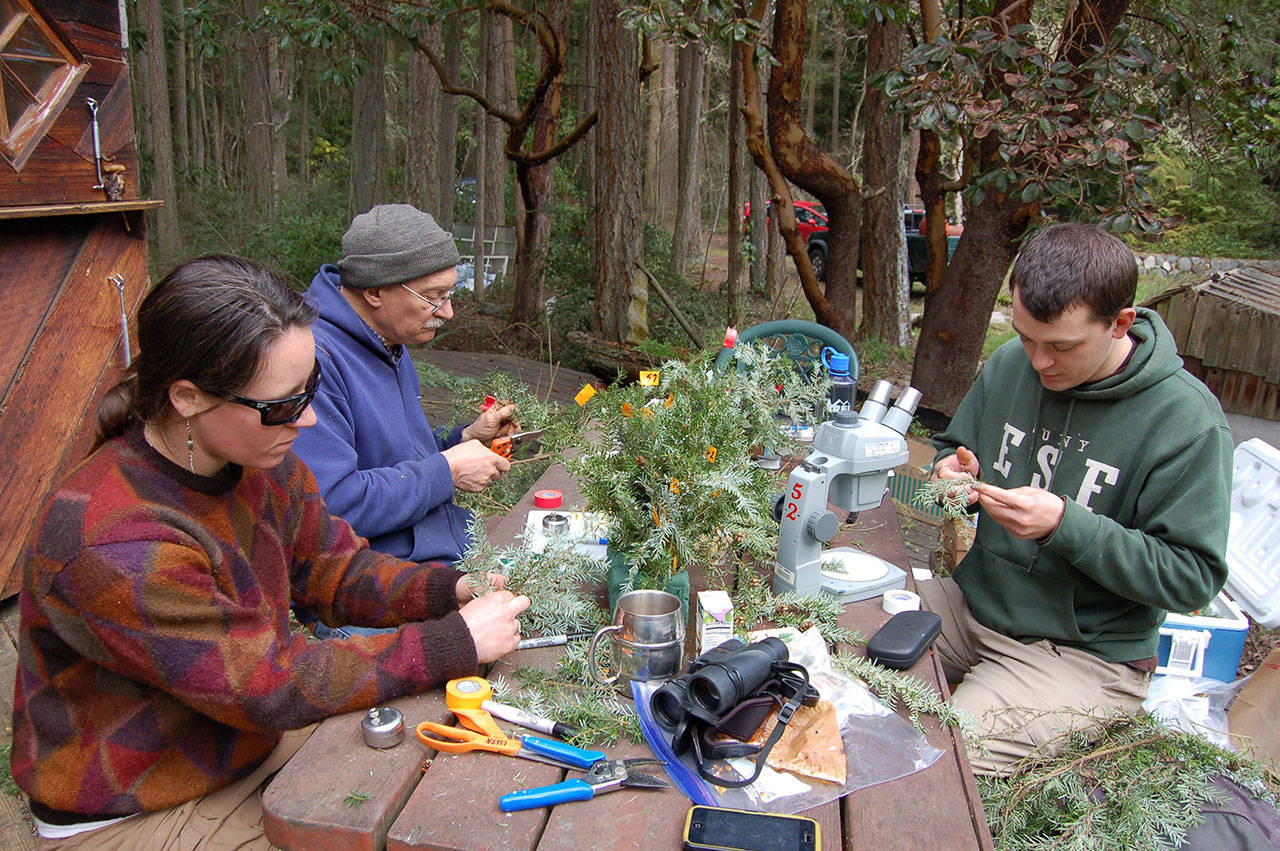
Elizabeth Sussky, left, Joseph Elkinton and Ryan Crandall, right, count insects found on samples of western hemlock from the Miller Peninsula. The team will collect 680 samples as part of a biological control experiment that could help save dying hemlock trees on the East Coast. (Erin Hawkins/Olympic Peninsula News Group)
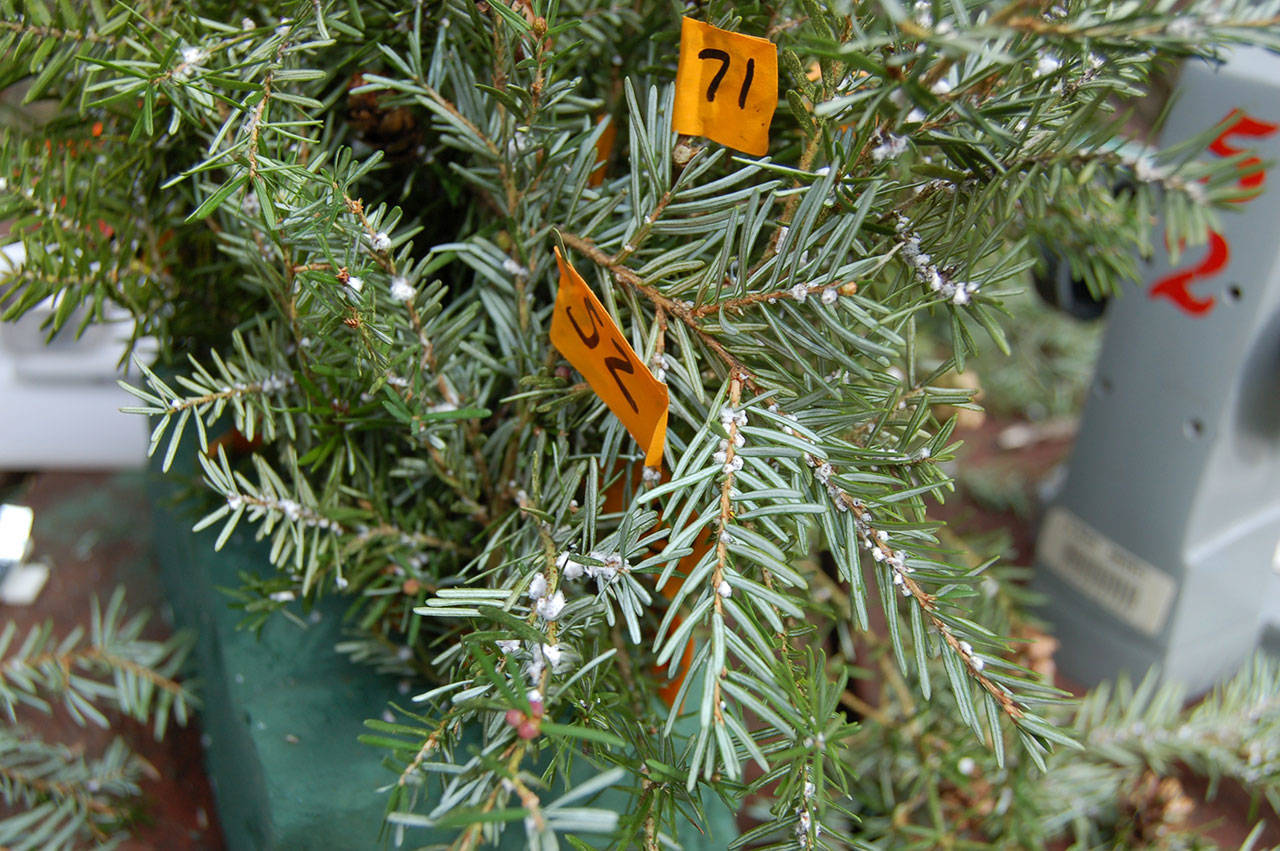
Elizabeth Sussky, Joseph Elkinton and Ryan Crandall are collecting 680 samples of western hemlock with heavy infestations of an invasive insect that are killing hemlocks on the East Coast. (Erin Hawkins/Olympic Peninsula News Group)
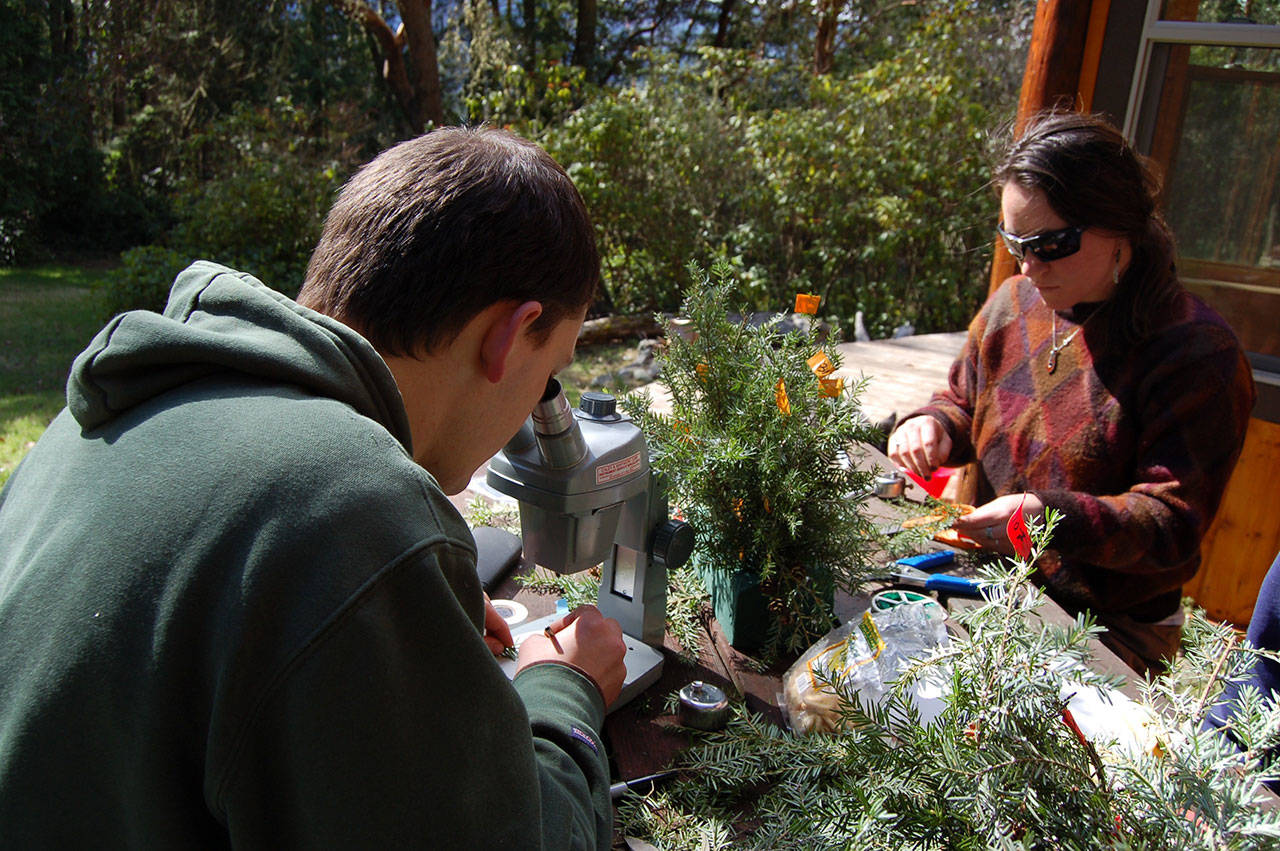
Ryan Crandall, left, looks at a western hemlock tree branch with infestations of an invasive insect killing hemlock trees on the East Coast. Elizabeth Sussky, right, counts the number of these insects on samples they will bring to the Seattle Arboretum for a biological control experiment. (Erin Hawkins/Olympic Peninsula News Group)
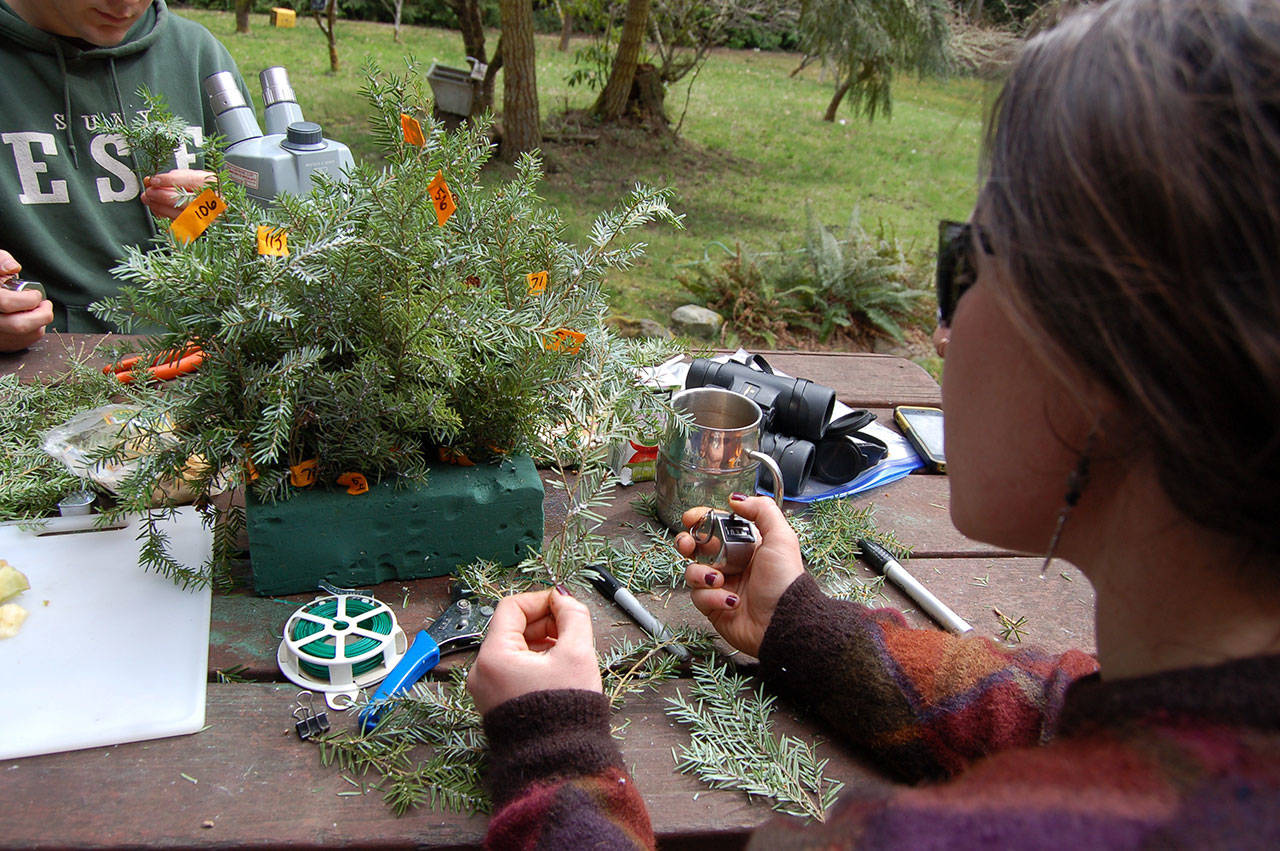
Elizabeth Sussky counts insects found on samples of western hemlock from the Miller Peninsula that her team will use as part of a biological control experiment. (Erin Hawkins/Olympic Peninsula News Group)
