
By Keith Ridler
The Associated Press
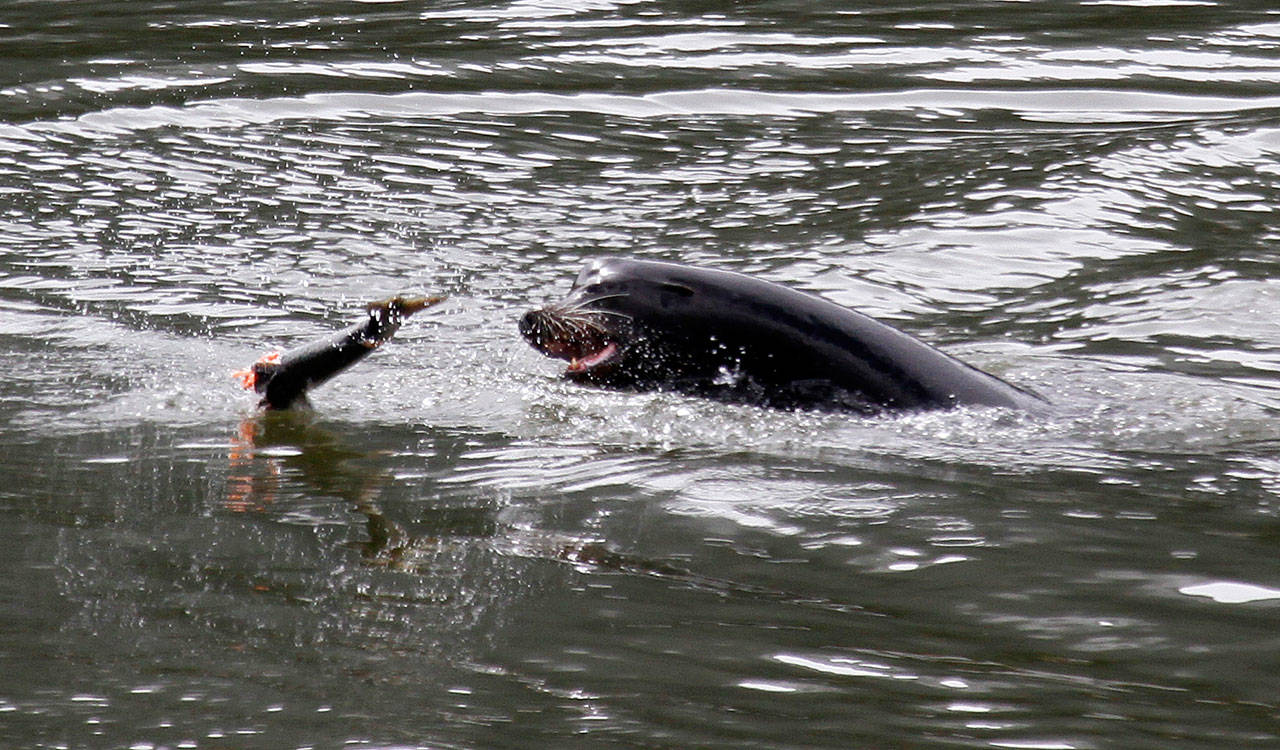
BOISE, Idaho — More California sea lions preying on imperiled salmon in the Columbia River below a hydroelectric project on the Oregon-Washington border are being killed under a revised policy, federal authorities said.
The National Marine Fisheries Service made public reduced criteria for removing sea lions at Bonneville Dam about 145 miles from the Pacific Ocean.
The new guidelines that went into effect April 17 permit any California sea lion seen in the area on five occasions or seen eating a fish to be put on a list for lethal removal.
- Related

State budget scrimps on replacing salmon-blocking culvertsMay 7, 2019
The former criteria required both those marks to be met.
Officials said 10 sea lions have been killed so far this year, most as a result of the policy change.
Robert Anderson, the agency’s marine mammal program manager, said Friday the Pinniped-Fishery Interaction Task Force decided to make the change after dissatisfaction with current efforts.
A study found the change could increase the number of sea lions killed by 66 percent.
Officials are authorized to remove 92 California sea lions annually from the area, but have never come close to that number.
Meanwhile, billions of dollars have been spent in Idaho, Oregon and Washington state to save 13 species of Columbia Basin salmon and steelhead protected under the Endangered Species Act.
Salmon and steelhead congregate near the bottom of the dam to go up fish ladders, facing some delays in “getting through the pinch points, and sea lions have figured that out,” Anderson said.
The California sea lions at the dam are all males, with some 200 to 300 showing up and numbers typically peaking in the spring.
They’re bulking up on salmon, with some sea lions reaching 1,000 pounds, before swimming roughly 800 miles to breeding beaches at the Channel Islands off the California coast.
Once there they try to establish territories, not eating for a month while mating with females in their area of control and fighting off rival males.
“It’s kind of classic biology,” Anderson said. “Get as big as you can to try to be successful.”
An estimated 70,000 California sea lions are drawn to the breeding beaches.
The overall population rebounded from about 30,000 in the late 1960s to an estimated 300,000 today, following the passage of the 1972 Marine Mammal Protection Act.
California sea lions at Bonneville Dam were a rarity until they started showing up in the early 2000s.
Authorities began the lethal removal list in 2008. Since then, some 400 sea lions have made the list, with 229 removed.
Of those, 15 have been sent to zoos or aquariums, seven died during capture, and 207 have been euthanized.
Killing sea lions “is not a long-term solution,” said Russ Kiefer, an Idaho Fish and Game fisheries biologist, noting the main problem for salmon and steelhead is habitat degradation along their migration corridor.
“It won’t be a game changer, but it will help.”
Snake River sockeye salmon, which reproduce in high-elevation Idaho lakes, teetered on extinction for several years before an elaborate hatchery program involving Fish and Game was created.
Last year for the first time, Stellar sea lions outnumbered California sea lions at Bonneville Dam, Anderson said. Federal authorities don’t have authorization to remove Stellar sea lions, which can reach 2,000 pounds. Stellar sea lions at the dam are also all males, bulking up before heading back to the Pacific Ocean and then, the majority, north to breeding areas.
In December, President Donald Trump signed a law that allows any California sea lion spotted 112 miles upriver from the mouth of the Columbia River to be put on the lethal removal list.
However, federal officials haven’t been doing that because they don’t have authorization, a process that would first require a request from Idaho, Oregon or Washington state.
Four tribes with fishing treaty rights also can make that request: Confederated Tribes of the Yakama Nation in Washington, Nez Perce Tribe in Idaho, Confederated Tribes of the Umatilla Indian Reservation in Oregon, and Confederated Tribes of the Warm Springs in Oregon.