
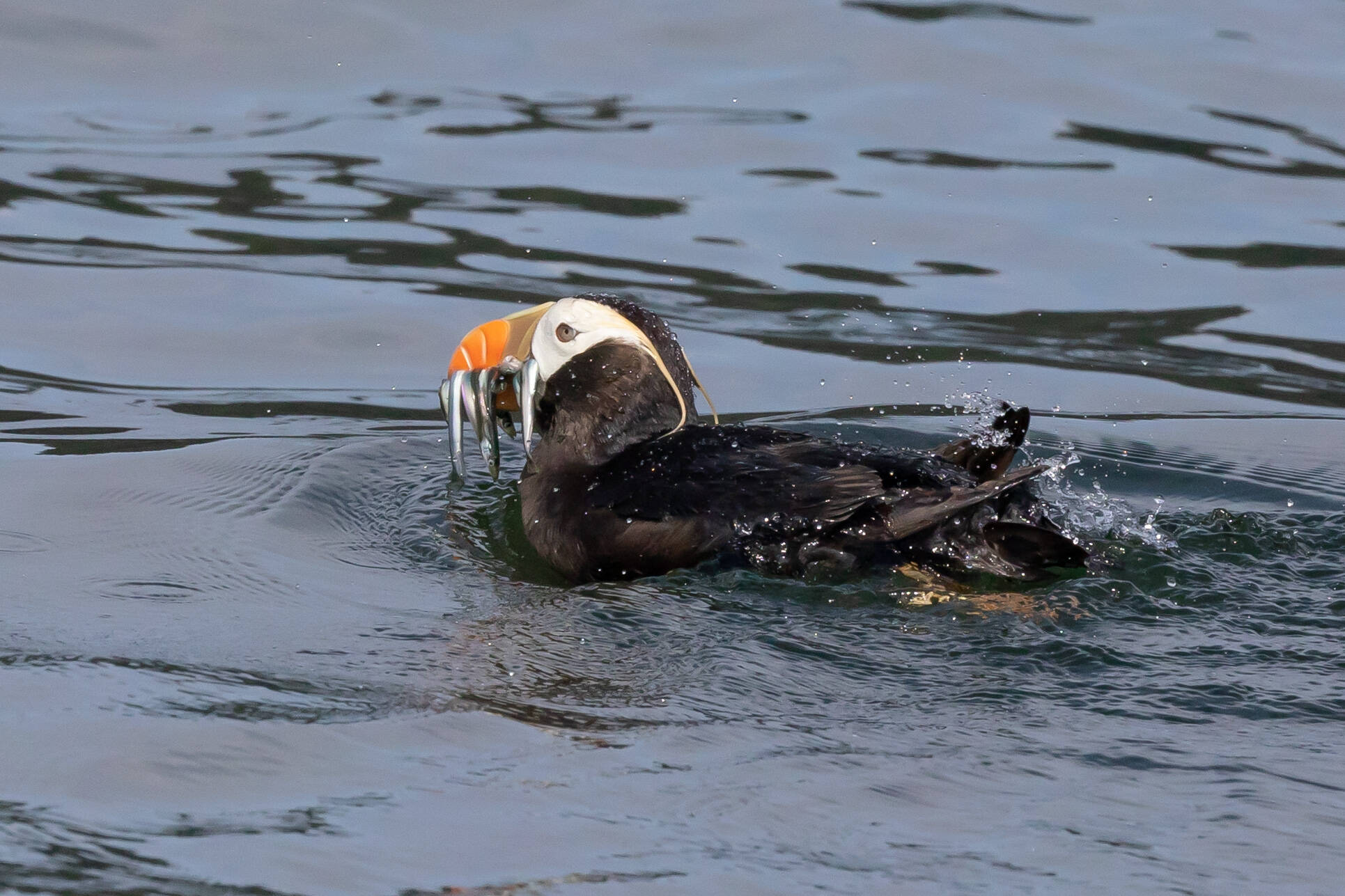
PROTECTION ISLAND — Once spread across the Salish Sea/Puget Sound, tufted puffins are now a rare sight in this area as their range contracts.
Endangered in Washington state since 2015, there was only one confirmed tufted puffin nesting pair active on Protection Island this breeding season, according to Scott Pearson, a senior research scientist with the Washington Department of Fish and Wildlife (WDFW).
The 364-acre Protection Island National Wildlife Refuge is one of only two places in the Salish Sea/Puget Sound that has a puffin colony: Smith Island, roughly northeast of Protection Island, is the other.
Pearson said Smith Island now has about 27 nesting pairs.
This summer, Puget Sound Express moved the destination for the puffin tours done in concert with the Port Townsend Marine Science Center from being exclusively Protection Island to potentially Smith Island, it said on its website.
‘The population on Protection Island has been declining for awhile,” said Betsy Carlson, citizen science coordinator for the Port Townsend Marine Science Center.
Tufted puffins typically court, nest and take turns raising their single puffling from mid-April to early September in Washington. The rest of the time they are traveling to or out in the open ocean, making them a pelagic seabird.
“Historically, there were 13 documented islands on which tufted puffins bred in the Salish Sea,” said Peter Hodum, one of the co-authors (along with Pearson), of the paper “Range-wide changes in the North American Tufted Puffin Fratercula cirrhata breeding population over 115 years,” found online at the Cambridge University Press website (cambridge.org).
Tufted puffin colonies on the Washington, Oregon and California coasts also are rapidly declining, according to the paper.
In the early 1900s, there were 43 active colonies along the coast and now there are 19. Hodum, during a talk for Harbor Wildwatch available on Youtube, (youtube.com/watch?v=9-l8PBDqA0E) said that in the early 1900s there was an estimated population of 25,000 and in 2010 an estimated 2,950.
The state’s tufted puffin plan, drafted in 2019, can be found at the WDFW website (wdfw.gov). It looks at causes of the decline and actions to address it. wdfw.wa.gov/sites/default/files/2019-06/6.%20TuffedPuffinDraftPSRReport.pdf Those include: prey/food decrease and climate change in addition to predation, disturbance, introduced species and pollution, explained Malia Somerville, general curator at Point Defiance Zoo, where the puffins successfully breed in captivity.
“An important part of trying to recover endangered species is identifying why they are endangered in the first place…. As long as that is still a problem, there isn’t a safe space for new animals to move into,” Somerville said.
“Any additional animals added to the population would similarly struggle to find food and survive while burdening the already dwindling resources. Those reintroduced birds would not have a high likelihood of success and would likely not result in an increased tufted puffin population.
“The state’s recovery plan does mention reintroduction as a possibility, noting it has not been tried before with this species and that the species is particularly sensitive to disturbances. That and other factors may mean reintroduction is not a viable option for tufted puffins.
“The vast majority of the plan focuses on improving habitat conditions for wild birds. If reintroduction was to be discussed as a priority within the recovery plan, there would be many conversations, discussions, questions, decisions, planning, et cetera.”
The U.S. Fish and Wildlife Service in 2020 declined to label the tufted puffin endangered, thus denying them federal endangered species protections.
In a 2020 U.S. Fish and Wildlife press release(www.fws.gov/press-release/2020-12/tufted-puffin-does-not-require-endangered-species-act-protections#:~:text=The%20U.S.%20Fish%20and%20Wildlife,available%20science%20for%20the%20species), federal officials justified the decision based on the size of the Alaskan colonies.
Range shrinking
The status review found that tufted puffins are undergoing a range contraction, specifically on the southern end of their range, which is where Protection and Smith Islands lie, “but that the species continues to be widely distributed across the northern part of its range and maintains high overall abundance,” the release said.
“What appears to be happening is we’re losing the buffer area, the edges of their distribution,” Hodum said, “[though] not so much in the heart of their population, where they seem to be stable.”
According to WDFW, “The tufted puffin is found throughout the upper latitudes of the North Pacific Ocean. It … nests during spring and summer in coastal colonies from California north to Alaska, and from Siberia south to Japan. Steep population declines throughout the southern part of its range suggest that the species may be undergoing a significant range contraction.”
In Japan, tufted puffins are officially endangered. According to Kyodo News, “The approximately 40-centimeter-tall birds, known as ‘Etopirika’ in Japan, nest in burrows on islands and in coastal areas along the North Pacific, including Moscow-held islands off Hokkaido claimed by Tokyo. The global population was estimated at 3.5 million in 1996, but numbers in Japan have been in rapid decline since the 1970s.
“The domestic count in 2015 was estimated to have decreased by 87 percent from 1980, according to Hokkaido University, and the seabird is categorized as highly endangered on the Environment Ministry’s Red List of threatened species.”
Global issue
For the last three years there has been only one confirmed nesting pair on Protection Island, according to Hodum.
Hodum told Harbor WildWatch that this has decreased from estimates of several hundred pairs in the past.
Marty Bluewater, who has lived on and off the island since the early 1970s — his home grandfathered into the sanctuary — said that he has seen three or four puffins on the water this year.
The additional puffins are likely unmated puffins returning to the island where they were born, as the puffins are generally thought to return to their place of origin each year, although there are exceptions to that rule, according to Hodum.
Bluewater said that even in the 1970s there weren’t many puffins.
“There were maybe 20 back then. And now these days I see a couple here and there,” he said.
“It’s sad to think they’ve dwindled down. I don’t know what the answer is, if there is an answer.”
Hodum said that there is a small possibility of another nesting pair on Protection Island but, “when you get to that few, whether it’s one or two, the take-home message doesn’t change.
“We’re on the cusp of losing tufted puffins — not just from Protection Island, but from the entire Salish Sea.”
________
Emily Matthiessen is a reporter with the Olympic Peninsula News Group, which is composed of Sound Publishing newspapers Peninsula Daily News, Sequim Gazette and Forks Forum. Reach her at emily.matthiessen@sequimgazette.com.
