
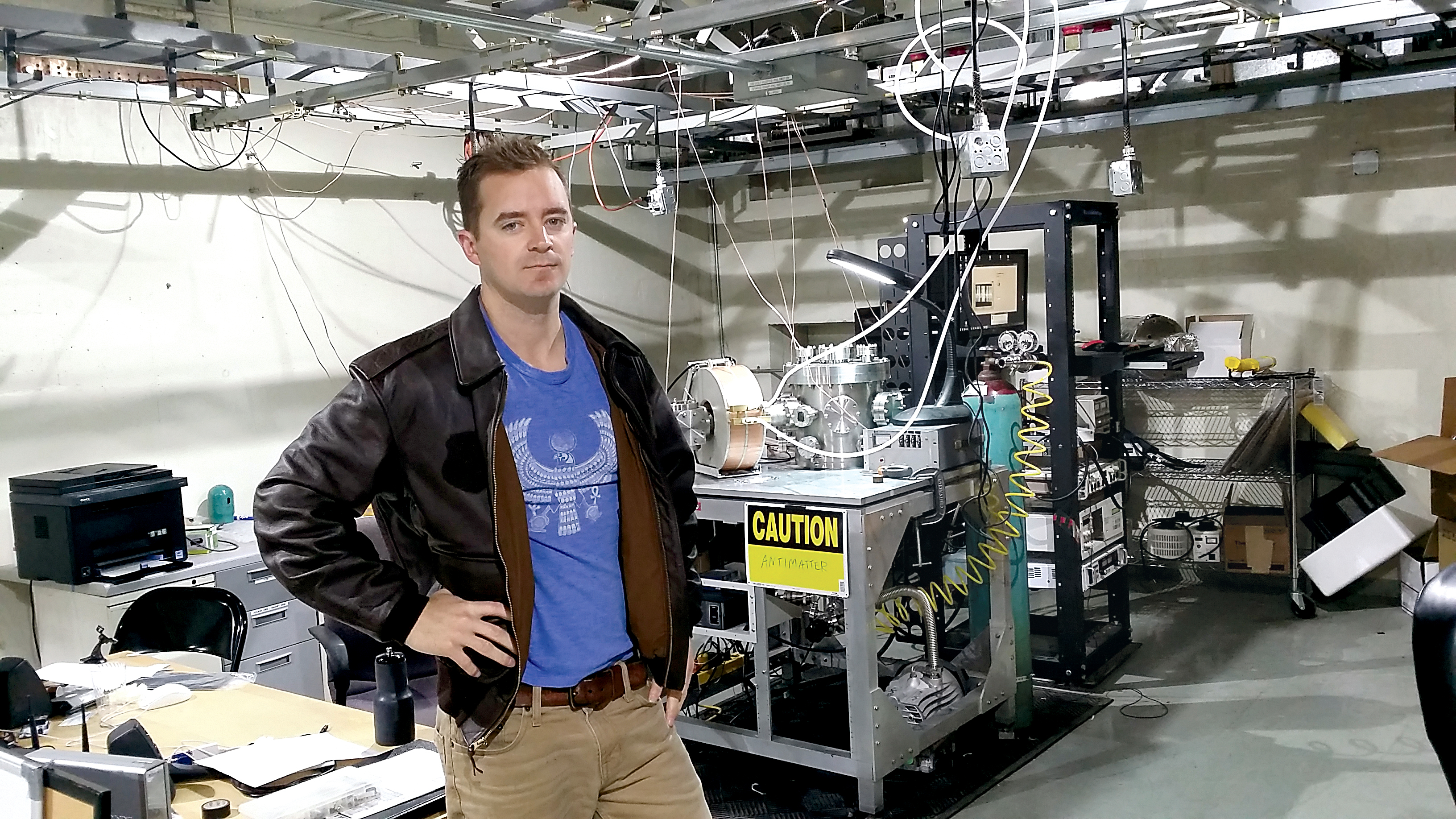
PORT ANGELES — A Port Angeles High School graduate aims to make interstellar travel a reality by making the world’s first antimatter rocket.
Ryan Weed, 31, now living in Seattle, and a team of researchers are attempting to harness the energy of positrons, also referred to as anti-electrons or antimatter — an endeavour once the realm of science fiction.
If they are successful, interstellar flight may be possible within the next century, he said.
“Antimatter is real,” said Weed, who graduated from Port Angeles High School in 2002 and has since lived in six countries and visited six continents.
“We even use it at most hospitals to image tumors” with positron emission tomography scanners, which are known as PET scanners, he said.
Weed, an Air Force pilot who flies out of Joint Base Lewis-McChord south of Tacoma, is cofounder and CEO of Positron Dynamics, a Livermore, Calif.-based company working to develop an antimatter rocket.
He has a bachelor of arts degree in physics from Wesleyan University in Middletown, Conn., a bachelors of science in engineering-applied physics from Columbia University, New York, and a doctorate from the Center of Excellence in Antimatter Matter Studies at the Australian National University.
His parents are Terry and Sherry Weed of Port Angeles. He has two older brothers and one older sister, also Port Angeles High School graduates, who no longer live in Port Angeles.
Weed is one of 13 fellows scheduled to be recognized for his work in antimatter propulsion at the WIRED2015 Innovation Fellowships held Oct. 15-16 in London.
He was nominated by a former Innovation fellow.
“It’s truly an honor and I’m looking forward to presenting our concepts and meeting some amazing people,” Weed said.
While there, he will “speak about why we need a game changing technology in space propulsion and how we can get to the stars,” he said.
In high school Weed “was interested in figuring out [how] things worked, [and] doing science things that I thought were interesting and cool,” he said.
“For example, a friend and I built a railgun [an electrically powered electromagnetic projectile launcher] in my garage from equipment we bought on eBay.
“Now the Navy is using railguns on their destroyers. Maybe it’s a coincidence that the things I think are cool just happen to be scientifically important,” he said.
Weed hopes someday to be accepted into NASA’s astronaut candidate program.
“I will apply in the next round, but they only ask for applicants once every four to five years,” he said and it might be a year or two until the next round.
Weed wants to become an astronaut because he is “an explorer at heart.
“I’ve always been attracted to strange and far-off places and activities that push the limits of human capability,” he said.
Positron Dynamics, founded in 2011, consists of five employees including a staff scientist and a semiconductor fabrication expert.
The company conducts experiments in a former nuclear fallout shelter in Livermore.
The experiments focus on ways to harness the energy of positrons to produce a propulsion unit capable of thrusting a rocket to extremely high speeds.
The engine envisioned by Positron Dynamics would have the potential of reaching “10 percent the speed of light, which is 20,000 miles per second,” Weed said.
That is the equivalent of 72 million miles per hour.
To put that into perspective, the now retired space shuttle was capable of a top speed of about 18,000 miles per hour, according to NASA.
“We believe antimatter propulsion is feasible and we are attempting to demonstrate” a working model “in the next few years,” Weed said.
“We are aiming for an in-space demonstration, working with our spacecraft design partner Mason Peck at Cornell University, within three years.
“This tech could scale to allow us to reach our nearest star system, Alpha Centauri, within a human lifetime,” Weed said.
After the first demonstration, “we expect the first customers to be Department of Defense followed by low earth orbit small satellite manufacturers,” Weed said.
Antimatter is the most potent fuel known to man, according to NASA.
While tons of chemical fuel are needed to propel a human mission to Mars, just tenths of milligrams of antimatter will suffice. A milligram is about one-thousandth the weight of a piece of M&M candy.
Antimatter is sometimes called the “mirror image” of normal matter because while it looks just like ordinary matter, some properties are reversed, according to NASA.
For example, normal electrons — particles that carry electric current in everything from cell phones to plasma TVs — have a negative electric charge. Anti-electrons have a positive charge, so scientists dubbed them positrons.
“When antimatter meets matter, both annihilate in a flash of energy,” wrote Bill Steigerwald of the NASA Goddard Space Flight Center on the NASA website, www.nasa.gov/.
“This complete conversion to energy is what makes antimatter so powerful,” he added.
“Even the nuclear reactions that power atomic bombs come in a distant second, with only about three percent of their mass converted to energy.”
One of the obstacles Positron Dynamics is working to overcome is that high-energy gamma rays can create radioactivity, which can make materials like steel and aluminum brittle after long exposure.
Special alloys can withstand the onslaught of gamma rays, Weed said.
“In addition, we are working with a company that has developed novel gamma ray shielding tech that utilizes a flexible Tungsten foam material to efficiently block gamma rays,” he added.
For more information about Positron Dynamics, visit www.positrondynamics.com.
________
Sequim-Dungeness Valley Editor Chris McDaniel can be reached at 360-681-2390, ext. 5052, or cmcdaniel@peninsuladailynews.com.
