
SEQUIM — Meet one of Sequim’s newest residents: the yellow-bellied marmot.
Spotted in late March along Sequim waters, the presence of the animal is a rarity, according to resource managers and experts.
“It’s definitely not native,” Richard Klawitter, a Port Angeles photographer and retired physical therapist, said of the yellow-bellied marmot, also called “rock chucks.”
Klawitter has been photographing Olympic marmots, a local marmot in Olympic National Park, since 1999 when he snapped a pup yawning.
That piqued his curiosity, leading Klawitter to spend a considerable amount of time observing them and working with researchers, he said.
Through his permitted observations and studies, he’s become well-versed on marmots and has given numerous talks about them.
“With marmot questions, they tend to come to me, which is fun,” Klawitter said.
Seeing the yellow-bellied marmot is unique, he said, because it’s only the third reported sighting of one in Western Washington in about a decade — one in Grays Harbor, another in Olympia and now one in Sequim.
“What’s surprising is that all three have been reported near water, which is not its typical habitat of dry and arid,” Klawitter said.
“It’s not an aquatic animal. It gets its water from the food it eats.”
Also known as a rock chuck, the yellow-bellied marmot tends to live in arid, low elevation areas in Central and Eastern Washington, he said.

The yellow-bellied marmot, or rock chuck, is not typically seen in Western Washington and particularly not near water says photographer Richard Klawitter. He said of the three Western Washington sightings in this half of the state, they were in Grays Harbor and Olympia. Photo courtesy of Richard Klawitter
Sequim’s yellow-bellied marmot was spotted by a homeowner along the Strait of Juan de Fuca on March 19 and then connected with a neighbor who contacted researchers with the University of Washington, and University of Alaska.
They confirmed it was a yellow-bellied marmot, Klawitter said.
He was contacted and went to the area but didn’t see it. Klawitter learned it moved four houses down and he was able to photograph it in early April.
It’s unknown if it’s male or female, but Klawitter said the odds of two showing up in the same place are slim.
“They are known to hitch rides like Olympic marmots, I’ve heard of three or four come off the mountain in tourists’ cars,” he said. “I think they’re attracted to radiator or brake fluid and do chew through lines.”
Klawitter said he had a marmot in his truck at one point, but found it and took it out.
“It could have happened with this one. Maybe someone got hay in March and it came over or it somehow got in a tourist’s car,” he said.
Where Sequim’s yellow-bellied marmot is now is likely where it’ll stay, Klawitter said.
“It’s at home in terms of what it’s used to (with rocks),” he said.
Klawitter said he told the homeowner there are three likely scenarios: the marmot could be predated, it could disperse or find another animal to associate with in the area.
The yellow-bellied marmot is one of the smaller marmots; this one appears to be about 16 inches, Klawitter said.
As a common animal elsewhere in the western U.S., the yellow-bellied marmot is not a threatened species and should pose no threat to the Olympic marmot since they prefer different habitats, he said.
Klawitter said he is surprised the hoary marmot isn’t reported more in Western Washington as they live in elevations more in Central Washington and closer to this area.
Efforts continue to monitor and preserve the Olympic marmot in Olympic National Park. A program launched in 2010 to monitor the animal’s declining numbers with studies continuing this year.
For more information, visit nps.gov/olym/learn/nature/olympic-marmot- monitoring.htm.
Olympic marmots, or any marmot, aren’t common in the greater Sequim area, resource managers report.
Lorenz Sollmann, deputy project leader at the Washington Maritime National Wildlife Refuge, said they haven’t had any documented marmots at the refuge in his tenure.
Hansi Hals, natural resources director for the Jamestown S’Klallam Tribe, said she knows of occasional Olympic marmot sightings in the foothills because they can disperse to low elevations.
She also said “they can also inadvertently take a ride, but that would occur in the summer months.”
________
Matthew Nash is a reporter with the Olympic Peninsula News Group, which is composed of Sound Publishing newspapers Peninsula Daily News, Sequim Gazette and Forks Forum. Reach him at mnash@sequimgazette.com.
Editor’s note: Homeowners asked that the specific location of the yellow-bellied marmot not be disclosed to prevent any potential issues with visitors.
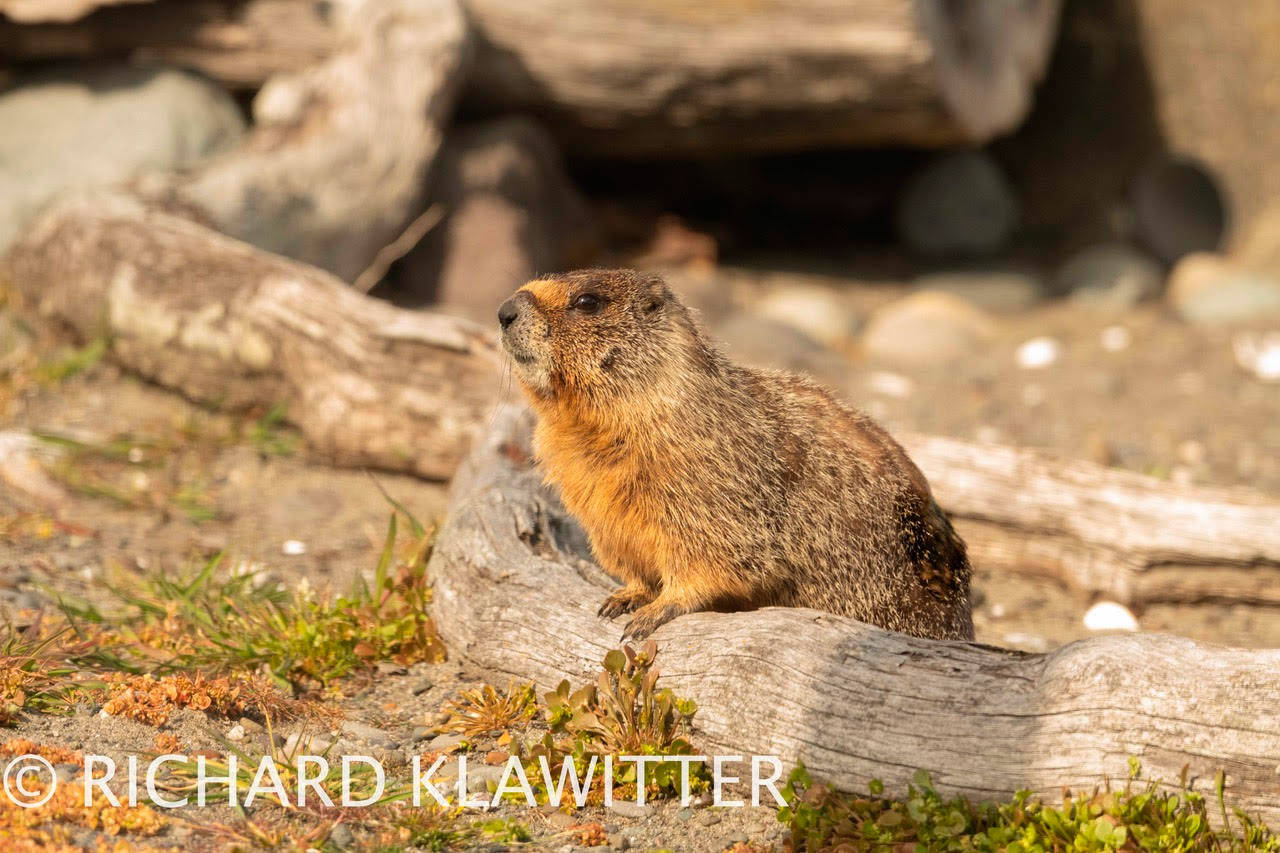
How this yellow-bellied marmot got to Sequim is unknown, but some think it may have hitched a ride in a vehicle from Eastern Washington where it is more native. Photographer Richard Klawitter said it’s only the third sighting of the animal in Western Washington in about a decade. Photo courtesy Richard Klawitter

This yellow-bellied marmot now calls Sequim home after being spotted in the area in March. It’s native to Eastern Washington and more arid climates. Photo courtesy Richard Klawitter
