
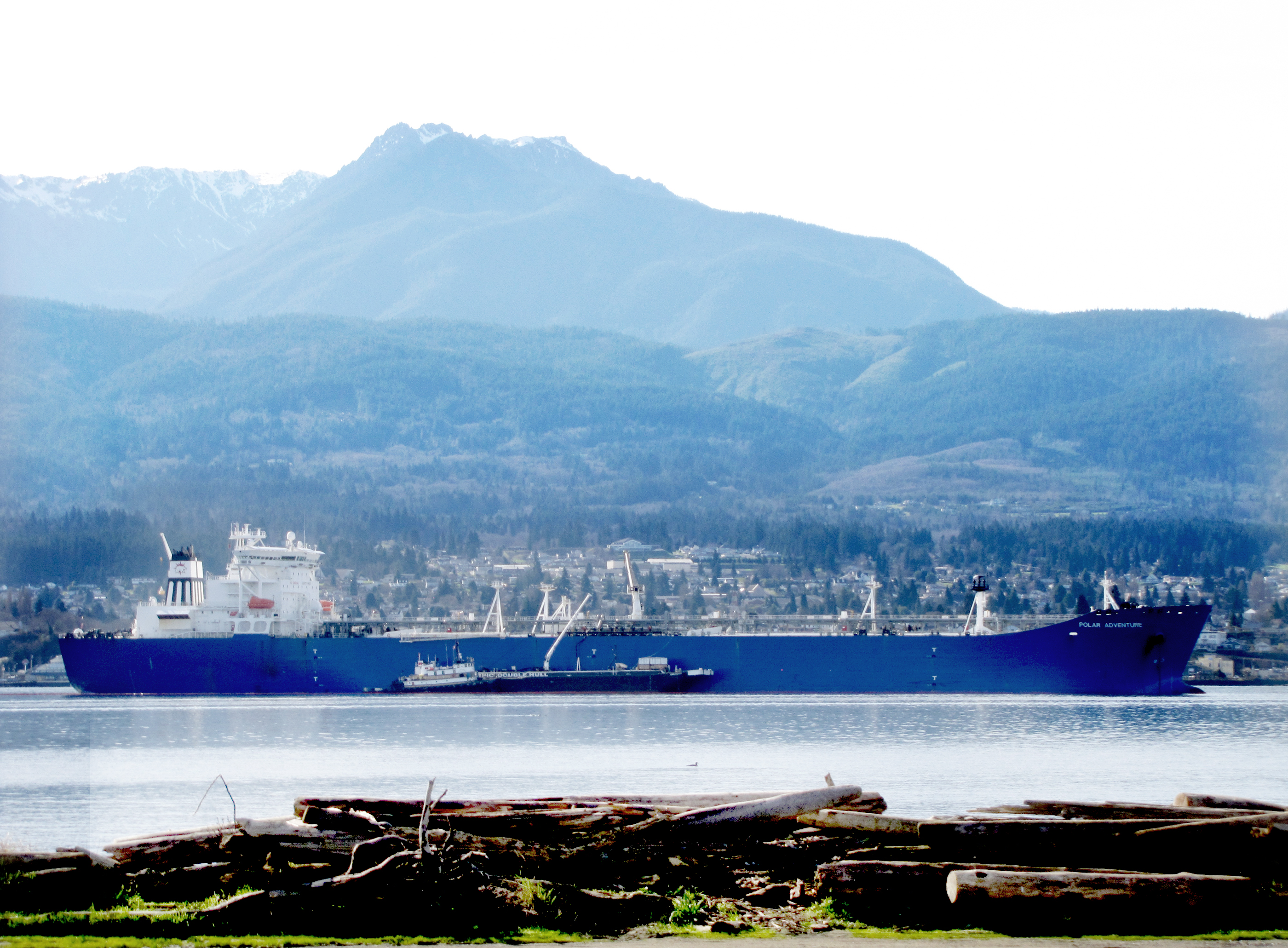
If you fear a big oil spill on Washington waters, you’re wiser to worry about small spills and fret about them more often, according to several public and private agency experts.
They told an oil spill forum earlier this month that pleasure craft and fishing boats leak more oil than do cargo ships, luxury liners or tankers.
And on the North Olympic Peninsula, they said, be grateful we have no train tracks because the threat from so-called crude by rail is greater than a marine spill.
Still, no one dismisses the possibility of a disaster like the Arco Anchorage catastrophe in Port Angeles Harbor late in 1985 “when a lot of folks instead of spending Christmas with their families went out and worked on an oil spill,” said Jeff Ward of the Clallam County Marine Resources Committee.
The committee and the Northwest Straits Commission sponsored the forum Feb. 5 at Port Angeles City Hall.
Participants included representatives of the Coast Guard, the state departments of Ecology and of Fish and Wildlife, British Petroleum and the Makah tribe.
“This is truly the safest place as far as a large port,” said Coast Guard Capt. Joe Raymond, commander of Sector Puget Sound, “and you are doing the most to take care of oil safety.”
As of Jan. 1, he said, no more single-hulled tankers ply Puget Sound.
“There’s steel, air and steel before you get to oil,” he said, and the oil storage tanks themselves are divided into segments.
Regulators also are insisting that bunker oil — fuel — be stored inside the hull instead of just beneath a ship’s skin.
Forty percent of ocean-going ships have been so equipped, Raymond said.
Of the estimated 10,000 freighters that travel the Strait of Juan de Fuca annually — about 800 a year fewer than a peak in 1990 — the Coast Guard detains between 30 to 40 ships a year, as it did the 748-foot Overseas Jademar last week in Port Angeles Harbor.
The Marshall Islands-flagged ship filled with Malaysian crude resumed its journey to Anacortes on Thursday after fixing safety deficiencies.
“If there is a safety or a security risk, we will meet them when they come into the Straits,” Raymond told the two-dozen people who attended the forum.
Canada and the United States share vessel traffic control off the coast and through the Strait, “which keeps the big ships in our very wide channels, our very deep channels,” he said, adding that the biggest risk of collision comes from pleasure craft and fishing boats that cross vessel traffic lanes.
Derelict vessels — especially pleasure boats whose ownership changes and evades detection — also pose problems. One derelict in Penn Cove on Whidbey Island leaked 8,500 gallons of oil that closed a commercial mussel farm for a month.
“We chase the same vessels over and over again,” Raymond said, “vessels coming down to the end of their lifetime that get passed on from owner to owner. They’re sold for a buck on the back of a bar napkin.”
Smaller sailors account for half the incidents and three-quarters of the volume of spilled oil.
Simultaneously, large-vessel traffic remains stable as container ships grow as big as aircraft carriers and luxury liners get larger.
“We literally measure our spills today from tankers in ounces, literally in ounces,” Raymond said.
The state Department of Ecology’s Dave Byers, the state’s response manager, said these precautions prevent major mishaps:
■ Prebooming, surrounding tankers with floating cordons when they transfer oil to or from barges or onshore tanks.
■ Caching spill-cleanup supplies in 99 locations around the state and training first responders to contain spills to immediate areas even before cleanup crews arrive.
■ Conducting three drills a year in hazard-likely areas: two exercises on the water, one a tabletop exercise.
■ “Fingerprinting” oil samples to identify polluters.
The state Fish and Wildlife Department oversees the rescue of oiled birds and mammals by volunteers who must undergo three days of free hazardous-waste operations and emergency response training, known as HAZWOPER, and annual one-day refreshers.
HAZWOPER classes will be held in Clallam County in March, with oiled-wildlife classes scheduled in April.
For more information, visit www.clallam.net/ccmrc.
Meanwhile, the Makah tribe, whose treaty waters have endured 1 million gallons of spilled oil, is updating its 2010 study of tanker traffic.
“Catastrophes usually start six or seven steps earlier,” said Keith Ledford of the tribe, citing human errors or equipment failures.
“We must try to interrupt the process at the beginning,” he said. “That’s where our energy is best spent.”
The tribe predicts a 25 percent increase in vessel traffic over the next decade, an 18 percent increase in oil spill risk and a 68 percent increase in spilled oil.
The threat is three times greater at Haro Strait, which lies between Victoria and the San Juan Islands, than at the entrance to the Strait of Juan de Fuca, Ledford said.
That, though, is less than the threat posed by oil moving by rail, the forum panel members said.
The risk for spills is mounting in Eastern Washington, according to the Coast Guard’s Raymond.
Railroad accidents, Byers said, spilled more oil in 2014 than trains spilled in the previous three decades.
Even with comparative safety of oil on the water, none of the participants could promise that no catastrophic spill could occur on the Strait of Juan de Fuca or the Pacific Coast, given the demand for petroleum products, the press of refinery schedules and the vagaries of tides and winds.
“It’s just the world we live in where it’s not going to be safe,” said BP’s Scott McCreery.
“There’s still always a risk, and that gives us concern for the wonderful creatures we have here,” said Dave Noviello of Fish and Wildlife.
“Prevention is the best solution.”
________
Reporter James Casey can be reached at 360-452-2345, ext. 5074, or at jcasey@peninsuladailynews.com
