
EDITOR’S NOTE: Related April 21 story: “Government expects legal action in wake of Elwha River sediment flowing into, clogging water plant”: https://giftsnap.shop/article/20130421/news/304219986
PORT ANGELES — Has the city’s drinking-water supply been compromised by sediment from the Elwha River Restoration Project?
Water from the city’s Ranney Well on the banks of the Elwha River is safe to drink and “crystal clear” now, city Public Works Director Glenn Cutler said Monday.
But how long will that last?
Cutler doesn’t know, he said Monday after touring the sediment-inundated area around the well with Olympic National Park and city officials.
And whether the well, which feeds the Port Angeles Water Treatment Plant, is impaired now isn’t known, either, he said.
“I am concerned about the quantity of the water that we are able to get up to the plant and whether the Ranney Well has been impaired or not,” he said.
“We are watching the height of the water column and collecting data at this time.”
Cutler said he might know more after a consultant from Kansas-based Layne Christensen Co., a water-management and drilling company, visits Port Angeles next week to review well logs and past and current data from Ranney, Cutler said.
Elwha River sediment unleashed by the nearly completed removal of two dams is inundating the shoreline around the city’s well, the main source of water for Port Angeles residents, including those in unincorporated areas to the east of the city.
An estimated 34 million cubic yards of sediment was behind the Glines Canyon and Elwha dams, with an estimated 6 million — the predicted amount, officials say — having moved downstream.
Water that was blue is now dark gray as it rushes down a side channel adjacent to the octagonal-shaped well.
The well is perched on land west of Port Angeles that includes a state Fish and Wildlife fish rearing channel and the National Park Service-owned Elwha Water Facilities treatment plant and intake apparatus — which are struggling with sediment-clogged filters.
The treatment plant eventually will be turned over to the city, Cutler said.
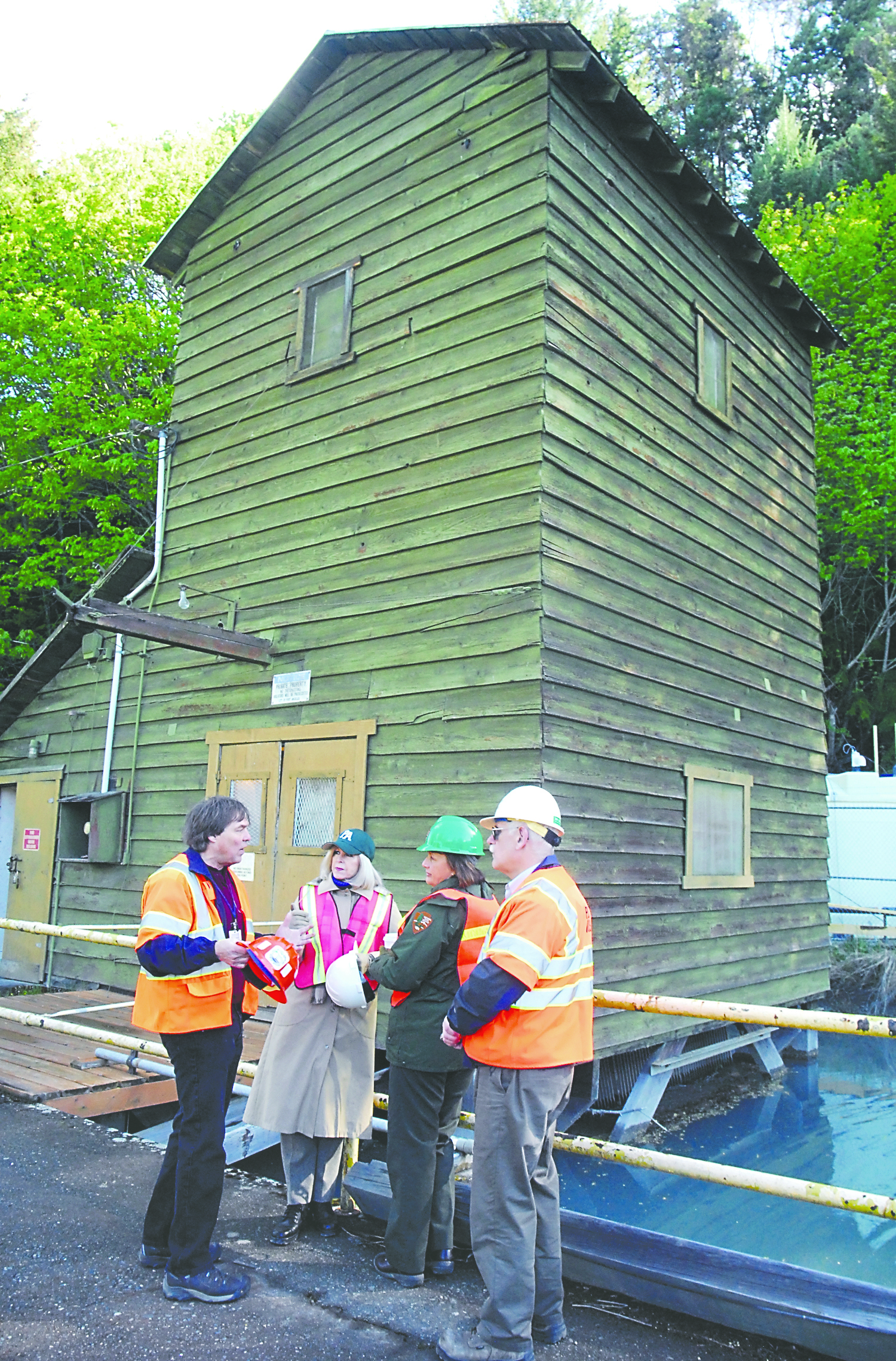
A tour Monday of the site, including the Ranney Well, included Olympic National Park Superintendent Sarah Creachbaum and Elwha River Restoration Project Manager Brian Winter, who joined Mayor Cherie Kidd, City Manager Dan McKeen, City Public Works Water Division Superintendent Ernie Klimek and Cutler.
The broad expanse of property is located on Crown Z Water Road beneath the Elwha River Bridge, built in 2009.
“I just want us to look at this together so that once we start to talk about solutions, we’re on the same page,” Kidd told the group as it set out on the walkabout.
“We have to deal with reality.”
Cutler outlined that reality from the city’s perspective.
He told the group that he wants to ensure that sufficient water make its way to the well and that fine sediment does not migrate through to the water it holds.
“My concern is the long-term migration of the sediment,” Cutler said.
Creachbaum said it was her first visit to the Ranney Well, a kind of well that has a center caisson and pipes that extend radially into an aquifer.
“We are all doing everything we can to ensure the safety of the water for downstream users,” Creachbaum said as she walked within 10 yards of the facility.
Underfoot, mixed with discolored grass, was an odorless, thick mat of gray sediment that had the feel and consistency of soft, uncured cement.
Across a tiny channel was a shoreline of sediment, its edges sharply square like a gray slab hanging above the moving water.
The sediment is building up new banks, covering existing rocks and making it impossible to see the riverbed, though Monday morning it was just a few feet below the surface.
“The change is enormous,” Kidd said in a later interview.
“[Creachbaum] made it very clear she wants to resolve this for our community,” the mayor added.
“No doubt, we have our work cut out for us.”
Sediment has already overtaken the $79 million Elwha Water Facilities, the priciest component of the $325 million Elwha River Restoration Project.
The 108-foot Elwha Dam has been removed and the 210-foot Glines Canyon Dam still has 60 feet to go, but dam removal has been halted since October while the sediment problem — which the Elwha Water Facilities was built to address as the dams come down — is solved.
Sediment that was supposed to be screened has instead entered the plant, though the facility is continuing to provide treated water to Nippon Paper Industries USA, park spokeswoman Barb Maynes said Monday.
Part of the tour consisted of viewing the intake apparatus, which includes two cylindrical screens placed vertically in the water with what resembles an oversized manhole cover on top.
Both those screens failed at sifting sediment, and four other screens that were supposed to be placed near the first two are stored in a 40-foot container on the property while workers determine a fix.
“Issues are arising, and they continue to arise,” Maynes said, adding that she could not identify those issues.
Sediment is entering area of the plant it was not intended to be, Maynes said.
“As issues evolve, responses to the issues evolve.”
Maynes said the park would not allow a Peninsula Daily News reporter inside the National Park Service-owned facility, which is built on city of Port Angeles property.
“This is not an open, public facility,” Maynes said.
________
Senior Staff Writer Paul Gottlieb can be reached at 360-452-2345, ext. 5060, or at paul.gottlieb@peninsuladailynews.com.
