
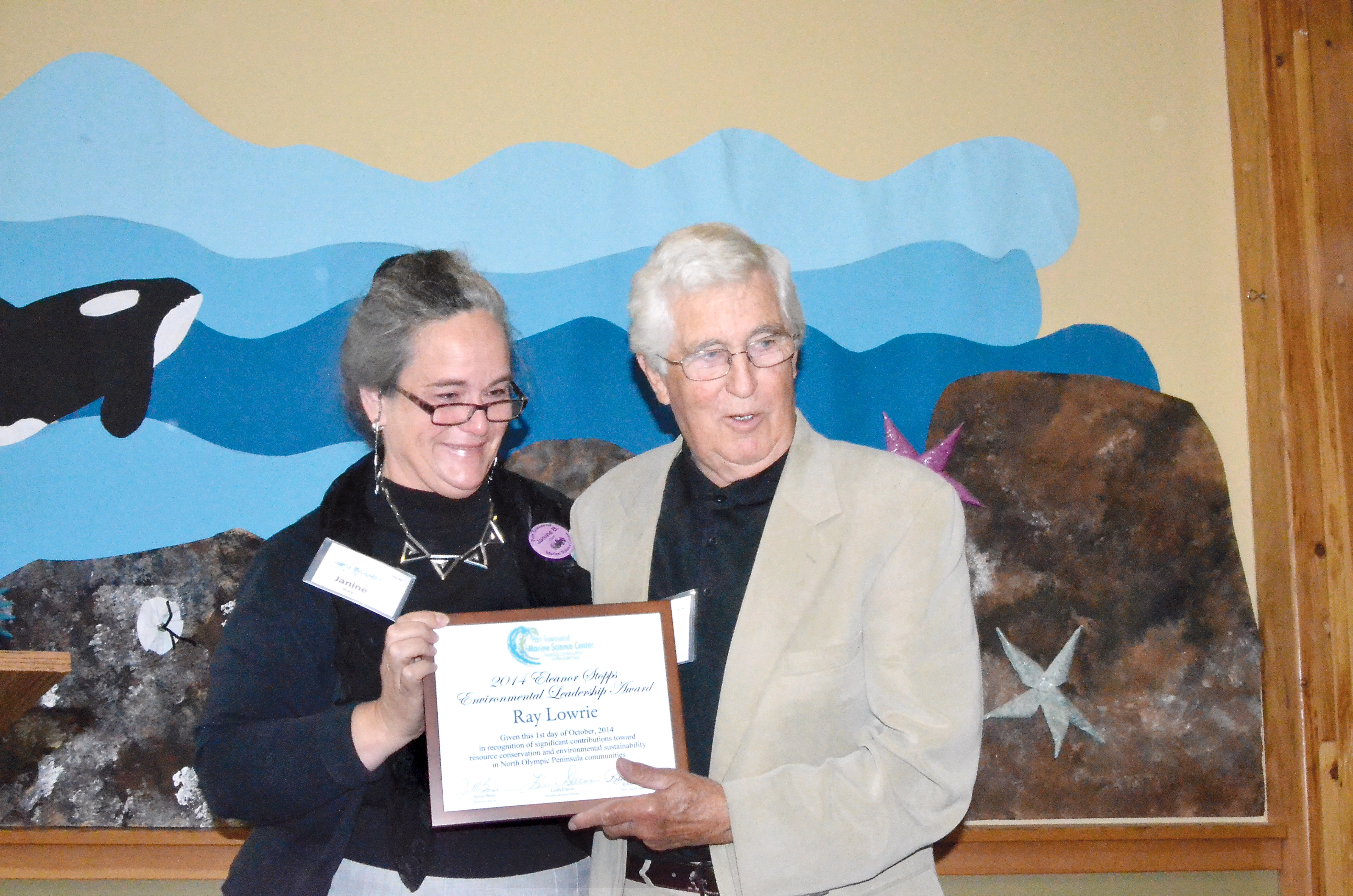
PORT TOWNSEND — A retired science teacher whose efforts were instrumental in the rehabilitation of Chimacum Creek was honored Wednesday with the 10th annual Eleanor Stopps Environmental Leadership Award.
Ray Lowrie, who taught in the Chimacum School District for 30 years, was given the award at a fundraising breakfast for the Port Townsend Marine Science Center.
“The main theme of the breakfast today is learning,” said Janine Boire, the center’s executive director.
“This is learning that changes lives, intergenerational learning and taking it to the next level to ‘go blue’ and support our oceans.”
The center raised a total of $50,160 at the breakfast at Fort Worden Commons that was attended by about 165 people.
An anonymous donor gave $25,000 of that through a matching grant.
Stopps, who died of cancer in April 2012 at the age of 92, was responsible for the 1982 establishment of the Protection Island National Wildlife Refuge, the only refuge created by public initiative during the Reagan administration.
Lowrie, 82, began teaching in Port Townsend in 1957 and moved to the Chimacum School District in 1960. He retired in 1992.
He said that when he began teaching, the students didn’t respect salmon and in fact killed them as part of a game.
“I had kind of a rough crowd, but they were really neat kids,” Lowrie recalled.
“Being a country boy myself, I appreciated when they came in smelling like low tide because they would go out early in the morning and dig clams in order to get pocket money.
“One of the kids came in one day and said he had spent the morning with a friend and had killed 95 salmon with machetes and felt bad because his friend had killed 105.
He set out to push their interest in salmon down a more constructive path, using Chimacum Creek as an outdoor classroom on salmon restoration.
A hatchery was built near the school at Putansu Creek with a $20,000 state grant. It operated from 1970 to 1992.
Boire credited Lowrie with rehabilitating the creek. Some 30,000 summer chum salmon now return to spawn annually.
“The first year, we saw around 15 dog salmon in [Putansu] Creek, and they were all dead, so you couldn’t tell if they had spawned or not,” he said.
“Twenty years later, there were 1,500 to 2,000 of them.”
Lowrie said those who resisted the idea of a hatchery changed their minds after seeing the effects.
“Everyone has a child or a grandchild or great-grandchild in their lives, and we need to protect this legacy,” he said.
The event’s keynote was supplied by Dr. Peter Ross, a former Canadian government scientist who is now the Vancouver, B.C., Aquarium’s ocean pollution science director.
“Governments are stepping back from scientific monitoring of the oceans,” he said.
“When they are pushed, they will regulate, but it’s becoming harder to accomplish this, so it’s important that the individual becomes more aware, engaged and vocal in terms of their practices, knowing what is in their garden and what pollutants are in the products they use,” he continued.
Ross recommended a phone app called “Beat the Microbead” — The app is available at www.beatthemicrobead.org — that scans product codes and determines the ratio of microscopic pollutants in its ingredients.
Ross said that even if the United States and Canada increased regulation, it wouldn’t be enough to stop ocean pollution because pollution that originates from Asia takes about five days to reach the West Coast.
The first Eleanor Stopps Environmental Leadership Award was given in 2005 by Jefferson County. The marine science center assumed the program in 2009.
Previous winners were Katherine Baril, Anne Murphy, Tom Jay and Sara Mall Johani, Al Latham, Peter Bahls, Sarah Spaeth, Dick and Marie Goin, Judith Alexander and Rebecca Benjamin.
For more information, visit www.ptmsc.org or phone 360-385-5582.
________
Jefferson County Editor Charlie Bermant can be reached at 360-385-2335 or cbermant@peninsuladailynews.com.
