
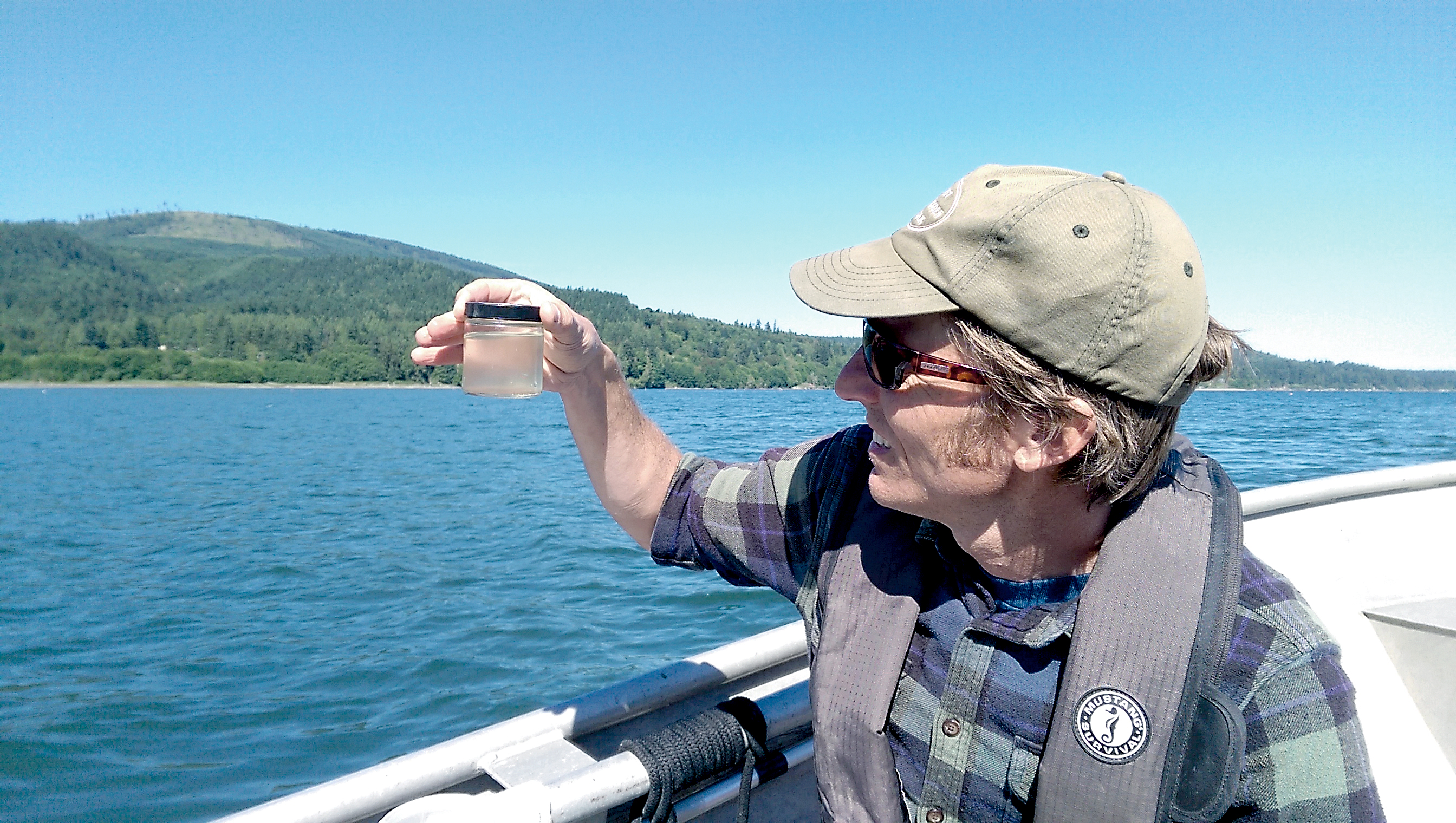
SEQUIM — An algae strain capable of producing a potentially deadly biotoxin rarely found on the North Olympic Peninsula has been found in large quantities in both Sequim and Discovery bays.
The marine algae has produced biotoxins in Sequim Bay, but not to the level that represents a public health risk, researchers said.
Tests are being done for the biotoxin in Discovery Bay.
The single-cell algae, Pseudo-nitzschia, sometimes produces a natural toxin called domoic acid that causes potentially fatal amnesic shellfish poisoning.
The algae does not always secrete the biotoxin, and scientists do not know what triggers the process in the wild.
The algae in both bays is connected with an enormous bloom in the Pacific Ocean, which has made its way east through the Strait of Juan de Fuca.
Research has been focused on the Pacific Ocean and Sequim and Discovery bays.
The algal plume is the largest of its kind in more than a decade, stretching from central California to southern Alaska in the Pacific Ocean.
The bloom has emitted some of the highest concentrations of domoic acid ever observed along the California and Oregon coast.
In early June, elevated toxin levels led shellfish managers to close the southern Washington coast to Dungeness crab fishing, the largest-ever closure of Washington’s multi-million-dollar crab fishery.
Present closures of some Strait beaches to recreational shellfish harvesting are due to other biotoxins, vibrio bacteria or pollution.
Shellfish absorbs and concentrates domoic acid, delivering a nasty dose if eaten, resulting in amnesic shellfish poisoning.
Amnesic shellfish poisoning can cause vomiting, nausea, diarrhea, abdominal cramps, headache, dizziness, loss of short-term memory, seizures, profuse respiratory secretions, cardiac arrhythmia and lead to coma and death.
There is no known antidote for domoic acid, and cooking or freezing affected fish or shellfish tissue does not lessen the toxicity.
In May, the bloom spread to Sequim Bay, where more than three million cells of Pseudo-nitzschia per liter of seawater were observed in a sample taken last week.
That number fell to a little more than one million per liter as of Tuesday morning, but is still well above the norm.
“We often see a few cells, like in the hundreds, but millions is high,” said Neil Harrington, Jamestown S’Klallam tribe environmental biologist.
The tribe has been collecting seawater samples from the bay since 2007.
The algae may be growing rapidly because of ample sunlight this season and above average water temperatures, Harrington said.
He noted the water just below the surface — measuring this week at about at 59 degrees Fahrenheit — is about 3 to 5 degrees above average for this time of year.
The bloom in Sequim Bay is one of the largest ever recorded in the bay, but as of yet has not produced enough domoic acid to warrant mandatory restrictions on shellfish harvesting.
“At the beginning of the bloom this year, in May, we did see some domoic acid toxicity of clams tested at the Jamestown Beach,” Harrington said.
“These levels were below regulatory limit for shellfish so did not lead to a closure.
“Levels of domoic acid have since gone down to not detectable. . . even while the Pseudo-nitzschia bloom intensified,” he said.
The bloom “is super dense,” Harrington added. “Three million cells per liter is a tremendous amount of algae in our water.”
Once Pseudo-nitzschia had a foothold in Sequim Bay, it continued traveling east to Discovery Bay.
Tests are in progress to see if shellfish contains domoic acid.
The algae “has been making its way across . . . over the course of this spring,” said Jamie Montague, citizen science coordinator at Port Townsend Marine Science Center.
According to recent samples taken by Montague and her colleagues, more than one million cells of Pseudo-nitzschia per liter of water have been found in samples of water from Discovery Bay.
As of yet, the bloom has not emigrated to Port Townsend Bay, Montague said.
Both the Jamestown S’Klallam tribe and the Port Townsend Marine Science Center take samples of seawater each week to track the development of toxin-producing algae.
They upload the data to an online database as part of SoundToxins, a cooperative partnership led by state managers, environmental learning centers, tribal harvesters, and commercial fish and shellfish farmers.
“We’re taking advantage of our active surveys to focus research on a serious concern for coastal communities and the seafood industry,” said Eileen Sobeck, assistant administrator for National Oceanic and Atmospheric Agency Fisheries.
“The better we understand what’s happening out on the water, the better we can address the impacts.”
University of Washington analyst Anthony Odell, coastal sampling coordinator at the Olympic Natural Resources Center in Forks, is tracking the effects of the bloom.
“The current bloom of Pseudo-nitzschia . . . appears to be the biggest spatially we have ever observed” in the Pacific Ocean, Odell said.
“It has also lasted for an incredibly long time — months, instead of the usual week or two.”
For the past 12 years, Odell has been a research analyst for the UW-led Olympic Region Harmful Algal Bloom Partnership.
The organization provides critical monitoring data and other information about toxic algae blooms to coastal communities on Washington’s Olympic Peninsula.
Odell left June 15 from Newport, Ore., aboard the Bell M. Shimada, a National Oceanic and Atmospheric Administration (NOAA) research vessel.
He is part of a NOAA-led team of experts in harmful algae who are surveying the extent of the algal patch and searching for “hot spots” — swirling eddies where the algae can grow and become toxic to marine animals and humans.
The science expedition will continue through mid-September, with the team surveying from San Diego, Calif., up to the north end of Vancouver Island.
As the ship travels north, it is making a large back-and-forth grid, sampling the water very near shore to several miles offshore.
While localized blooms of marine algae that naturally produce domoic acid are common in spring, the bloom on the Pacific Coast is the largest and most severe in more than a decade.
Sardines, anchovy and other fish that feed on the algae and other microorganisms known as plankton can accumulate the toxin, in turn poisoning birds and sea lions that feed on them.
“This is unprecedented in terms of the extent and magnitude of this harmful algal bloom and the warm water conditions we’re seeing offshore,” said Vera Trainer, manager of the Marine Microbes and Toxins Program at the Northwest Fisheries Science Center in Seattle.
“Whether they’re related, we can’t really say yet, but this survey gives us the opportunity to put these pieces together.”
While the phenomenon is natural and cannot be prevented, better knowledge could help to predict and prepare for its effects, researchers said.
NOAA Fisheries and others also are developing advanced robotic systems and models to better detect and forecast harmful algal blooms.
________
Sequim-Dungeness Valley Editor Chris McDaniel can be reached at 360-681-2390, ext. 5052, or cmcdaniel@peninsuladailynews.com.
