
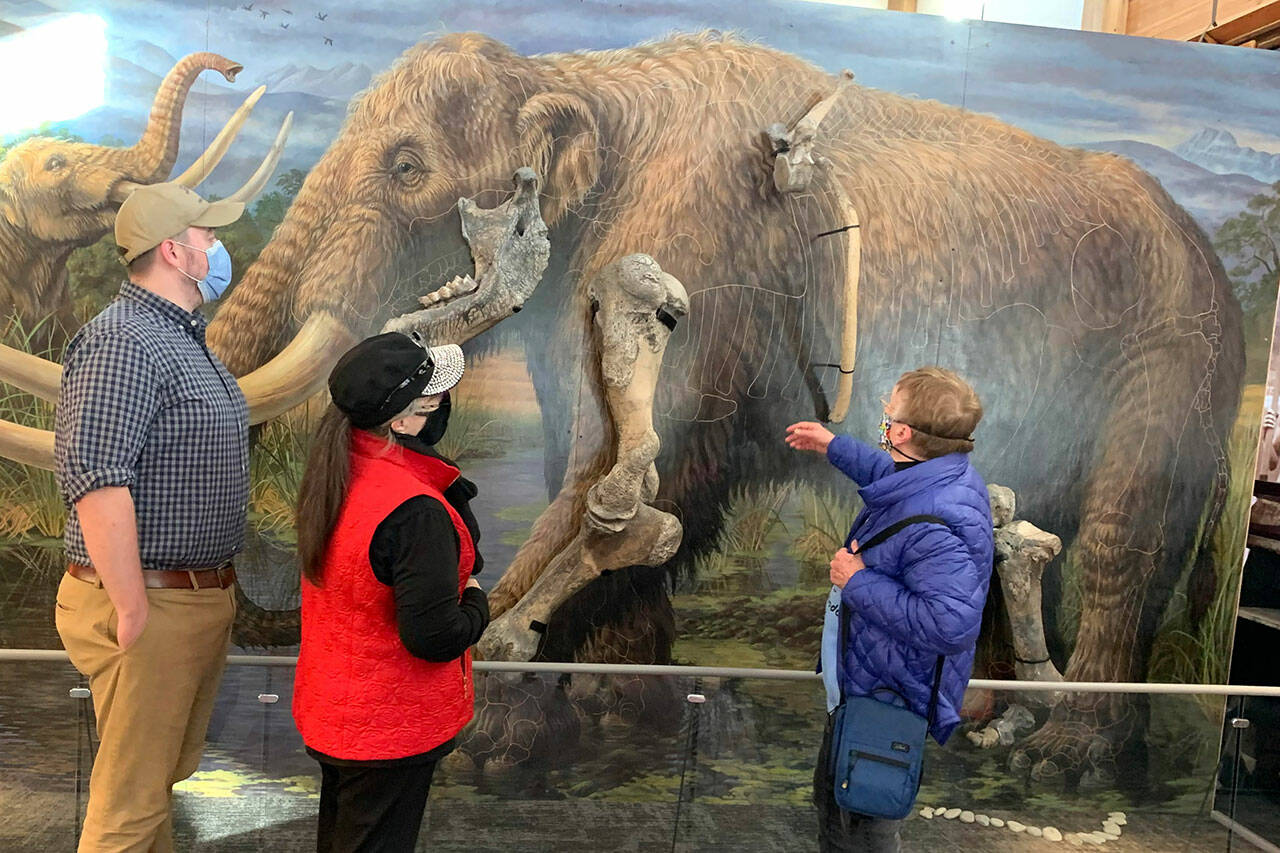
SEQUIM — Using 21st century technology to peer into mankind’s history dating back nearly 14,000 years, a team led by a Texas A&M professor has confirmed what researchers believe is the oldest weapon made of bone ever found in the Americas.
And, as many Sequim natives recall, evidence for this research was found by accident 4½ decades ago in Happy Valley.
Michael Waters, professor of anthropology and director of Texas A&M’s Center for the Study of First Americans, led the team whose research — using a CT scan and 3D software — was published in early February in the peer-reviewed journal, Science Advances.
Alongside articles such as “NRF2 controls iron homeostasis and ferroptosis through HERC2 and VAMP8” and “Covalent organic frameworks with Ni-Bis (dithiolene) and Co-porphyrin units as bifunctional catalysts for Li-O2 batteries,” Waters’ team detailed its studies of bone fragments embedded in a mastodon rib bone, pieces first discovered by Emanuel “Manny” Manis, who was digging a ditch on his Happy Valley property using a backhoe.
Archeologist Carl Gustafson conducted an extensive excavation at the Manis site just south of Sequim proper from 1977-1979.
In his team’s research, Waters isolated bone fragments to show it was the tip of a weapon. At 13,900 years old, he said, it is 900 years older than projectile points found to be associated with the Clovis people, whose spear points date from 13,050 to 12,750 years ago.
“We isolated the bone fragments, printed them out and assembled them,” Waters noted in a Texas A&M Today article. “This clearly showed this was the tip of a bone projectile point. This is this the oldest bone projectile point in the Americas and represents the oldest direct evidence of mastodon hunting in the Americas.
“What is important about Manis is that it’s the first and only bone tool that dates older than Clovis. At the other pre-Clovis site, only stone tools are found. This shows that the First Americans made and used bone weapons and likely other types of bone tools.”
The projectile was made from the bone of a mastodon, a prehistoric relative of the elephant.
Waters said the only reason the Manis specimen was preserved is because the hunter missed, and the projectile got stuck in the mastodon’s rib.
“We show that the bone used to make the point appears to have come from the leg bone of another mastodon and was intentionally shaped into a projectile point form,” Waters said.
Waters studied the rib bone previously, presenting findings in a 2011 paper published in Science.
In the team’s newest study, Waters and company isolated bone fragments using CT images (more than 2,000, according to their paper) and 3-D software.
They were able to create 3-D images of each fragment and print them out at six times scale, Waters said, then fit the pieces back together to show what the projectile looked like before it entered and splintered in the mastodon’s rib.
Little is known about the people who used the Manis spear point other than they were some of the first Indigenous people to enter the Americas, though Waters said the Manis site and others are giving archaeologists some insight.
“It is looking like the first people that came to the Americas arrived by boat,” Waters told Texas A&M Today.
“They took a coastal route along the North Pacific and moved south. They eventually got past the ice sheets that covered Canada and made landfall in the Pacific Northwest.”
In 1978, the Manis Mastodon Site was placed on the National Register of Historic Places.
In 2002, on the 25th anniversary of the discovery, Clare Manis Hatler — whose then-husband Emanuel made the original discovery — donated the 2-acre site to the National Archaeological Conservancy.
And, in 2019, Hatler donated the collection of more than 50 cartons including bones, ivory, teeth, soil samples, stone tools, photographs, field notes, educational materials and more, to the Washington State Historical Society.
A Manis Mastodon tusk remains on display at Sequim Museum & Arts, 544 N. Sequim Ave.
A stone historical marker denotes the location of the archaeological find off Lester Way.
________
Michael Dashiell is the editor of the Sequim Gazette of the Olympic Peninsula News Group, which also is composed of other Sound Publishing newspapers Peninsula Daily News and Forks Forum. Reach him at editor@sequimgazette.com.
