
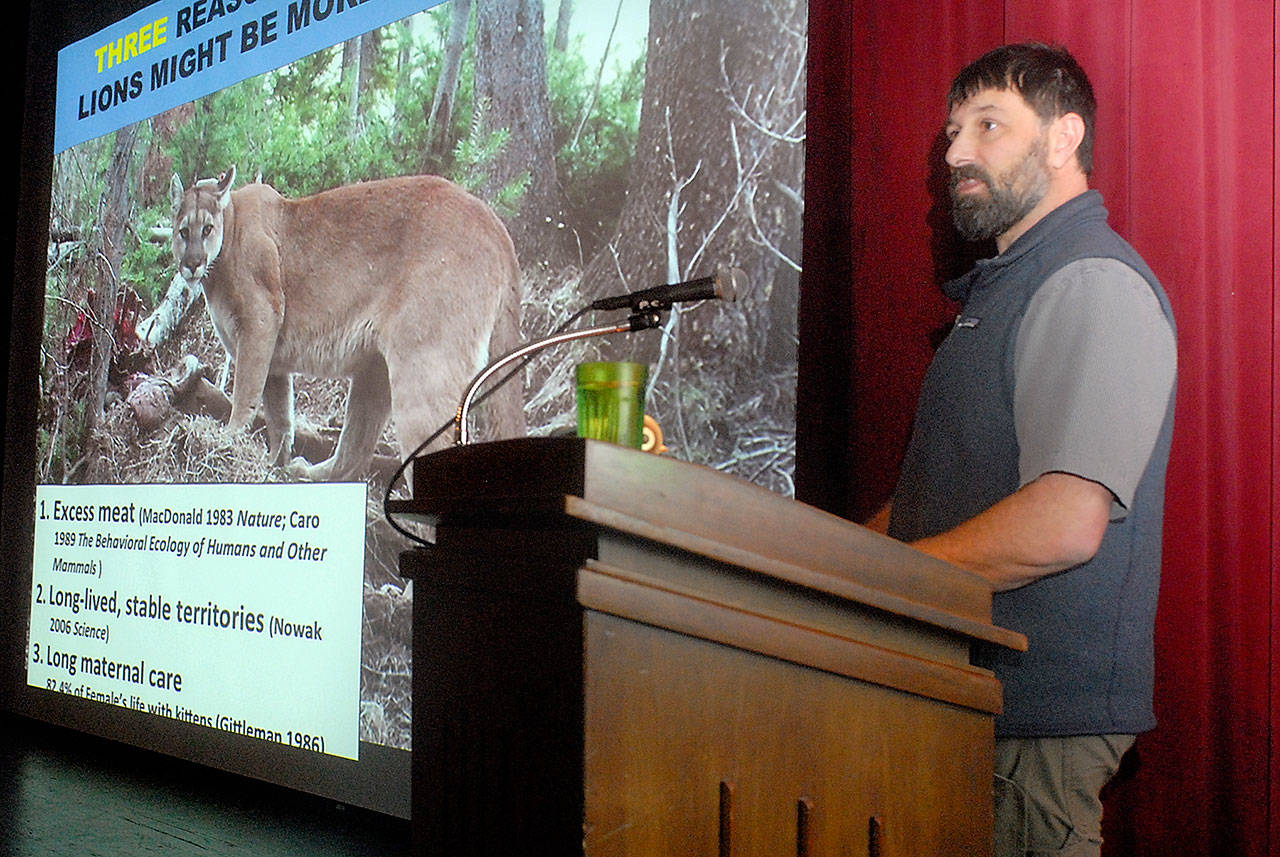
PORT ANGELES — Cougars are far more social than previously thought, a Sequim scientist told a Peninsula College audience last week.
A 17-year study in northwest Wyoming found that social tolerance among mountain lions was largely driven by direct reciprocity, Mark Elbroch said in a Studium Generale presentation Thursday.
“If one mountain lion tolerated another mountain lion at their kill, that other mountain lion was 7.7 times more likely to tolerate them at one of their future kills,” Elbroch said.
“That was amazing.”
Reciprocity implies that an animal is intelligent enough to remember its past encounter with another animal and use that experience to decide whether or not to interact with the same animal again, Elbroch said.
“In the last 10 years, there has been increasing evidence from many, many species — not just primates — that animals are exhibiting reciprocity,” said Elbroch, who recently moved to Sequim.
Elbroch is a lead scientist for Panthera, a global conservation organization that supports research and sharing science with large audiences.
His hour-long presentation to more than 200 students and community members featured video clips of cougars interacting in the Teton Range near Jackson, Wyo.
The mountain lion — also known as the cougar, panther, puma and catamount — has been studied closely since 1964.
“The most frequent social behavior of mountain lions is avoiding other mountain lions,” Elbroch said.
“I’m serious. It’s taken us 60 years to learn that.”
New technology such as Global Positioning System collars and motion-triggered cameras are changing long-held beliefs about the solitary predator, Elbroch said.
“Mountain lions interact way more regularly and predictably than we ever thought before,” Elbroch said.
Cougars have 12- to 15-year life spans that present many opportunities for social interaction, Elbroch said.
Female mountain lions spend 82 percent of their lives rearing kittens, he said.
“Why wouldn’t we expect that they would have developed social behaviors and strategies to maintain those relationships?” Elbroch said.
The Wyoming study was conducted in an area with a low mountain lion population density and ample prey such as deer, elk, moose, bighorn sheep, beavers and coyotes.
Early in the study, it was discovered that 60 percent of mountain lion interactions were about food.
“That flies in the face of everything that is supposed to be happening out there,” Elbroch said.
”So we thought we’d take a closer look.”
Elbroch and his fellow researchers developed a hypothesis, predicting that they would not identify a mountain lion network and that cougar interactions would be explained by overlapping territory and kinship.
They also tested an alternative hypothesis based on direct reciprocity, hierarchical reciprocity and egalitarian reciprocity.
After studying 134 GPS-collared mountain lions, the researchers found that there was a social network and that all of the cougars shared food at least once.
Clusters were identified where certain mountain lions interacted more frequently. The clusters matched the spacial constraints of male territories on the landscape, Elbroch said.
”Because males are territorial, they decide which mountain lions are interacting with whom and how they interact with each other,” Elbroch said.
”That was a pretty cool thing.”
Elbroch used an example from the study to explain the ramifications of removing a male from its territory.
After M-29 was killed by a hunter, another male, M-85, drifted into its territory.
Three months later, female F-51 encountered M-85 and attacked the 170-pounder. F-51 was killed in the ensuing fight, leaving two 6-month-old kittens as orphans.
One kitten died of starvation and the other died after getting porcupine quills lodged in its chest.
“That’s what we call the indirect effect of losing a territorial male,” Elbroch said.
Elbroch said he plans to conduct mountain lion research on the North Olympic Peninsula with the Lower Elwha Klallam Tribe’s wildlife biologist Kim Sager.
“Kim and her team are launching a mountain lion study right here in Port Angles, and they have been kind enough to let me tag along,” Elbroch said told the audience.
“This could be an amazing opportunity to start seeing the secret lives of mountain lions around Port Angeles and perhaps even further afield if the funding is there, but we need support to grow the project.
“It’s just beginning,” he added, “and hopefully we’re going to learn all sorts of cool things about your mountain lion.”
Elbroch is a regular contributor to National Geographic’s CatWatch blog.
His biography is available on the Panthera website, www.panthera.org.
________
Reporter Rob Ollikainen can be reached at 360-452-2345, ext. 56450, or at rollikainen@peninsuladailynews.com.
