
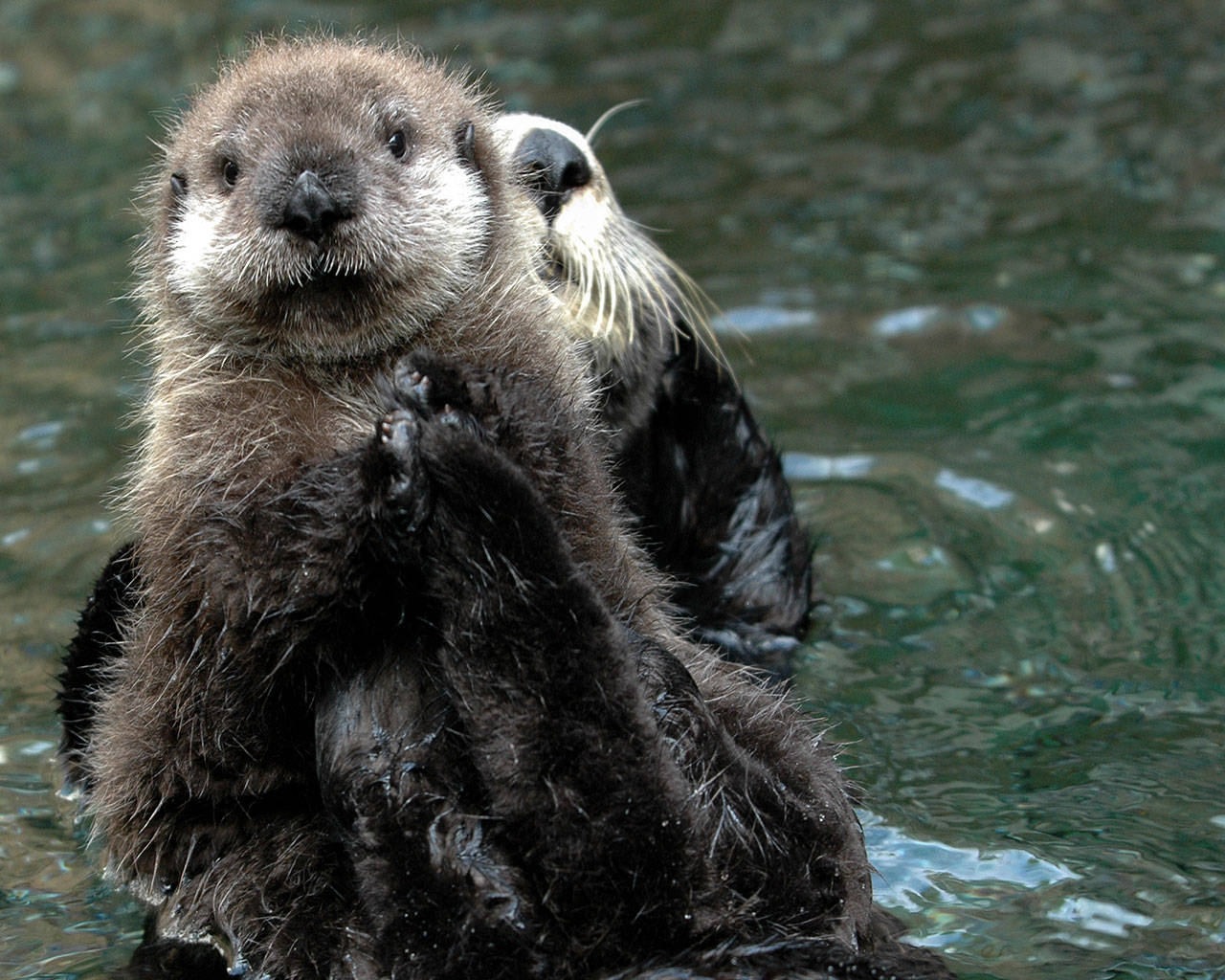
FRIDAY HARBOR — Leisurely resting in the kelp near Race Rocks, B.C., Odin, a lone male sea otter with an injured eye, is one of the few of his kind making their way back into the Salish Sea.
Named after the Norse god who sacrificed his eye for wisdom, Shawn Larson believes Odin might be the savior the world needs to combat climate change.
“Sea otters are a keystone species,” Larson, curator of conservation research at the Seattle Aquarium and research curator for The Whale Museum in Friday Harbor, explained during her recent talk, “Sea Otter, Enhydra lutris, Conservation — Can They Save the World?”
As a keystone species, sea otters play a critical role in their ecosystem, Larson said during her presentation late last month in a packed Whale Museum hall.
Before delving into that important function, however, she described sea otter basics.
“Sea otters are true marine mammals,” she said. She added that sea otters are close to her heart, and are the species on which she wrote her college thesis.
The main difference between sea and river otters, she said, is how long they remain in the marine environment. Sea otters spend most of their lives in the ocean while river otters merely frequent water.
Size is another major difference as sea otters are up to four times bigger than their river relatives.
Unlike other marine mammals, sea otters, or Enhydra lutris, have no blubber layer. Instead, they rely on a dense coat, which is the thickest in the animal kingdom, Larson said.
“Evolutionary-wise, it would have been nice if they had at least a thin layer of blubber,” Larson said, because they can struggle for warmth without enough food or if they have a poor quality coat. Instead, these marine weasels rely on fur.
Jim Maya, Friday Harbor naturalist and founder of Maya’s Legacy Whale Watching, said that there are approximately 1 million hairs per square inch in an otter’s coat. In comparison, a dog usually has around 60,000.
During peak hunting years of the 1741-1911 fur trade, nearly 15,000 sea otters were killed between 1804 and 1807, according to harvest records Larson presented. The last known native sea otter in Washington state was shot in 1910 near Willapa Bay, Larson said.
The following year, the Fur Seal Treaty was signed and although the agreement was intended to protect fur seals, Larson said it protected the handful of otters left, as well.
Today, the sea otter remains listed as a threatened species in the western part of Alaska and throughout California.
Reintroduction
In the late 1960s, sea otters were reintroduced to Washington. Since that time, according to Larson, the population has grown at a rate of approximately 10 percent annually. Researchers estimated in 2017 that the state had around 2,058 sea otters.
One of Larson’s projects was studying the effects the fur trade had on sea otter genetic diversity. Searching Native American middens for pre-fur era sea otter DNA, her study found on average that historic populations had a 0.79 genetic diversity rate.
After near-extinction, present day populations have a 0.47 genetic diversity rate. Most animals that are not inbred have a genetic diversity rate of 0.79 to 0.80, she noted.
Throughout the past decade or two, with the Washington population inching upward, sightings of these otters in the San Juans are increasing. Larson explained, however, these creatures were never abundant in San Juan County and the inland sea.
During the 20-plus years he has been boating around the Salish Sea, Maya said, he has seen sea otters, including Odin, a total of 10 times.
A few identifying tips, he noted, are a round head rather than the pointier head of the common river otter and the coloring is more brown, as opposed to the gray head of a seal. They are frequently found lying on their back among the kelp.
The few Maya has seen were solitary, and he guesses they were young males looking for females.
Larson noted that by nature sea otters tend to be highly social animals.
“They like to be in large groups, or rafts,” she said. “They don’t care if you’re a brother, sister, cousin. However, they do sexually segregate — males tend to hang out with other males and females with other females.”
While Washington’s population may be slowly increasing, the number of sea otters in Alaska is decreasing.
Larson explained that researchers suspect transient orcas might be the culprits. Seal populations in Alaska also are dwindling as a result of the growing number of transient orcas, so it’s possible they are also eating otters as an alternative.
Global warming
A decline in otter populations is concerning because they could hold a key function in at least slowing global warming, Larson said.
Sea otters need to consume approximately 7,000 to 9,000 calories daily just to maintain their body weight, Larson noted, and a sea otter’s favorite meal is the sea urchin. Meanwhile, the preferred food source of urchins is kelp.
Larson explained that kelp forests provide shelter for fish, including salmon, and other ocean creatures, but also convert carbon to oxygen in a manner similar to trees.
Without sea otters keeping urchins in check, kelp forests become decimated, and more carbon dioxide remains in the atmosphere. In fact, Larson said, data shows kelp forests with sea otters sequester, or absorb, carbon dioxide 100 times more than those without.
In order for Odin and his clan to save the world, they will need clean seas, Larson said, free of toxic chemicals, fertilizers, pesticides and herbicides.
Oil spills need to be prevented, Larson added. More than 800 Alaskan sea otters died after the Exxon Valdez spill in 1989.
Because sea otters tend to stay in one area, state and local governments can be more effective in managing them than larger governmental bodies, Larson continued. Further research could also assist in better understanding the animals, thereby aiding conservation efforts.
“There is a lot we know, but there is also so much to find out about them,” Larson concluded.
