
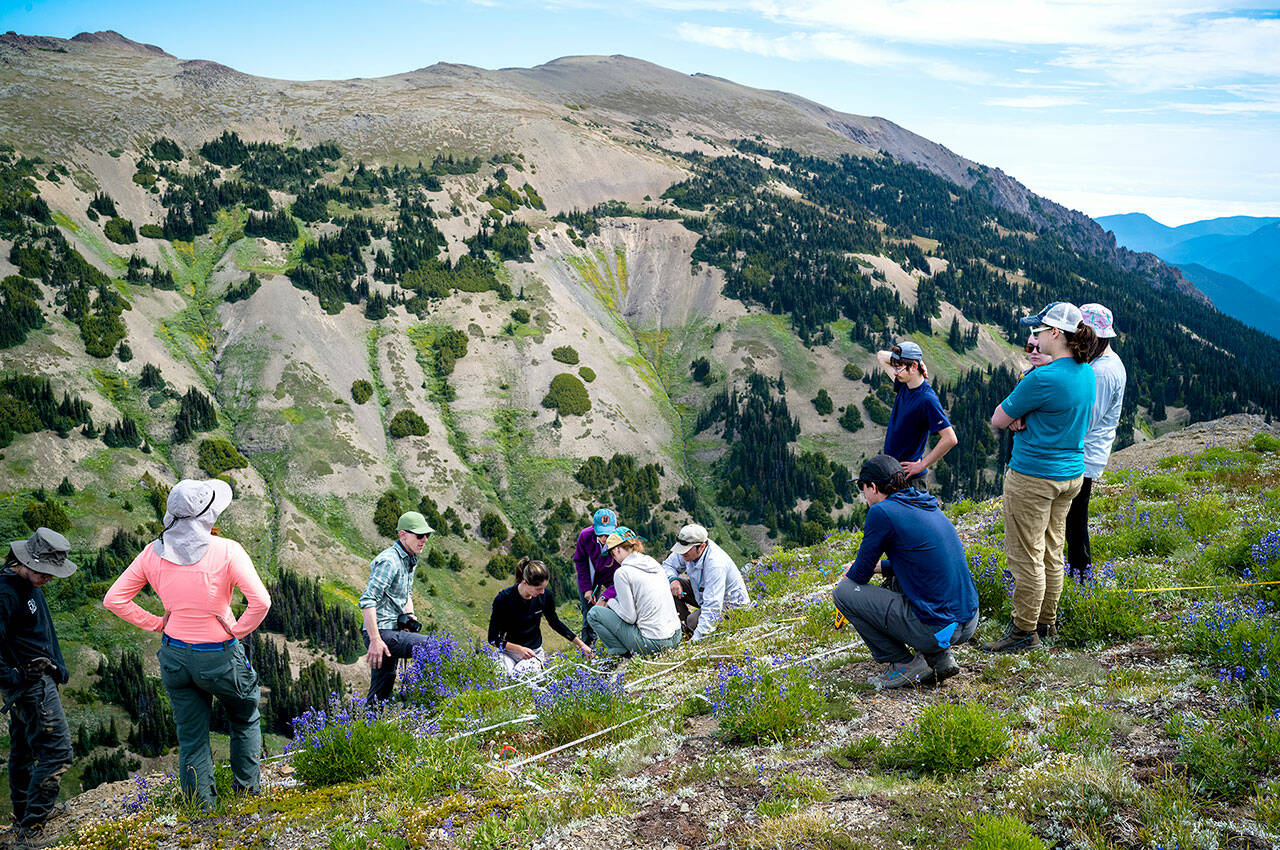
The Olympic Mountains are being used to study climate change after sites were set up for that purpose this past summer.
In late July and early August, Western Washington University Professor Eric DeChaine, along with 10 students from the university and scientists from the Missouri Botanical Garden, hiked up into the mountains to set up Global Observation Research Initiative in Alpine Environments (GLORIA) sites.
“It’s a system of monitoring Alpine plant responses to climate change in real time,” DeChaine said. “It was started years ago in Austria. Since then, they have a whole protocol that anybody doing this has to use so all the studies can be compared to one another.”
What the team did was hike up into the mountains to two remote areas where they set up grids to study the existing plants.
“An interesting thing about the GLORIA protocol is the sites have to be accessible and repeatable,” DeChaine said. “No super steep slopes, they’ve got to be more well rounded, which isn’t great for the Olympics. Our sites are in the northeast portion of Olympic National Park and Olympic National Forest. One is out of the Obstruction Point area and the other is in the Baldy area.”
Each site is made up of four peaks, he said. One peak is at the forest line and one is at the highest point you can go and then there are two peaks between those two.
“What we would do is each day we would hike out to one of those peaks and survey that peak by setting up a grid of 3-meters-by-3-meters in each direction and then identify and count all the plants that were in that grid,” DeChaine said. “We would also survey the entire summit and record all the species that were on the summit and take different measurements as well. We put in temperature monitors so we can monitor any changes.”
The plan is to go back to the sites every five years and survey them again using the same methodology to see if there are any changes.
“There could be just plants coming in from lower elevations that are native to the Olympic Mountains,” DeChaine said. “There could be plants coming in that are non-native that then might be really bad for the area up there. It could also be that we find stability and that there actually isn’t much change at all.”
The hope for the experiment is that it continues for as long as possible with teams checking the sites every five years so long-term changes can really be observed, he said.
“The expectation for the lower plants is that as warming occurs, the suitable environment for plants will move northward or up slope and they would encroach upon the Alpine habitat, the plants that are already there, which would respond by moving further upslope,” DeChaine said. “The plants at the top may experience extinction because they have no where else to go.”
The Missouri Botantical Garden approached DeChaine about doing the GLORIA experiment in the Olympic Mountains, he said.
Robbie Hart, a scientist at the garden, said he’s always known the Olympic Mountains were special.
“I was born and raised in Port Angeles and think of it as my home mountain range,” Hart said. “It’s especially dear to me and I’ve wanted for a long time to see if we could establish a site there.”
The Missouri Botantical Garden has established many GLORIA sites but they’ve all been in the Himalayan Mountains. Because of how the Olympic Mountains were formed, there are plants which exist on them that are not found anywhere else in the world, Hart said.
“I wanted a local partner who could bring their own expertise and energy to the project,” Hart said. “The way the method works is you gather baseline data and come back every 7-10 years in the future. Of course that’s difficult to do because you can’t predict what’s going to happen. The more local people you have involved, the greater the chance the resurveys happen again and again. Eric was also the perfect person because he’s a fantastic mountain field worker and he has deep knowledge of the Alpine endemic plants of the Olympics that are found nowhere else in the world.”
Due to the unique plants found in the Olympic Mountains, the range is known by scientists around the world, Hart said. Scientists he’s spoken to have been happy to hear the GLORIA experiment is happening in the Olympics, he said.
For more information about the GLORIA experiment, go to www.gloria.ac.at/home.
________
Reporter Emily Hanson can be reached at emily.hanson@peninsuladailynews.com.
