
By Phuong Le
The Associated Press
POULSBO — Just hours into the experiment, the prognosis was grim for salmon that had been submerged in rain runoff collected from one of Seattle’s busiest highways.
One by one, the fish were removed from a tank filled with coffee-colored water and inspected: They were rigid. Their typically red gills were gray.
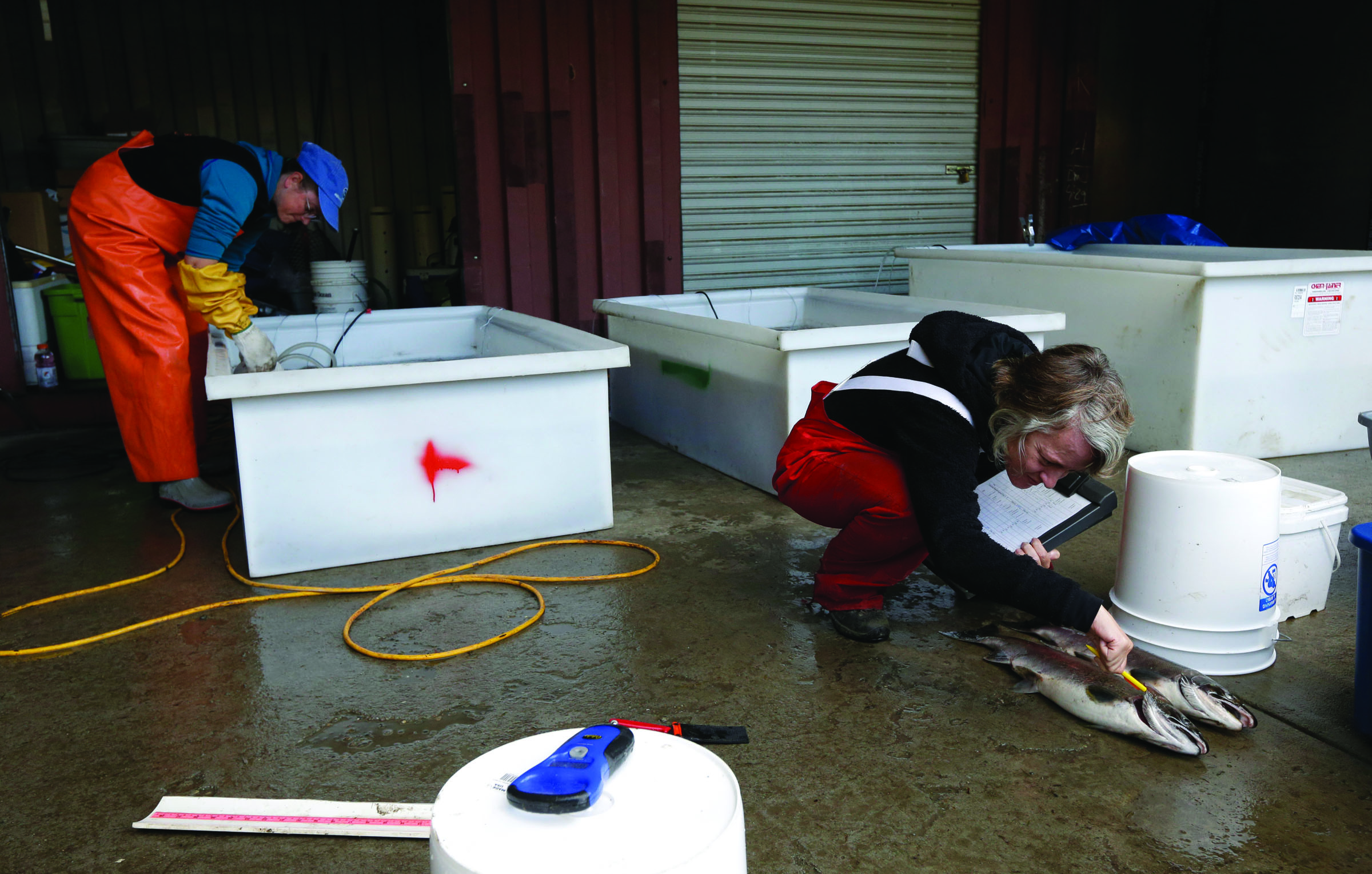
“He’s way dead,” David Baldwin, a research zoologist with the National Oceanic and Atmospheric Administration’s Northwest Fisheries Science Center, declared at the four-hour mark.
This was the fate of coho salmon exposed to the everyday toxic brew of dirt, metals, oil and other gunk that washes off highway pavement after rains and directly into Puget Sound.
When that runoff was filtered through a simple mixture of gravel, sand and compost, however, the outlook was much brighter.
Salmon exposed to treated water were healthy and responsive, even after 24 hours.
The research being conducted by scientists with NOAA, Washington State University and the U.S. Fish and Wildlife Service offers a promising solution to stormwater pollution, a major problem for Puget Sound and other streams and lakes in the nation.
With pollution from industrial pipes closely regulated, cities and states are more often tackling stormwater runoff that results from everyday activities: oils from leaky cars, pesticides from lawns and other pollutants that wash off roads and sidewalks and into streams and lakes.
Across the country, there’s been an aggressive push for rain gardens and other green techniques that rely on vegetation, soil or natural elements to slow and filter stormwater.
“The results are pretty stark,” said Jenifer McIntyre, a researcher with WSU who is part of salmon experiment.
“So far, what we’re seeing is that, absolutely, things like rain gardens are going to be part of the solution.”
Washington state now requires municipalities to adopt such green techniques to get a stormwater permit under the Clean Water Act after a conservation group sued.
A campaign is trying to get 12,000 rain gardens in Puget Sound to help reduce water pollution.
Portland, Ore.; Kansas City, Mo.; and Philadelphia and other cities have embraced similar green technologies.
“It’s really promising, showing that rain gardens and bio-filtration are removing the pollutants that are killing the salmon,” said Chris Wilke with Puget Soundkeeper Alliance.
More than a decade ago, researchers began noticing adult coho dying before spawning in urban creeks in Seattle.
Monitoring over eight years, they observed fish consistently dying and at high rates in Longfellow Creek and other urban creeks compared with a stream that wasn’t in an urban area.
The salmon swam erratically near the water’s surface, appeared disoriented and displayed other neurological symptoms.
Disease or typical water issues such as temperature or dissolved oxygen didn’t appear to be a problem.
The evidence pointed to one or more chemical contaminants, most likely carried into urban streams through stormwater runoff, according to a study by NOAA and others.
The scientists are still working to find out the underlying cause of death: what contaminant or mixture of contaminants in that runoff is harmful to salmon.
“There used to be coho salmon runs all through Puget Sound and creeks. There haven’t been for decades,” said Julann Spromberg, a toxicologist working for NOAA Fisheries.
“They’re coming back, and they’re dying. We need to figure out what’s going on.”
“A silver bullet would be nice, but it doesn’t appear to exist,” she added.
In an experiment two years ago, the scientists exposed adult coho salmon to artificial cocktails of metals and petroleum hydrocarbons in runoff and found that it didn’t kill the fish.
Actual runoff was another matter.
One morning at Grovers Creek Hatchery in Poulsbo, Spromberg and her colleagues ran an experiment to find out how fish respond to stormwater runoff and runoff that had been treated.
About a dozen salmon were netted and placed in 2-foot-long PVC tubes and then submerged into one of three holding tanks.
One tank was filled with runoff collected from a downspout off Highway 520 in Seattle.
In a second tank, that same runoff had been seeped through a mulch layer and into 55-gallon drums filled with gravel, sand and compost to simulate a rain garden.
A third tank with well water was used as a control.
Over the next few weeks, the scientists repeated the experiment two additional times. Each time, salmon in the dirty water died while the others survived.
In the next phase of the research, they plan to expose coho salmon embryos to find out how stormwater runoff affects fish development.
“People don’t understand necessarily how all those tiny little actions can make a combined effect — tires worn down, exhaust from my car. It’s not something that people are thinking about on a daily basis,” McIntyre said.
