
By Annette Cary
Tri-City Herald
KENNEWICK — The question of where Mid-Columbia monarch butterflies migrate in the West isn’t a question anymore, thanks to a Prosser researcher.
With new information from a five-year study, Washington State University professor David James has advice for how area residents can help save the declining population.
James’ study of about 15,000 monarch butterflies had no research money, so he relied on volunteer “citizen scientists” and inmates at the Washington State Penitentiary in Walla Walla for help.
The inmates raised, tagged and released butterflies, and some wild butterflies were tagged.
Monarchs are a dwindling species in the West.
Research by associate WSU professor Cheryl Schultz put the risk at 72 percent that not enough of the monarchs will be migrating in the West within 20 years to sustain the population. In 50 years, the risk is 86 percent.
It’s estimated that western populations of monarchs, once a common summer sight, have declined 90 percent during the past two decades.
But thanks to James and hundreds of volunteers, more is known about the species.
James found proof that monarch butterflies migrate from the Northwest to California in late summer and fall, a journey averaging nearly 500 miles.
The route was suspected, but there was no data to back that up.
“These butterflies averaged almost 40 miles of travel each day,” he said. “That’s pretty remarkable for such a small creature.”
They might ride warm air currents a few thousand feet up in the air, then use strong upper-air currents to navigate, James said.
When they come out of the skies to land in the evening, they look for nectar and again in the morning before they continue their journey.
“They need fuel,” James said. “If we have large areas without flowers, then they won’t make it.”
Residents along their route from British Columbia down to California can help by planting flowers attractive to monarchs that bloom in the late summer and fall.
Rather than roses and other highly bred ornamentals, monarch butterflies depend on flowers such as daisies, asters and buddleia, a flowering plant commonly called butterfly bush.
In the Mid-Columbia area, native rabbitbrush, with its bright yellow blossoms, is a favorite when monarch butterflies are heading south, James said.
They often follow river valleys in their migration path, making the Tri-Cities, with its three rivers, an area where they might stop.
Migration is a vulnerable time for monarch butterflies, but their decline is more complicated.
In breeding areas, their fate is tied to milkweed, where monarchs lay their eggs and their caterpillars feed.
The Mid-Columbia has plenty of milkweed. Interstate 82 is “milkweed alley,” James said.
But California has far less milkweed than it had 20 years ago, and that milkweed is particularly important. The first generation of monarch butterflies overwinters in California and its offspring might travel farther north.
The U.S. Fish and Wildlife Service is expected to decide in June 2019 whether to list the monarch butterfly as a threatened species under the Endangered Species Act.
One unintended benefit of James’ research has been adding to the monarch butterfly population.
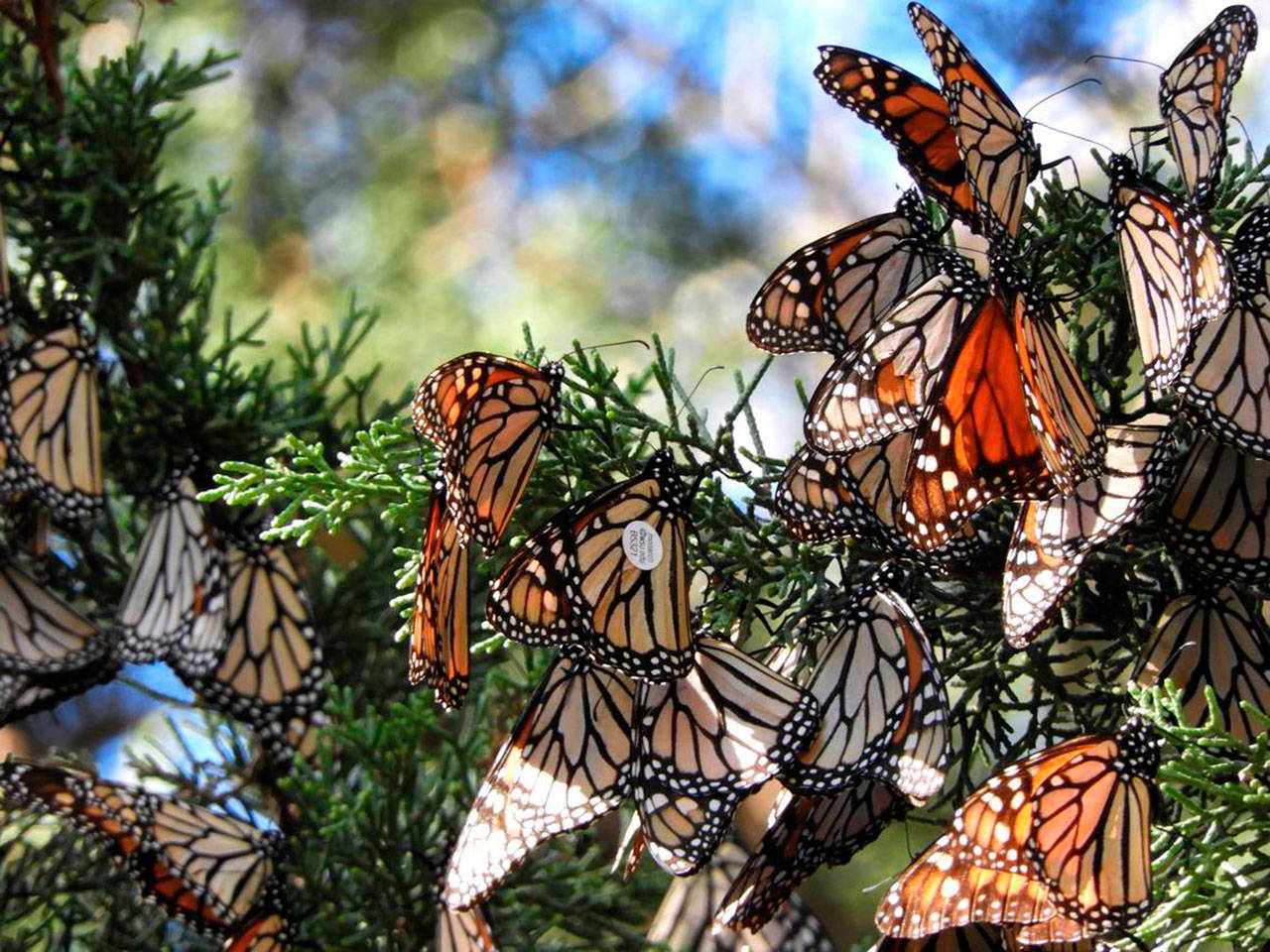
About 875 wild monarchs were tagged with a small sticker attached to their wings. The tag includes an email address and a serial number for the butterfly.
But 13,778 monarchs were tagged and released after being raised specifically for the research project. About a third of those were raised by inmates in Walla Walla.
During the first five years of the project, with findings published in the Journal of the Lepidoptereists’ Society, 60 tagged butterflies were later spotted more than six miles from where they were released.
James asks people who see a tagged butterfly to snap a photo with a cellphone and email it to him.
On average, the 60 tagged butterflies found traveled just shy of 500 miles.
The longest journey recorded was a butterfly James released in Yakima that was fished out of swimming pool near Goleta, Calif., a straight-line distance of 845 miles.
The recently published study covered research through 2016 and did not include data from the best year of butterfly sightings, 2017. James received reports of about 70 monarch butterflies, more than in the first five years of the study.
The project continues with the help of volunteers.
Even if the monarch butterfly is not listed as a threatened species, the project has raised public awareness of its plight, James said.
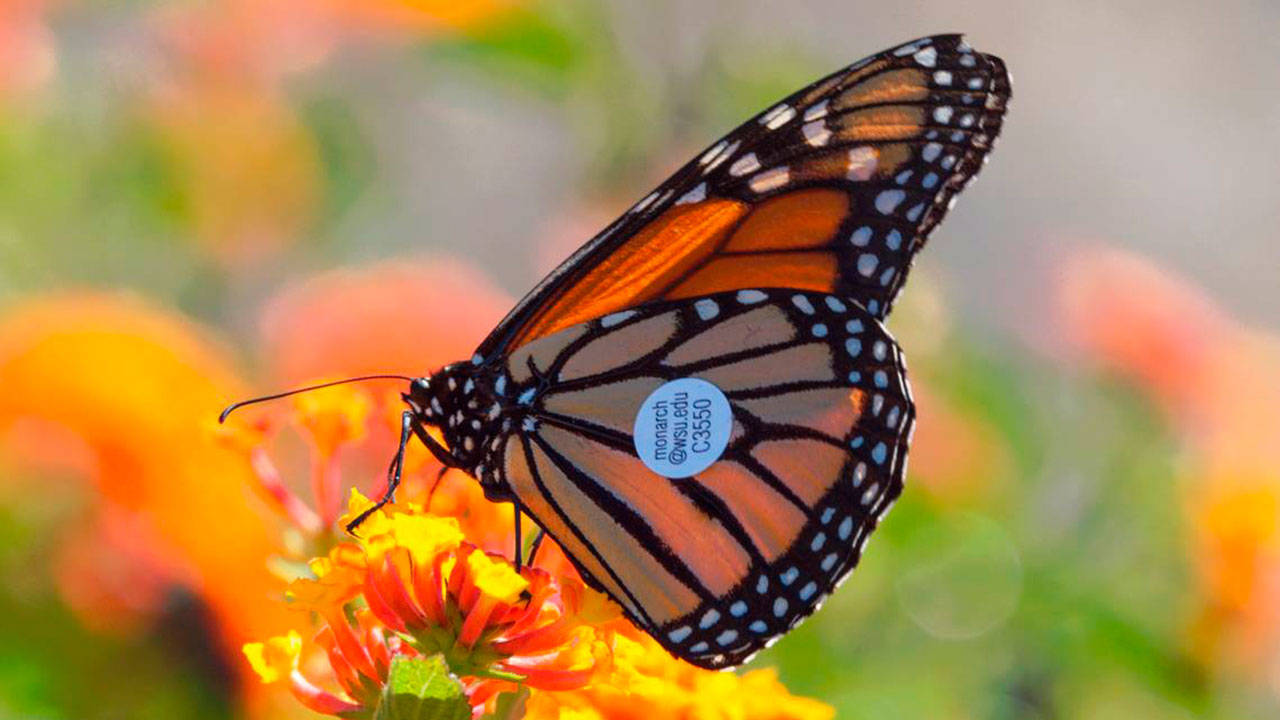
This monarch butterfly, with a WSU tracking tag on its wing, was spotted in Avila Beach, Calif., between Los Angeles and San Francisco. (Washington State University)
