
By LAURIE GOODSTEIN
c.2014 New York Times News Service
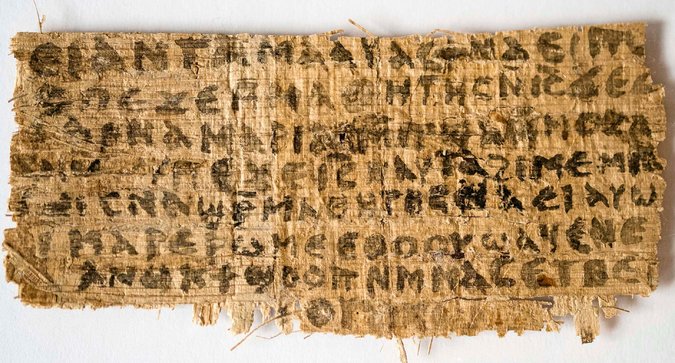
NEW YORK — A faded fragment of papyrus known as the “Gospel of Jesus’s Wife,” which caused an uproar when unveiled by a Harvard Divinity School historian in 2012, has been tested by scientists who conclude in a journal published on Thursday that the ink and papyrus are very likely ancient, and not a modern forgery.
Skepticism about the tiny scrap of papyrus has been fierce because it contained a phrase never before seen in any piece of Scripture: “Jesus said to them, ‘My wife…’ ”
Too convenient for some, it also contained the words “she will be able to be my disciple,” a clause that inflamed the debate in some churches over whether women should be allowed to be priests.
The papyrus fragment has now been analyzed by professors of electrical engineering, chemistry and biology at Columbia University, Harvard University and the Massachusetts Institute of Technology, who reported that it resembles other ancient papyri from the fourth to the eighth centuries.
(Scientists at the University of Arizona, who dated the fragment to centuries before the birth of Jesus, concluded that their results were unreliable.)
The test results do not prove that Jesus had a wife or disciples who were women, only that the fragment is more likely a snippet from an ancient manuscript than a fake, the scholars agree.
Karen L. King, the historian at Harvard Divinity School who gave the papyrus its name and fame, has said all along that it should not be regarded as evidence that Jesus married, only that early Christians were actively discussing celibacy, sex, marriage and discipleship.
“I took very seriously the comments of such a wide range of people that it might be a forgery,” Dr. King said in an interview this week. She said she is now very confident it is genuine.
When you have all the evidence pointing in one direction, it doesn’t make it 100 percent, but history is not a place where 100 percent is a common thing,” Dr. King said.
The new information may not convince those scholars and bloggers who say the text is the work of a rather sloppy forger keen to influence contemporary debates.
The Harvard Theological Review, which is publishing Dr. King’s long-delayed, peer-reviewed paper online on Thursday, is also publishing a rebuttal by Leo Depuydt, a professor of Egyptology at Brown University, who declares the fragment so patently fake that it “seems ripe for a Monty Python sketch.”
Dr. King presented the fragment with fanfare at a conference in Rome in September 2012, but was besieged by criticism because the content was controversial, the lettering was suspiciously splotchy, the grammar was poor, its provenance was uncertain, its owner insisted on anonymity and its ink had not been tested.
An editorial in the Vatican’s newspaper also declared it a fake.
New Testament scholars claimed the text referred to the “bride of Christ,” which is the church — an interpretation Dr. King said was entirely possible.
It is very unusual to test the ink and papyrus of a fragment so small — this one is 4 by 8 centimeters — because it can damage the item, papyrologists say. The authenticity and dates of other famous fragments were determined by paleographers examining the handwriting.
The “Jesus’s Wife” papyrus was analyzed at Columbia University using micro-Raman spectroscopy to determine the chemical composition of the ink.
James T. Yardley, a professor of electrical engineering, said in an interview that the carbon black ink on this fragment was “perfectly consistent with another 35 or 40 manuscripts that we’ve looked at,” that date from 400 B.C. to A.D. 700 or 800.
At M.I.T.’s Center for Materials Science and Engineering, Timothy M. Swager, a chemistry professor, and two students used infrared spectroscopy to determine whether the ink showed any variations or inconsistencies.
“The main thing was to see, did somebody doctor this up?” Dr. Swager said in an interview. “And there is absolutely no evidence for that. It would have been extremely difficult, if not impossible.”
However, Dr. Depuydt, the Egyptologist at Brown University, said that testing the fragment was irrelevant and that he saw “no need to inspect it.”
He said he decided based on the first newspaper photograph that the fragment was forged because it contained “gross grammatical errors,” and each word in it matched writing in the Gospel of Thomas, an early Christian text discovered in Nag Hammadi, Egypt, in 1945. “It couldn’t possibly be coincidence,” he said.
A forger could easily create carbon black ink by mixing candle soot and oil, he said: “An undergraduate student with one semester of Coptic can make a reed pen and start drawing lines.”
But the scientists say that modern carbon black ink looks very different under their instruments. And Dr. King said that her “big disappointment” is that so far, the story of the fragment has focused on forgery, not on history.
