
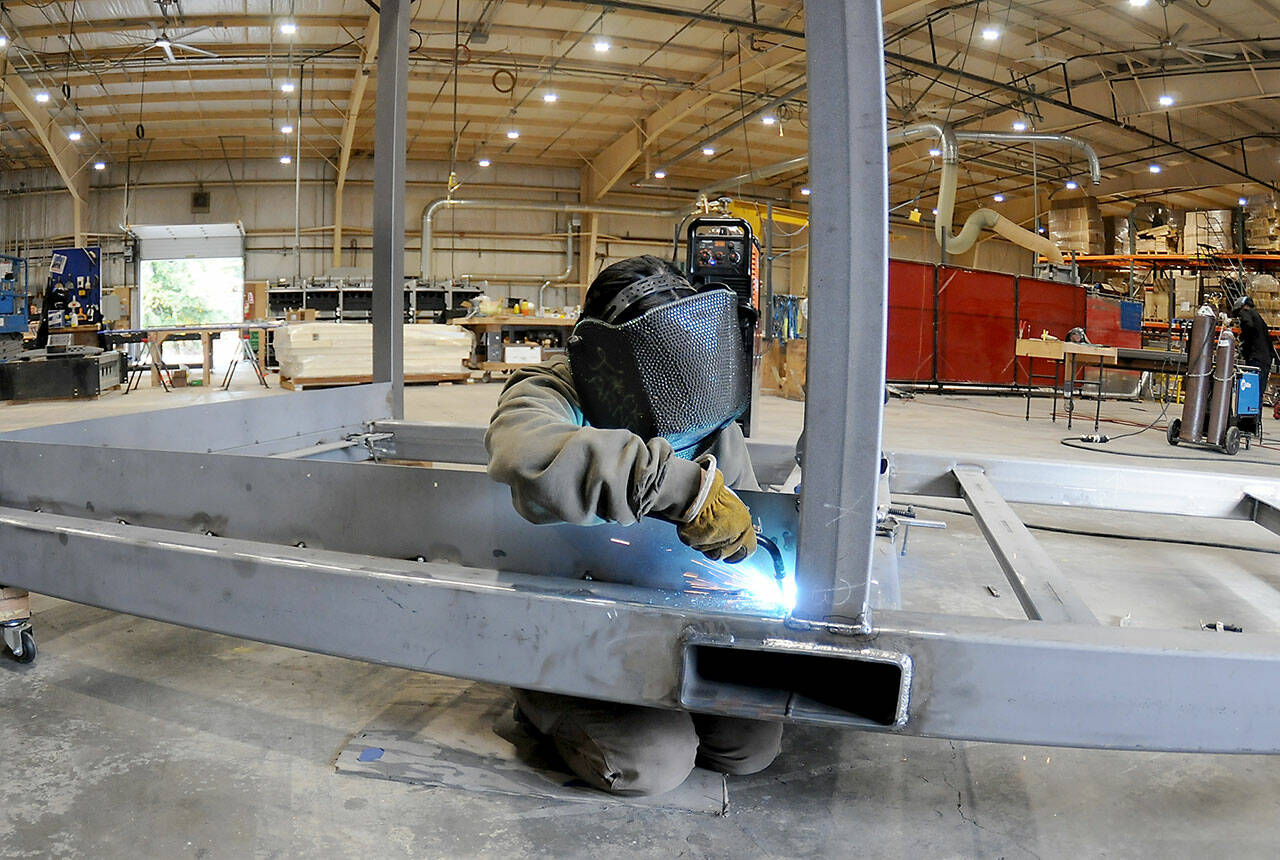
PORT ANGELES — A Port Angeles nonprofit is reusing repurposed carbon fiber and underutilized Northwest timber to tackle everything from microplastics to military housing — and, potentially, the Olympic Peninsula’s affordable housing shortage.
Composite Recycling Technology Center (CRTC) operates across 50,000 square feet of manufacturing space in two buildings at the Port of Port Angeles Airport Business Park, where its 46 employees design, develop and manufacture innovate products made from high-performance carbon fiber and advanced cross-laminated timber — materials that are more sustainable than conventional alternatives.
According to the state’s Clean Energy Fund, about 29 million pounds of carbon fiber scrap used in everything from automobiles to aircraft to boats to wind turbines ends up in landfills every year.
“We intercept it and make it into anything we want,” CRTC CEO Dave Walter said. “Innovation has always been one of our core values.”
CRTC’s first product, a pickleball paddle made from recycled carbon fiber, launched in 2017. By 2019, the company had shifted to producing Swiftnet, a portable pickleball net that can be purchased on CTRC’s website or at Swain’s, and a semi-permanent net sold under the Selkirk brand.
Since then, its product line has expanded to include carbon springs used in orthotics braces and park benches found on the Olympic Discovery Trail. The company is now developing a rope for kelp and shellfish aquaculture that won’t shed microplastics and resists UV degradation like the synthetic rope that’s commonly used in the industry. The rope is currently undergoing testing at sea farms on the Hood Canal and in Alaska.
In 2023, CTRC broadened its focus, partnering with the Makah Tribe to turn Western hemlock — a locally abundant species but with narrow commercial use — into thermally modified lumber for what it calls advanced cross-laminated timber.
Western hemlock is generally less strong than Douglas fir, making it less suitable for structural applications like framing or beams. When thermally modified, however, it becomes stronger, more durable and even fire-resistant.
A $2 million state Department of Commerce Small Business Innovation Fund grant seeded the partnership, with half the funding supporting the construction of the Makah Sawmill in Neah Bay and the other half enabling the CRTC to purchase a thermal modification chamber, where the wood is dried under high heat and without oxygen.
The process begins with green Western hemlock that is kiln-dried at the Makah Sawmill, which reduces its moisture content from about 70 percent to 12 percent. Its moisture content is further reduced to 6 percent to 8 percent in CRTC’s thermal modification chamber. The transformation alters the wood’s cellular structure, increasing its resistance to decay and insects and dimensional changes like warping.
CRTC uses the thermally modified wood to manufacture 4-foot-wide cross-laminated panels of 8- , 10- and 12-foot lengths. The panels are created by stacking, gluing and pressing layers of the wood in alternating directions, a process that significantly enhances their strength.
The result is a versatile product suitable for a range of uses, including flooring, siding, decking and structural panels.
“The goal,” marketing intern Grace Flodstrom said, “is to take an undervalued material and turn it into something valuable for building homes.”
All of the assembly is done at CRTC’s Port Angeles facility.
Walter acknowledged that CRTC takes a somewhat different approach than other manufacturers, which typically start with a design and then select the material.
“We do it the other way around,” he said. “We make the design fit the material.”
Some of the Western hemlock will return to Neah Bay as advanced cross-laminated timber panels used to construct BOLEH homes (Built On Lot Engineered Home) — a turnkey kit containing everything from pre-cut panels to windows, flooring and roofing.
Each two-bedroom, one-bath engineered home will cost about $239,000, or roughly $250 a square foot, to install.
“They’re less expensive than stick-built homes, and sturdier and longer-lasting than manufactured homes,” Walter said.
The Makah Tribe is exploring the construction of up to 50 homes, and CRTC plans to train tribal members in their assembly.
The big picture, Walter said, is to create quality, affordable housing using an environmentally sustainable source to support jobs.
CRTC’s work with advanced cross-laminated timber has drawn attention beyond Clallam County.
The nonprofit is collaborating with the Seattle architectural firm atelierjones to design accessory dwelling units with the material.
It’s also working with the U.S. Army Corps of Engineers’ Construction Engineering Research Laboratory (CERL) to adapt advanced cross-laminated timber for temporary military housing. Together, they’ve designed a 640-square-foot B Hut prototype.
This summer, CRTC and CERL assembled the prototype at Fort Leonard Wood, Mo. The building is shipped in two 20-foot-long containers that form the B Hut’s frame, with all of the necessary tools and components packed inside. The design allows the structure to be easily assembled, disassembled and transported to almost any location.
The B Hut underwent seismic testing at the CERL’s base in Champaign, Ill., in late 2024, when it survived forces twice as strong as those from Japan’s 2011 earthquake — and in February, it’s scheduled for cold-weather testing in Alaska, where it will face temperatures below 20 degrees and winds of up to 50 mph.
“Even if it doesn’t work out for the military, it still has value for emergency housing,” Walter said. “It’s far more stable than a FEMA trailer.”
CRTC continues to expand its BOLEH project. A $1.3 million North Olympic Peninsula Recompete Coalition Grant will fund a second thermal modification chamber that is expected to be installed late next year. The additional capacity will allow CRTC to essentially double its lumber output.
To support workforce development, the nonprofit also is building a training and learning center inside its facility, where contractors and employees will learn how to assemble BOLEH homes and use advanced cross-laminated materials.
It is currently developing a one-bedroom, one-bath BOLEH mobile demonstration model that it will take to tribes across the Peninsula. The goal: show firsthand how the system works and encourage adoption of locally sourced housing solutions.
According to the state Department of Commerce, the state will need to add 1.1 million homes over the next two decades to meet demand — more than half for low-income households.
By transforming an underused resource into durable housing materials, CRTC hopes to help close that gap while supporting rural economies and environmental stewardship.
“It’s about creating double value,” Walter said. “We’re solving a housing shortage while giving new worth to a marginal timber — and doing it in a way that supports jobs and sustainability here at home.”
________
Reporter Paula Hunt can be reached by email at paula.hunt@peninsuladailynews.com.
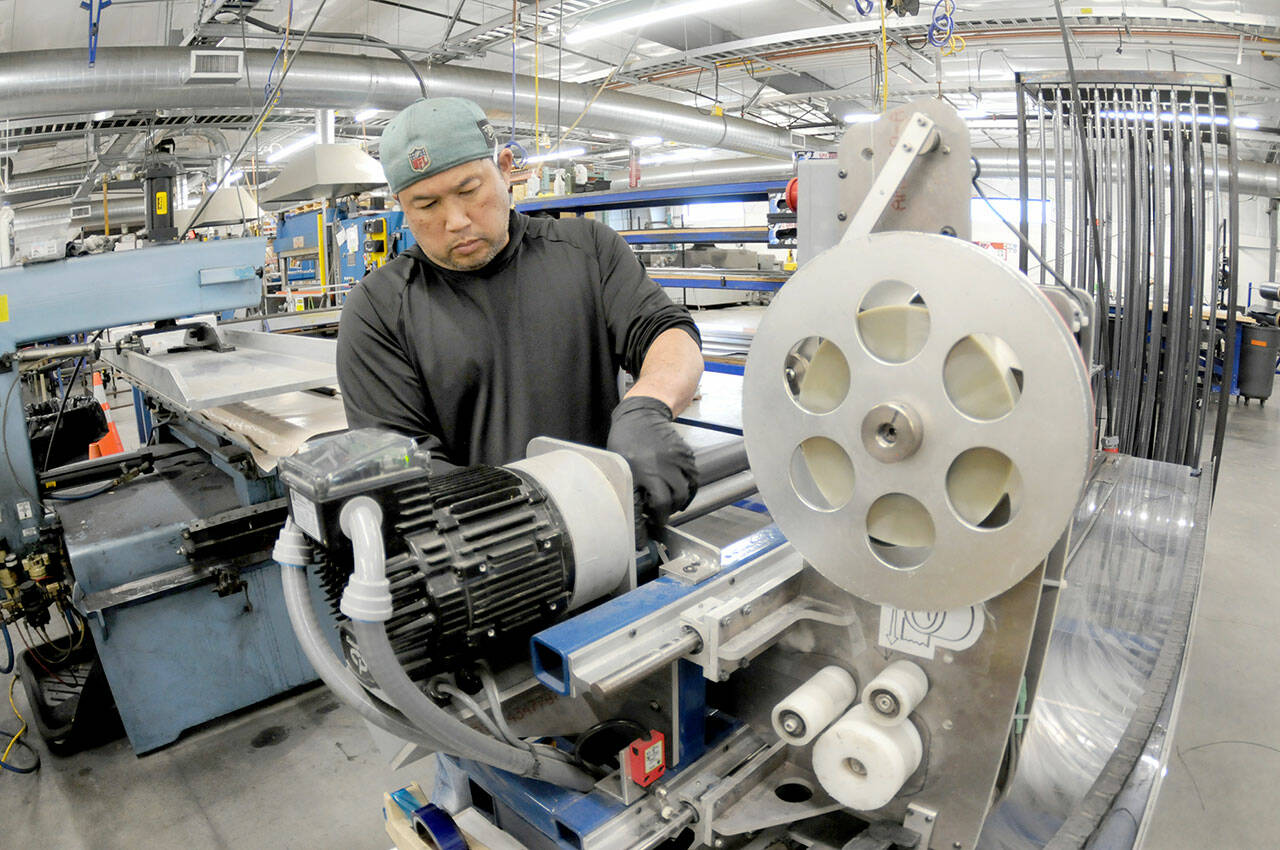
Grant Ledesma spools tape around a component of a portable housing unit being built at Composite Recycling Technology Center in Port Angeles. (Keith Thorpe/Peninsula Daily News)
