
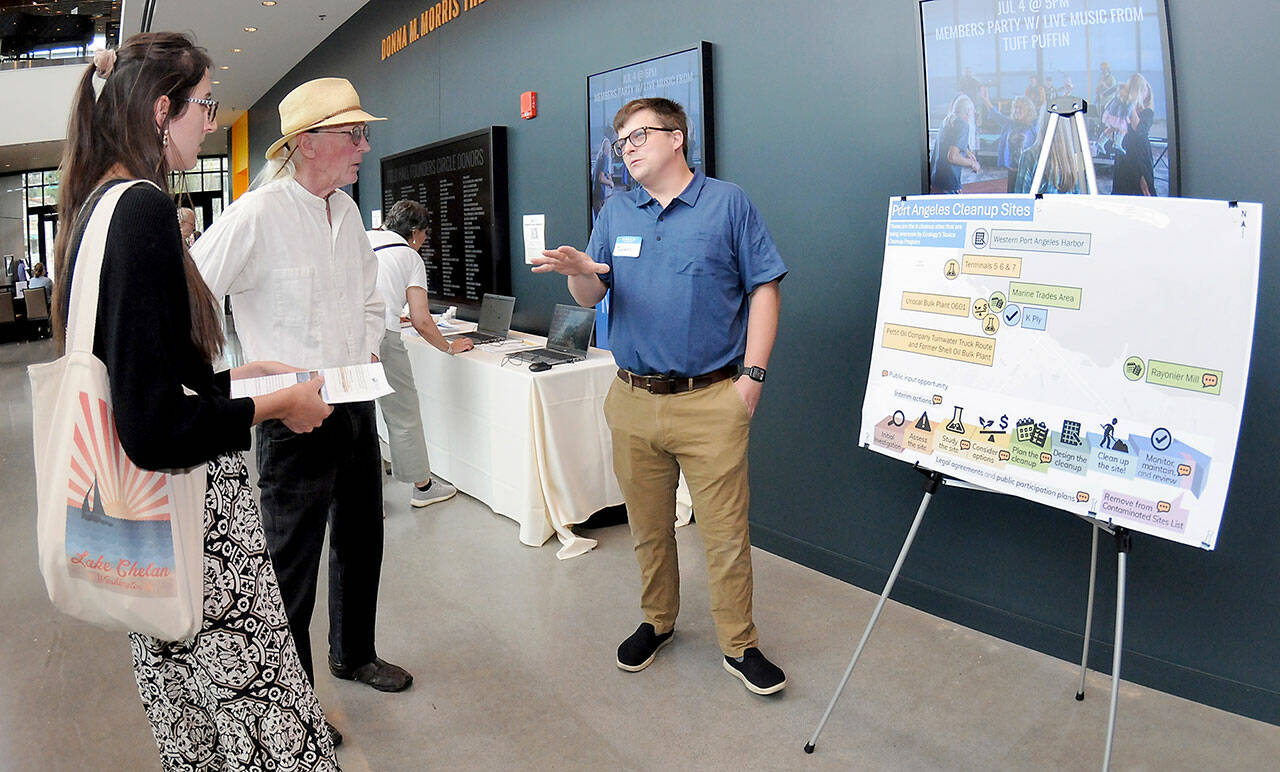
PORT ANGELES — The nearly 90 people who attended the Washington State Department of Ecology’s open house Tuesday at Field Arts & Events Hall received an update on the Rayonier Mill cleanup that detailed information about the status of cleanup at the site, where and what kinds of contaminants were found, cleanup remedies, cost estimates and the path for moving forward.
Nonetheless, attendees appeared more frustrated than satisfied with responses from Ecology staff during a half-hour question and answer period after the presentation.
There was exasperation at the long, drawn out cleanup process that began more than 25 years ago, doubts about the effectiveness of the remediation methods and skepticism that Rayonier would comply with the consent decree it signed with Ecology on June 6.
The decree requires Rayonier implement a 136-page interim action plan that specifies, among other things, a schedule and due dates for task completion; how the work is to be performed; health and environmental controls; compliance measures; and monitoring. Ecology estimates the cost will be $30 million — although it will likely be higher.
The 80-acre site at the bottom of Ennis Creek on east side of Port Angeles Harbor has been used for industrial purposes since 1917. Rayonier ran a pulp mill there from 1930 until it closed in 1997. (The Western Port Angeles Harbor cleanup is separate from the Rayonier project.)
During the almost 70 years it extracted cellulose from wood using an ammonia-based acid sulfite process, the mill released toxins into the harbor through wastewater created by the pulp-making process and from the thousands of creosote-treated pilings that supported docks and structures, into the air by burning seawater-soaked wood and into the ground from its operations.
Among the contaminants left behind were dioxins and furans; PCBs (polychlorinated biphenyls); metals like arsenic and lead; ammonia and petroleum hydrocarbons (TPH).
Rayonier has completed some remediation, removing over 30,000 tons of the most contaminated soil between 1993–2008 as well as 800 concrete deck panels.
But the perception remains that it is an untrustworthy actor that has used delay tactics to avoid taking responsibility for cleanup.
”They’re going to probably drag their feet and this is going to play out for many, many decades,” a man in the audience said. “It’s already been 30 years.”
A number of people disagreed with Ecology’s plan to cap 10 acres of contaminated soil with a 2-foot layer of clean gravel, geotextile fabric and then clean soil to support vegetation — rather than remove it.
Ecology determined that completely removing the soil was the most permanent remedy, but that the cost outweighed its benefits. Marian Abbett, Ecology’s Rayonier Mill project manager, said the department was required by law to use a disproportionate cost analysis guide to analyze different remedies for contaminated sites.
“The incremental cost to do an even better cleanup is just substantial and disproportionate,” she said. Therefore, the less costly but still beneficial capping method was chosen.
People also expressed doubt that a soil cap could withstand natural disasters like a tsunamis, landslides, earthquakes and sea rise.
Connie Groven, an environmental engineer with Ecology’s toxic cleanup program, said the department would be gathering data on such events and conducting modeling to determine the actual design of the cap and how it would be constructed.
“It will be built to withstand what’s predicted,” she said.
Ecology estimates that design, permitting and construction will take 7 to 10 years. After the project is complete, there will be long term monitoring to ensure Ecology standards continue to be met.
Public comment on the Rayonier Mill cleanup consent decree, draft interim action plan and SEPA determination of non-significance is open until Aug. 12 at 11:59 p.m. Comments can be submitted online at go.ecology.wa.gov/comment2270.
Comments can also be emailed to Marian.Abbett@ecy.wa.gov or mailed to Marian Abbett, Washington State Department of Ecology, P.O. Box 47775, Olympia, WA 98504-7775.
________
Reporter Paula Hunt can be reached by email at paula.hunt@peninsuladailynews.com
