
OLYMPIC NATIONAL PARK — A rare bumblebee living in Olympic National Park has been getting a lot of attention recently.
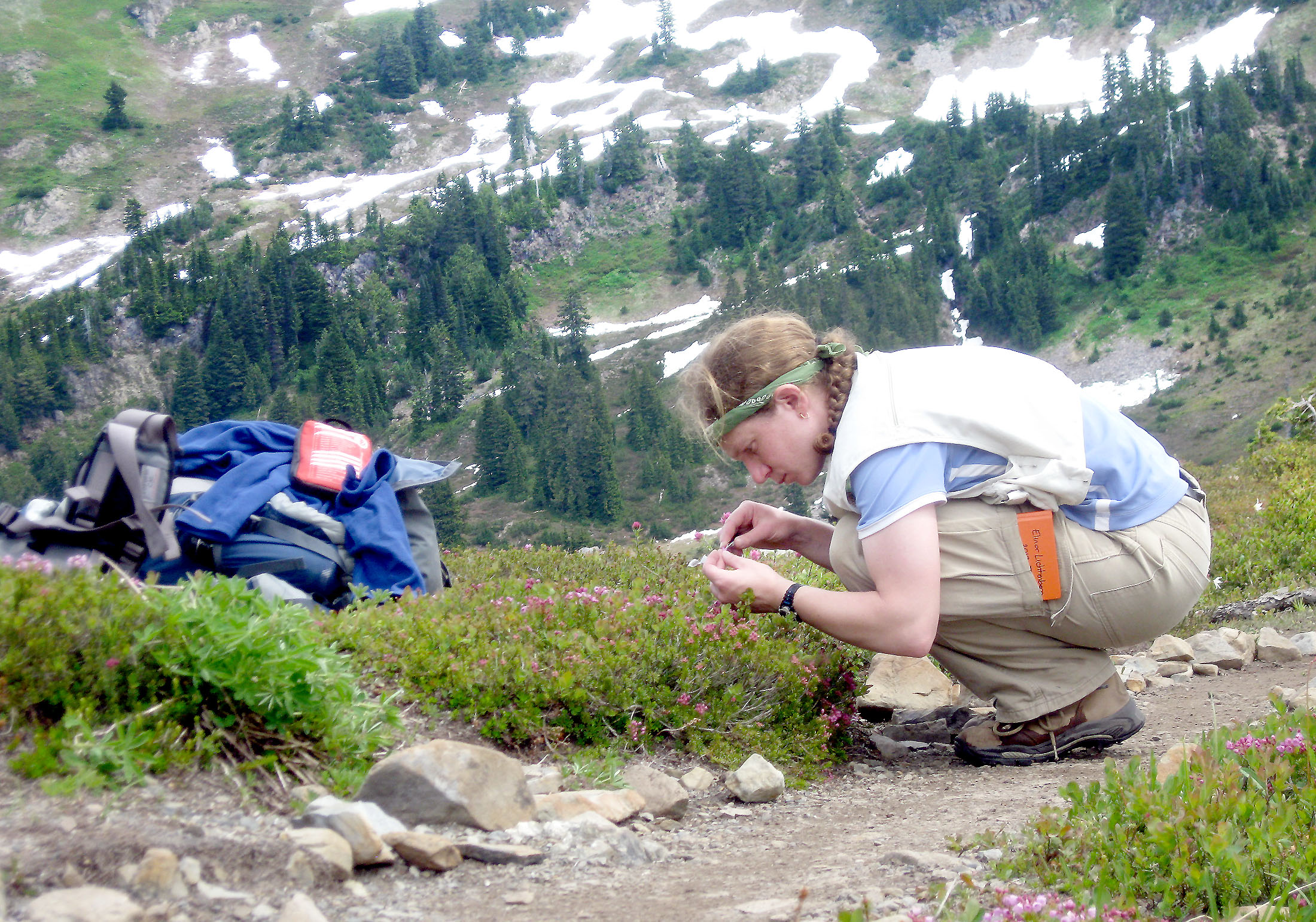
Last month and in July 2013, researchers from the U.S. Department of Agriculture, Utah State University and Washington State University descended upon the park in search of the Western bumblebee, scientific name Bombus occidentalis.
Only five of the bumblebees with the distinctive white rump were found in 2013, said Jamie Strange, a research entomologist with the U.S. Department of Agriculture at Utah State University.
But this year, 10 Western bumblebees were found near Obstruction Point in the park, said Jon Koch, a doctoral student of Strange’s.
That has raised hopes that the bee, a species whose numbers have precipitously declined since the 1990s, is making a comeback.
The effort is part of a larger research project in which Strange studies genetic similarities and differences between populations of numerous types of bumblebees in Western Washington national parks and National Park Service-managed sites.
“Communities of bees at high elevations are very distinct from communities of bees that you find in the Strait of Juan de Fuca and the Puget Sound region,” Strange said.
Though studying more than just the Western bumblebee, Strange said the project will still provide vital information on Bombus occidentalis itself.
Strange said the Western bumblebee was one of the most popular bees raised for commercial pollination until its numbers began to drop.
The bees, which produce little honey, were raised as pollinators and sold by the nest to farmers all over the country by large-scale production warehouses, Strange said.
Research done by other bee experts so far points to a type of fungal pathogen called Nosema bombi as a likely culprit in the rapid decline of the Western bumblebee, Strange said.
The pathogen is suspected to have hitched a ride in Western bumblebee nests shipped from Europe to the U.S., he explained, and later spread to wild populations.
In roughly two decades, the Western bumblebee had been nearly wiped out from about 30 percent of its historic range, which once included most states west of the Rocky Mountains, Strange said.
Scattered populations are still found in the Spokane area and parts of Oregon, Montana and Idaho, he said, though with reduced numbers.
Koch, one of those with boots on the ground scrutinizing wildflowers in the Olympic Mountains looking for occidentalis, said Western bumblebees, like all bees, are vital parts of ecosystems because of the vital service they provide to flowering plants.
“Losing a pollinator is never a good thing because you don’t know what sort of repercussions you might have from losing it,” Koch said.
Western bumblebees seem to be most commonly found in higher-elevation alpine areas, such as those found in the park, Strange said, though the reason for this is not fully understood.
The Western bumblebee and a closely related species were the hardest hit by the fungal pathogen, Strange said, which finds its way into the guts of bees and pumps out spores, eventually killing the insect.
Part of the genetic research currently being done could help scientists develop plans for shifting Western bumblebees from stronger populations to weaker ones, Strange explained.
Strange said he was hopeful that seeing more Western bumblebees than last year in the park could be the beginnings of a comeback, though he said it’s too early to tell.
“We don’t know that for sure, but certainly indications this year could at least point to rebounding in population of some sort,” Strange said.
The project has so far found Western bumblebees in the Hurricane Ridge and Royal Basin areas of Olympic National Park, Strange said, sites that seemed to be devoid of the species during surveys conducted in 2009, 2010 and 2011.
“They’re definitely up there in the meadows. We’re still not finding them down in the lowlands,” he said.
Koch said he and the team of researchers found a particularly positive sign during their August trip: four Western bumblebee queens with pollen on their hind legs.
“That’s a really good sign [the females] are nesting and bringing pollen back to [their] broods,” Koch explained, adding that Western bumblebees live in underground hives typically built in abandoned rodent borrows.
The search for the Western bumblebees began with a sighting by writer, photographer and self-described “bee nerd” Will Peterman in Brier north of Seattle last summer, The Seattle Times said.
Some experts had feared it was gone forever from the Puget Sound lowlands.
Peterman and a corps of volunteers have since confirmed colonies near Everett, Lynnwood and Tacoma, as well as on the Olympic Peninsula.
He and other volunteers raised $18,103 in an Indiegogo campaign to fund volunteer surveys in Washington state, Oregon, Idaho and several Rocky Mountain states.
The volunteer also collected cell samples for the DNA analysis Strange has undertaken.
Rich Hatfield of the Oregon-based Xerces Society for Invertebrate Conservation isn’t convinced yet that the species is making a comeback, The Times said.
Strange, who is still trying to nail down the role of disease in the species’ decline, holds out hope that Western bumblebees may regain their vigor and be raised commercially again someday — and even transplanted back into their native range.
