
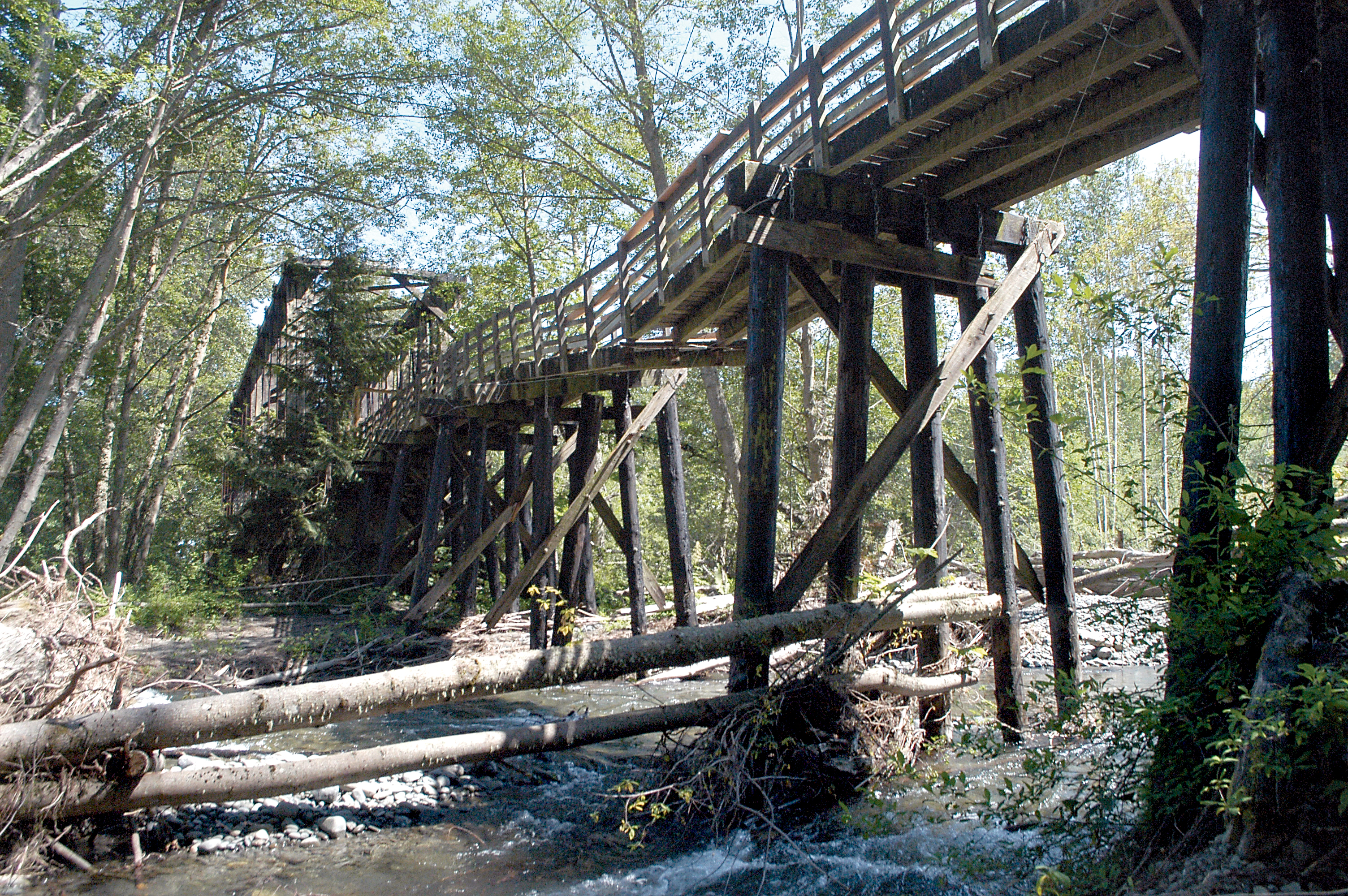
SEQUIM — Plans to replace a damaged trestle to the west of the Railroad Bridge over the Dungeness River call for a complete overhaul.
Replacing the trestle is estimated to cost $1.8 million.
The rain-swollen Dungeness River on Feb. 6 tore away pilings and a truss section of the trestle — located in Railroad Bridge Park, 2151 W. Hendrickson Road.
The bridge itself is undamaged, but traffic over it has been closed because the trestle is unsafe.
“The trestle will have to be replaced, mainly because it is a trash rack and because it has 200 creosote pilings in a natural river,” said Powell Jones, director of the Dungeness River Audubon Center, during a presentation at last week’s Sequim Chamber of Commerce luncheon.
There are many logs currently jammed up against the bridge as a result of the February storm, Jones said.
In the past, the wood could be removed quickly using chain saws and dynamite, but that is no longer the case.
“It turns out we have something called the Endangered Species Act, and we have four ESA listed salmon in this river, which means that for me to get in and cut out the wood or have somebody do it takes about as much permitting as it would to build a new bridge,” Jones said.
To allow logs to pass through without hindrance, a possible plan eyed by the Jamestown S’Klallam — which owns the nearly 100-year-old bridge — would reduce the number of support beams needed to prop up the trestle, Jones said.
The current trestle is propped up in 38 areas by five creosote poles in each area. The depth of the pilings vary from 6 to 25 feet.
One of those support structures, piled down about eight to nine feet, was washed away in the February storm.
There are eight potential designs being considered, with one standing out as the current favorite, Jones said.
“The design team has to do two things. They are really bound by salmon, so really, whatever design comes out has to be beneficial for the salmon. And two: aesthetics.”
A suspension-style bridge would allow salmon and debris to pass beneath unimpeded but would not match the railroad bridge aesthetically.
“It just doesn’t look right with a classic bridge,” Jones said.
“In the long run, we are looking at a design [that] will be shorter and have 187 feet between piers.”
The trestle is 570 feet long, which means there would only be three support structures beneath the trestle — a dramatic reduction from the 38 currently propping up the structure.
“The long term plan is the bridge is designed in a way that will allow stuff to pass underneath it, to allow salmon to do their thing, and [allow] people” to cross over safely, Jones said.
And the new trestle would match the style of the 130-foot Railroad Bridge, he added.
The Jamestown S’Klallam tribe has worked to find funding to repair or replace the trestle since it was damaged, said Annette Nesse, chief operating officer.
In early May, the tribe secured a $172,000 grant from the state Recreation & Conservation Office’s Salmon Recovery Fund Board to fund the design phase.
The tribe hopes to get another $1.8 million grant to fund the complete replacement of the trestle through Recreation & Conservation during this year’s grant cycle.
“We are in the running for a significant grant that would do a full replacement of the trestle, not the bridge,” Jones said.
According to the tribe, the Salmon Recovery Fund Board has indicated that the application for construction costs currently ranks in the top three proposals for the grant cycle that will be awarded in July.
To be eligible for the construction grant, the tribe must provide matching funds or in-kind services equaling 33 percent of the grant, according to the board website.
To help meet this requirement, the tribe has committed $150,000 in insurance claim payments and an additional $200,000 in tribal funds toward the ongoing effort.
The tribe is in the process of determining whether it is more cost-effective to repair the damage quickly and then rebuild the trestle or wait a little longer, skip the repair and move directly to the long-term rebuild.
“We have money in hand to put in a temporary fix,” Jones said.
But, “we don’t want to throw good money after bad. We don’t want to do repairs that will only last 10 years. We want to have this be a community treasure for the next 100 years, and celebrate 200 years.”
With funding allocated from the tribe to perform design work, tribal archaeologists were on site last week gathering input for the design, Jones said.
Workers will have a limited window to perform work within the river itself.
“Right now, because of ESA listed salmon, we only can get in the river and work from about mid-July through late August,” Jones said.
Community treasure
“You can walk out there on any given day, and you see all these people that come and look and enjoy the bridge,” Jones said. “It is actually a very spectacular piece of architecture.”
Over the last five years, the bridge has averaged over 120,000 crossings per year, Jones said.
The bridge serves as a backdrop for educational programs, Jones added.
“The bridge itself is an amazing teaching tool for all sorts of things like science and engineering and mathematics.”
And it is the “heart” of Olympic Discovery Trail, he added.
Raging river
“The Dungeness River is a steep river, which means that it does a couple of things,” Jones said.
“When it floods, it floods extremely quick . . . and it gets very, very violent. It tears things out, and it destroys things.”
A storm in November 2014 caused record flooding that scoured out a new channel beneath the trestle, setting the stage for the damage in February.
“It moved in November and the water receded, and it fell back into its old channel,” Jones said.
“In February, we had a much smaller flood, but the channel had been created and it moved over to that other channel and it basically scoured out the polls that are now missing.”
________
Sequim-Dungeness Valley Editor Chris McDaniel can be reached at 360-681-2390, ext. 5052, or cmcdaniel@peninsuladailynews.com.
