
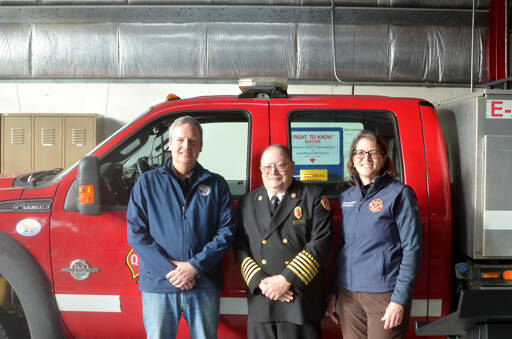
QUILCENE — The state Department of Natural Resources delivered a wildland fire engine to Quilcene Fire Rescue as part of its wildland fire prevention programming.
The delivery comes amid increasingly severe wildfire seasons on the North Olympic Peninsula, including the Bear Gulch Fire near Lake Cushman in Mason County, the largest wildfire on the west side of the state in a generation.
“This last year we had over 1,800 fires started, about 40 percent on the west side,” Commissioner of Public Lands Dave Upthegrove said in a speech Thursday at Quilcene Fire Rescue’s Station 21. “Fortunately, we kept about 95 percent or more under 10 acres and that’s thanks to a large part to the investments the Legislature made and thanks to our local partners getting their equipment.”
The engine is one of 25 surplus engines being provided — free of charge — to fire districts in wildfire-prone areas across the state this spring, according to a DNR news release.
The surplus vehicle joins and improves upon two other wildfire engine vehicles owned by the fire department, said Quilcene Fire Rescue Lt. Nick Singleton, the rescue’s wildland fire lead.
“This DNR engine has more personnel seating capability and a slightly larger chassis,” Singleton said.
The vehicle can seat five and holds more water, with a 420-gallon tank compared to a 285-gallon tank the fire department has used in recent years.
“In the wildland, 50 gallons, 100 gallons goes a long way,” Singleton said.
Valued attributes in a wildland fire engine, compared to a general-use engine, include quick access, rugged terrain capability and rapid initial attack, said Justin Matheson, chair of the Brinnon Fire Commission’s board.
In attendance Thursday were representatives from local fire agencies, including the Brinnon Fire Department, Discovery Bay Volunteer Fire and Rescue and the Jefferson County Fire Marshal’s Office.
Speeches were given by Upthegrove, State Rep. Kristine Reeves, D-Federal Way, chair of the House Agriculture and Natural Resources Committee and Quilcene Fire Rescue Chief Tim McKern.
“This is going to be great,” McKern said. “It’s going to allow us to do some more mobilizations in the Olympic Region and outside of the Olympic Region as well.”
“Small local fire departments in rural areas are often the first to respond to wildfires, and legislative funding to ensure they have the equipment they need helps put fires out quickly and keeps us safe,” Upthegrove said.
In 2021, the Legislature passed House Bill 1168, which pledged $500 million for wildfire prevention, preparation and resilience efforts, to be funded over four biennial budget cycles in $125 million installments, Upthegrove said.
Along with wildfire mitigation on private property, forest health treatments, prescribed burning, equipment purchases and community resilience grants, the bill funds the surplus wildfire truck program, he said.
While nearly the full amount was funded in the first two bienniums, the third installment was reduced by more than half to $60 million in the most recent budget cycle, Upthegrove said.
“Without fully funding the wildfire prevention and response efforts, we’re going to see more fires, larger fires and larger costs to taxpayers with more disruption to homes and property,” Upthegrove said.
Gov. Bob Ferguson has proposed an additional $30 million in his recommended budget, Upthegrove said, leaving the program $35 million short of the bills intended service levels.
Community resilience programs and prevention-focused grants, rather than core firefighting assets, are expected to absorb the greatest impacts of the funding shortfall, he said.
Upthegrove noted that there can be a disconnect between rural spaces and urban centers, which are somewhat removed from wildfire threats. He said he’s focused attention on communicating with legislators on the Interstate 5 corridor, highlighting that the threat of wildfire is increasingly a statewide concern.
Upthegrove said wildfire suppression is a statutory obligation of the DNR, requiring the state to pay whatever it costs to extinguish fires, even when prevention funding falls short.
“By law, the Legislature is required to fund suppression,” Upthegrove said.
Suppression costs totaled $280 million last year and often exceed the cost of preventative investments, he added.
When a fire near the Columbia River Gorge threatened the town of White Salmon last summer, fuel reduction and firebreak work completed two years earlier slowed the fire enough for crews to contain it before it reached the town, he said.
“That firebreak probably saved the town of White Salmon,” Upthegrove said.
________
Reporter Elijah Sussman can be reached by email at elijah.sussman@peninsuladailynews.com.
