
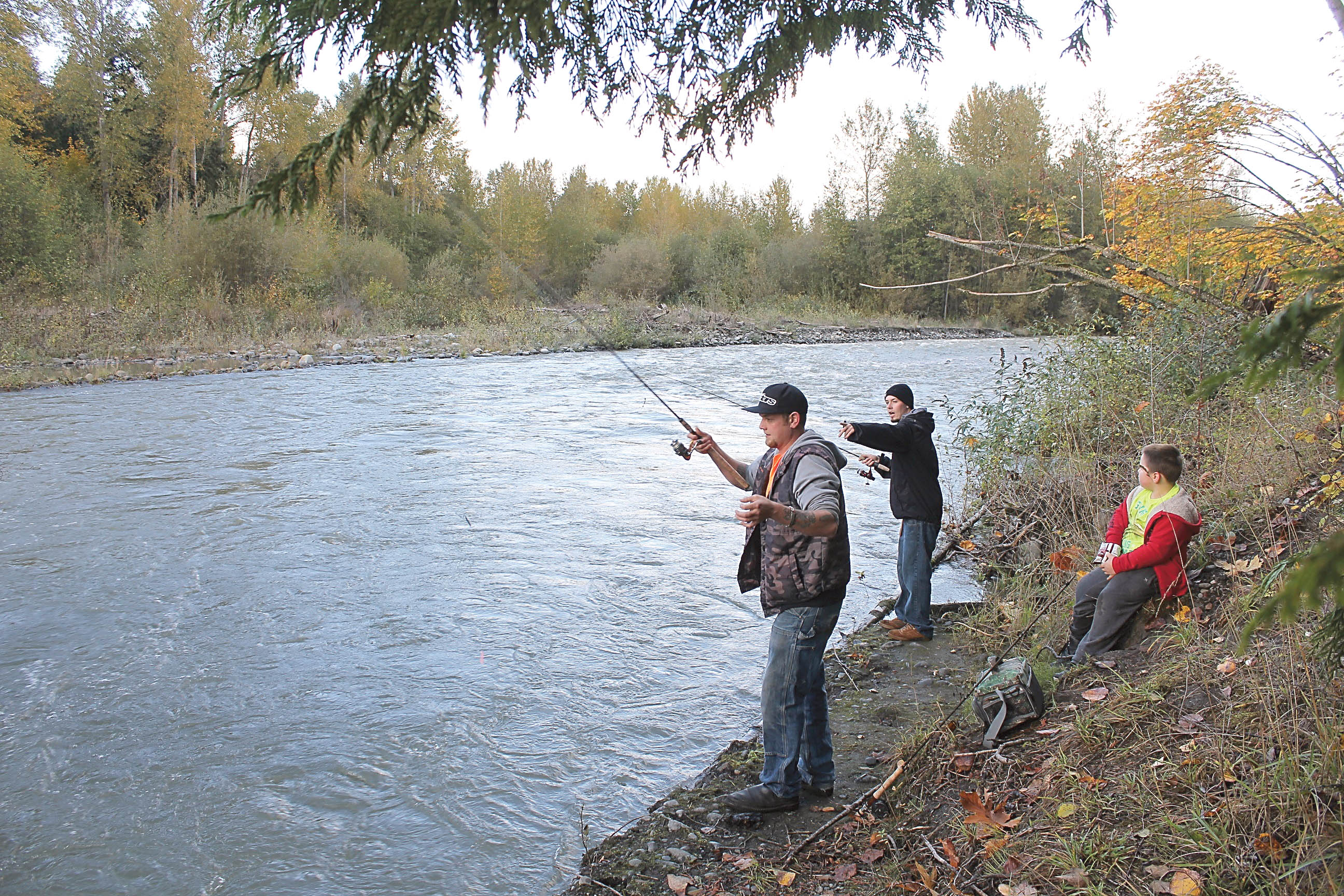
SEQUIM — The effort to put more water into the Dungeness River, particularly during the critical low flow in the late summer season, is taking shape.
Officials with the state Department of Ecology said a number of aquifer recharge and flow restoration projects are necessary, citing the river’s importance to the ecology of the North Olympic Peninsula, where it provides water and habitat for fish and wildlife, and agricultural and recreational assets for the human population.
There’s just one problem: the river often has too little flow to do its ecological job, or at least to perform the task as well as possible.
Some of the proposed projects are relatively small, including a plan to reopen a small portion of an abandoned irrigation ditch in Carlsborg to allow water from the river to percolate down to the aquifer below.
At least one proposed project is on a larger scale: a lake that may swell to 88 acres on 330 acres of Department of Natural Resources Land just south of Sequim.
The lack of water in the river in late summer led to the Dungeness Water Rule, which was implemented in January 2013 and put restrictions on new uses of water within the eastern half of Water Resource Inventory Area 18 from Bagley Creek to Sequim Bay.
Ecology has said water drawn
from a well also draws water from the river and other streams.
They have also said that water rights for the Dungeness are over-appropriated. That is, more rights have been issued than there is water in the river.
Every new use would therefore infringe on someone’s existing water right.
Because that’s the case, anyone who wants to drill a well in that area, or to put the water from an existing well to a new or expanded use, has to “mitigate” the impact on the Dungeness and the various streams also in the area affected by the rule.
Currently, this “mitigation water” is purchased from a reserve the Washington Department of Ecology set aside administratively.
This reserve isn’t made up of real water, but rather was created on paper by Ecology, which appropriated the water right, citing its authority to do so under state law if the water use serves “overriding considerations of public interest.”
If Ecology hadn’t created the reserve, development within the area would have come to a complete halt.
The reserve isn’t sufficient to provide all of the water needed. In some areas, no mitigation water is available for outside use.
That’s why the state and local officials are working to create new opportunities to return water to the river, thereby creating mitigation credits that can be purchased by developers.
Joe Holtrop, executive director of the Clallam Conservation District, said he’s currently working with others, including the Washington Water Trust and Ecology, toward implementing several aquifer recharge projects.
Holtrop said aquifer recharge projects make sense because “we have no sources of new water, and no place to store it.”
The first project on the schedule will put an abandoned irrigation ditch in Carlsborg back to work.
Holtrop said the ditch, near Jake Way, was made obsolete several years ago when the Cline Irrigation District put in a new pipeline.
Once the $100,000 project is complete, water from the river will be shunted into the ditch and allowed to percolate down to the aquifer.
Holtrop said that will likely take place in the late spring or early summer of the year, “when the river is consistently running high.”
The Clallam Ditch Company will handle the operation and maintenance of the project.
Mike Gallagher, who heads up the Water Resources Program in Ecology’s Southwest Regional Office, said while the project is designed to recharge the aquifer, it may also provide some mitigation credits by adding water to the river.
Unfortunately, Gallagher said, the utility of the credits would be limited because they would be almost wholly attached to the Dungeness River.
Ecology says any well drilled anywhere within the regulated area pulls water from every stream within the area, with the amounts calculated by using an Ecology-created model.
“More work would need to be done for the other [stream basins],” Gallagher said.
The funding for the program is drawn from a $2.05 million fund the Washington Legislature approved in 2013 to pay water mitigation fees and for water storage conservation projects in the Dungeness River basin.
State Sen. Jim Hargrove, D-Hoquiam, said he worked toward securing the funding because it pays the mitigation costs incurred by homeowners who must purchase mitigation rights for indoor water use.
Hargrove said that was an issue of fairness, but that it was also important as a means of deflecting potential legal difficulties.
He said he’s still discussing new options for utilizing some of the funding to provide additional mitigation water, including the possibility of drilling deep wells in the upper, southern portion of the regulated area, where no new water is available for outdoor use.
“We want the rule to be as useful as possible,” he said. “Not just for the fish and wildlife, but also for the people living up there.”
Holtrop said another, much larger project is also in the planning stages.
If it’s approved, and if the required $20 to $30 million is provided by the Washington Legislature, the result would be a new reservoir located on 330 acres of Natural Resources land near the intersection of River and Happy Valley roads south of Sequim.
Holtrop said several configurations are under consideration, ranging from a surface area of 32 acres to 88 acres and with a volume between 550 and 1,586 acre-feet.
The reservoir would collect water during the snow melt season and perhaps through the winter, he said.
In the late summer, when water is needed for irrigating local farms, the water would be drawn from the reservoir rather than from the river, as is now the case.
Reducing the amount the irrigators draw from the river would have the practical effect of increasing the river’s flow during the most critical time of year.
Gallagher estimated that would provide as much as 30 cubic feet per second in mitigation water.
Holtrop said some preliminary work has been done on the design of the reservoir.
Amanda Cronin, who runs the Dungeness Water Exchange for the Washington Water Trust, is expected to discuss soon with Natural Resources a possibility of a long-term lease of the land.
Holtrop said the project is largely speculative right now, with feasibility studies yet to be conducted.
He added that it’s an expensive project.
But, he said, in the long run it likely makes sense.
“It’s one of those things that, if we didn’t do it, in 15 or 20 years, people would ask why we didn’t.”
“It could be critically important if the snow pack declines.”
Holtrop said the reservoir also provides some attractive possibilities for recreation.
With a capacity of up to 1,500 acre-feet (enough to cover 1,500 acres one foot deep in water), the new reservoir would be far and away the largest freshwater lake near Sequim.
Gallagher said that according to which plan is used, the reservoir could grow to 90 acres.
