
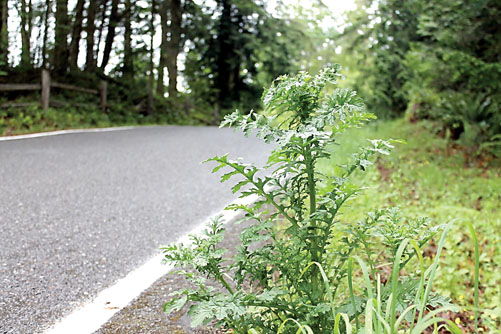
PORT ANGELES — Clallam County’s noxious weed department coordinator has written a plan for combating invasive species on county roadsides.
If implemented, the 91-page draft plan — the Clallam County Integrated Roadside Weed Management Plan — would be the first update to the county’s approach since 1990, according to Cathy Lucero, who heads noxious weed control in the county.
Clallam County has about 528 miles in its road system, which equates to about 1,000 acres of land.
Control invasion
For years, the county’s road department has used a roadside vegetation management approach never intended to control invasive and noxious plant species.
“It has really just been about the hardscape and making a safe, efficient transportation system because that’s the primary role of the road department,” Lucero said.
“As the invasive species issue started to come into the foreground, people really didn’t think about it.”
The plan ties the county road department to the weed board and deploys three new tools, Lucero said.
The multi-pronged strategy integrates prevention techniques, cultural control and focused herbicide use.
The draft plan includes judicious use of herbicide treatments on noxious weeds only, according to Lucero.
In developing the draft plan, Lucero did extensive surveys of nearly half of the county’s roads.
Of the nearly 500 acres she has surveyed, about 4 acres were identified as areas ideal for herbicide treatments.
Based on this initial survey, Lucero said, that’s about “1 percent we’d actually like to use herbicide on.”
Although the plan doesn’t require a formal adoption process, Lucero is proposing the Board of Clallam County Commissioners adopt an ordinance to supersede the old vegetation management approach and a resolution that doesn’t allow any herbicides ever.
“The ordinance puts boundaries on where herbicides can be used, and it binds the road department to a process in their own county law,” she said.
The weed board
Lucero enforces Washington’s weed law, which is coordinated through the Washington State Noxious Weed Control Board.
The five-member, volunteer Clallam County Noxious Weed Control Board has regulatory power over all of Clallam County except federal and tribal lands.
Throughout the 19 years Lucero has worked with private landowners to control noxious weeds and invasive plant species, she has continued to run into a challenge because of the number of noxious weeds growing along county roads.
“It’s really hard for me to go after a private landowner when the county isn’t leading the way and being the best steward and model,” she said.
About one-third of the roads Lucero surveyed had either a weed required to be controlled by law or one so rare it was the only sighting in the county, she said.
“We had 16 different species that met that criteria,” Lucero said.
Instead of focusing on widespread invasive species such as scotch broom and thistle, Lucero is after the infrequent species in hopes of controlling them before they become rampant.
“The weed law emphasizes what we have the least of as the top priority because you have the best chance of control,” she said.
Workshops
Lucero made maps of the targeted areas, included them in the draft plan and will have them on hand during a series of upcoming informational workshops in Sequim, Port Angeles and Forks.
Residents will be able to ask questions or tell how roadside vegetation is managed near their homes and businesses, Lucero said.
A handful of experts will attend the workshops.
They include a researcher from Washington State University, the state Noxious Weed Control Board executive secretary, the vegetation branch manager for Olympic National Park and the noxious weed coordinator for the state Department of Agriculture.
A state Department of Transportation landscape architect also will be available at the Sequim and Port Angeles workshops.
In making provisions for landowners who don’t want any herbicides used adjacent to their property, Lucero hopes to build a pool of landowners interested in contributing toward effective roadside vegetation management near their property.
“This could be a new opportunity for citizen engagement,” she said.
Other tools
Herbicides are just one of three tools the weed board aims to use in working with the road department.
Prevention can be accomplished through cleaning weed-seed-contaminated gravel pits, stopping the use of contaminated gravel along the roads and taking advantage of new road construction to plant native species.
Also in the plan is the suggestion that the road department alter its reliance on mowing as its roadside vegetation management.
Mowing can invigorate some unwanted plants, create open space for noxious weeds and invasive species to grow, decrease the ability of native plants to thrive and remove potential habitat and/or resources for pollinators, Lucero said.
“Prevention is huge,” Lucero said. “That’s really where you want to be — it’s the cheapest and it’s the least impactful.”
Cultural control
The third approach the draft plan recommends is cultural control: encouraging native plants as the first line of defense against noxious weeds.
A “full circle” approach to managing county roadside vegetation where noxious weeds are controlled and a healthy, native plant community is allowed to thrive has been a long time coming, Lucero said.
“We’re kind of in a reaction stage because we haven’t done enough for so long — so we really want to root the program now,” she said.
Value of biodiversity
A diverse, healthy native plant community provides water filtration, food production, erosion control and habitat for pollinators, Lucero said.
“When [noxious/invasive species] get listed, it’s because they are interfering with the functions that we rely on,” she said.
“I’m not after every weed on the road because the environment may adapt to that and it will be limited, but these appear to be the biggest bullies.”
But change is accelerating, she said.
“There has been too much change too fast,” Lucero said, but through multiple control methods, “you can help prolong the protection of the community and allow it to make its own adaptation.”
________
Alana Linderoth is a reporter with the Olympic Peninsula News Group, which is composed of Sound Publishing newspapers Peninsula Daily News, Sequim Gazette and Forks Forum. Reach her at alinderoth@sequimgazette.com.
