
HOOD CANAL — A conservation easement between the state Department of Natural Resources and the Navy that prohibits industrial development along areas of Hood Canal won’t stop a gravel-moving facility nicknamed the “pit-to-pier,” the project manager said.
The agreement signed earlier this week suggests that the proposed construction of the project would not be allowed.
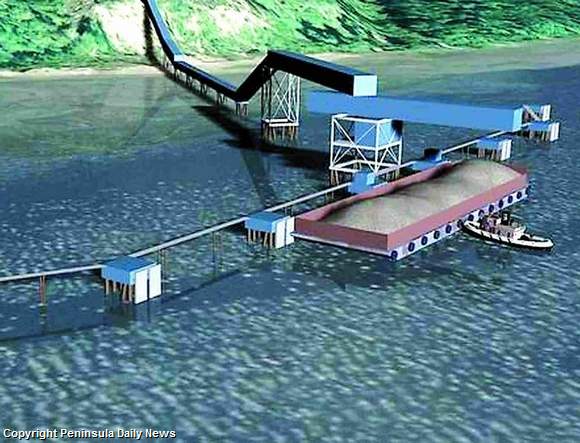
The project is a 4-mile-long conveyor belt to move gravel and rocks from an extraction area near the former Fred Hill Materials Shine pit to a processing facility and then to a 998-foot pier on Hood Canal.
“This agreement will collapse under its own stupidity,” said Dan Baskins, Thorndyke Resources Project manager.
“This is a goofy way to try to stop the project, and we don’t believe the Navy had the authority to sign this agreement.”
Baskins had said earlier that the agreement wouldn’t stop the project. He said this week the company is considering legal action but has not made a decision yet.
The pact between Commissioner of Public Lands Peter Goldmark and the Navy covers more than 4,800 acres of Hood Canal aquatic lands, in a strip of state subtidal lands stretching from the Hood Canal Bridge south to just below the border between Jefferson and Mason counties.
The Navy will pay DNR $720,000 for a 55-year easement.
It restricts development in the area around Naval Base Kitsap and gives the Navy unrestricted access to waters for it to conduct exercises that are crucial for military readiness and national defense, according to Naval Base Kitsap Commanding Officer Capt. Tom Zwolfer.
Naval Base Kitsap is just north of Silverdale on the Kitsap Peninsula.
The easement will not permit new construction by the Navy, nor will it affect public access, privately owned lands, recreational uses or aquaculture or geoduck harvest.
It forbids new nearshore commercial or industrial construction along the areas of the Hood Canal and neighboring waterways where the Navy operates the term of the easement and forbids any large-scale commercial development on state-owned aquatic lands, according to Matthew Randazzo, senior adviser to the commissioner of public lands.
While Thorndyke owns the land on which the operation will be located, the easement forbids large-scale industrial development in the water.
As designed, the proposed pier would extend 998 feet from the shore, with supports installed in the deepwater section of the canal.
There are no plans to develop a proposal for a shorter pier, which would service up to six barges daily, because the current plan is what is needed to support the project, Baskins said.
Thorndyke has no permit from Jefferson County. It is in the process of review.
Baskins called the easement “political,” saying that both Randazzo, who joined DNR in 2013, and staffer Cyrilla Cook, who worked on the agreement, were long-term opponents of the Thorndyke project.
“People don’t give up their prejudices when they go to work for the government,” Baskins said. “Sometimes it follows them when they enter the public sector.”
Randazzo would not comment about the easement’s effect on specific projects and said it was not directed at any single enterprise.
He said the impetus for the easement, developed over a two-year period, originated with Goldmark.
“The conservation of Hood Canal and the safeguarding of Navy operations from encroachment has been a priority of Commissioner Goldmark from the start of these discussions in 2012, and he deserves the credit for this historic agreement,” Randazzo said.
“This is an unprecedented agreement between two large government agencies.”
Randazzo is confident the agreement would withstand a legal challenge.
“This easement has been vetted by the Washington state attorney general and attorneys for the Department of Defense,” he said.
________
Jefferson County Editor Charlie Bermant can be reached at 360-385-2335 or cbermant@peninsuladailynews.com.
